
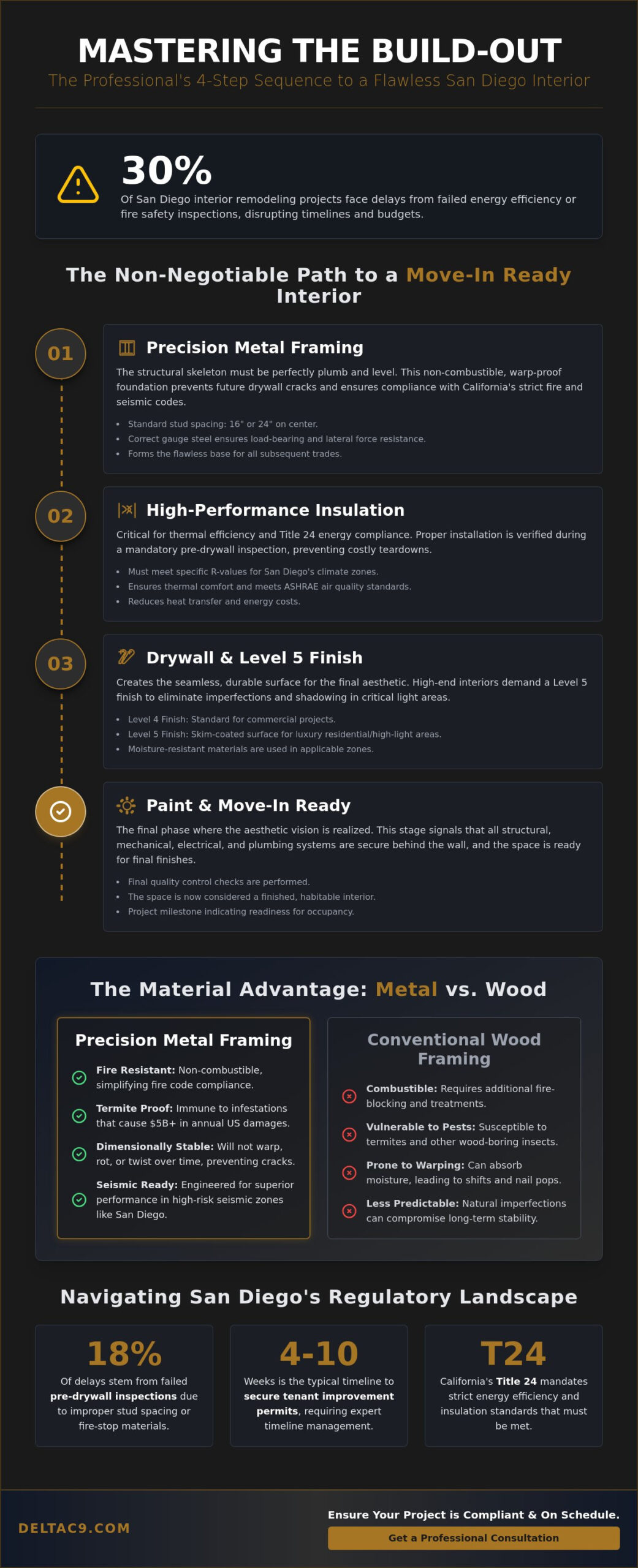
According to 2023 San Diego Development Services Department reports, approximately 30% of interior remodeling projects encounter delays because of failed inspections related to energy efficiency or fire safety. You probably feel the weight of these statistics when you’re trying to synchronize various subcontractors. It’s frustrating to manage the handoff between a framer and an insulation specialist, only to find the drywall team can’t start because of a missed inspection. We’re here to help you regain control of your project timeline.
This article outlines the precise steps to master a professional build-out, ensuring your metal frame ,insulation,drywall,paint ready to move in process is seamless and fully compliant with local Title 24 requirements. You’ll learn how to select the right materials for the San Diego climate and how to maintain structural integrity from the first stud to the final coat of satin finish. We’ll provide a clear overview of the integrated workflow that transforms a skeleton structure into a high-quality, professional interior.
Key Takeaways
- Master the critical four-step sequence of interior construction to ensure your project maintains structural stability and professional-grade quality.
- Evaluate the engineering advantages of precision metal framing over wood for enhanced fire resistance and long-term durability in the San Diego climate.
- Navigate the latest Title 24 energy standards to select high-performance insulation that optimizes efficiency for both coastal and inland environments.
- Implement Level 5 finishing techniques and moisture-resistant materials to achieve a flawless, crack-free surface tailored for high-end interiors.
- Learn how to coordinate a metal frame ,insulation,drywall,paint ready to move in workflow that guarantees a seamless transition from shell to a finished, habitable space.
The 4-Step Sequence to a Move-In Ready Interior in San Diego
Achieving a high-performance interior requires more than aesthetic choices. It demands a disciplined adherence to a specific structural sequence. In San Diego, the transition from a cold shell to a finished space follows a rigid four-stage path: metal frame ,insulation,drywall,paint ready to move in. This sequence ensures that structural integrity precedes thermal efficiency. This foundation then allows for the seamless surface application required for final occupancy. Skipping or rushing any stage compromises the stability and safety of the entire environment.
A general interior specialist manages these integrated trades to prevent scheduling overlaps. The order of operations is non-negotiable. If you install surfaces before the insulation inspection is signed off, you face mandatory teardowns and significant financial loss. This methodical approach reduces risk. It ensures business continuity for commercial tenants and long-term stability for homeowners. By treating the interior as a single, engineered system, professionals maintain control over every variable from the studs to the final coat of satin finish.
Understanding the ‘Move-In Ready’ Standard
In San Diego’s 2026 building market, “move-in ready” means the interior environment meets specific ASHRAE standards for air quality and thermal comfort. For commercial projects, this typically involves a Level 4 finish on all visible surfaces. Residential standards often require a Level 5 finish in high-light areas to eliminate shadowing. Reaching the “paint ready” milestone is the primary indicator of a project’s health. It signals that all mechanical, electrical, and plumbing rough-ins are secure. High-quality Drywall installation acts as the final barrier. It protects the internal infrastructure while providing the necessary canvas for the final aesthetic finish.
San Diego County Regulatory Compliance
Navigating local mandates requires technical precision and up-to-date knowledge of the California Building Standards Code. San Diego County enforces strict Title 24 energy efficiency requirements. These regulations dictate specific R-values for interior wall insulation to minimize heat transfer between zones. Building officials conduct mandatory pre-drywall inspections to verify framing spacing and fire-blocking. In 2025, the City of San Diego Development Services Department reported that 18% of project delays stemmed from failed pre-drywall inspections. These failures were often due to improper metal stud spacing or missing fire-stop materials. Securing permits for tenant improvements typically takes 4 to 10 weeks. Professionals who understand this timeline ensure that the metal frame ,insulation,drywall,paint ready to move in workflow remains uninterrupted and compliant with all 2026 safety protocols.
Precision Metal Framing: The Structural Skeleton
San Diego’s coastal environment and seismic activity demand construction materials that offer long-term stability and resistance to local threats. Metal framing has become the gold standard for high-end interiors because it doesn’t warp, rot, or succumb to termite infestations, which cause over $5 billion in property damage across the U.S. annually. Unlike traditional timber, steel remains perfectly straight over decades, providing a reliable foundation for a metal frame ,insulation,drywall,paint ready to move in project. This material’s non-combustible nature also simplifies compliance with strict California fire codes, offering a level of safety wood cannot match.
The transition to a metal frame ,insulation,drywall,paint ready to move in status depends entirely on the plumb and level nature of the steel studs. Precision framing prevents the structural shifting that typically leads to unsightly drywall cracking or nail pops in the final paint layers. In San Diego County, which sits in a high-risk seismic zone, contractors must implement specific bracing techniques to ensure the assembly can withstand lateral forces. Using the correct gauge is the first step in this engineering process. Gauge refers to the thickness of the steel used in the stud, where a lower number indicates a thicker, more robust material capable of supporting higher vertical and lateral loads.
Metal Stud Selection and Layout
Layout precision dictates the success of every subsequent trade. Standard spacing for most commercial applications is 16 inches on center, while 24 inches might be used for non-load-bearing residential partitions. Utilizing specialized track and stud systems allows for the creation of curved walls or complex architectural features that would be difficult to execute with wood. This flexibility ensures that modern, open-concept designs maintain their structural integrity without sacrificing aesthetic fluidity. If you’re managing a complex build, a professional infrastructure consultant can help verify that your layout meets all local engineering specifications.
Seismic and Fire Safety Integration
Safety in Southern California is heavily regulated, particularly regarding fire-rated assemblies in multi-family and commercial buildings. These walls must comply with California’s Title 24 energy code to ensure thermal efficiency and occupant protection. During the framing stage, we also integrate acoustic isolation techniques, such as resilient channels or sound-dampening clips, to reduce noise transfer between rooms. For a deeper look at these methods, see our guide to professional soundproofing in San Diego. These early-stage decisions ensure the final interior isn’t just beautiful, but also quiet and secure.
High-Performance Insulation for the San Diego Climate
Once the metal frame is secured, insulation becomes the critical barrier between the external environment and your interior comfort. Achieving a metal frame ,insulation,drywall,paint ready to move in status requires strict adherence to the 2026 Title 24 standards. These California energy codes are designed to reduce the state’s carbon footprint by mandating high-performance building envelopes. In San Diego’s coastal Zone 7, requirements typically focus on moderate thermal resistance, while inland regions in Zone 10 require higher R-values to combat summer temperatures that frequently exceed 90 degrees Fahrenheit.
Selecting the right material is a technical decision based on the structure’s specific needs. Mineral wool is a preferred choice for metal buildings because of its 2,150°F melting point and superior acoustic properties. Fiberglass batts remain a cost-effective standard, but closed-cell spray foam is increasingly used in San Diego to provide both insulation and an airtight seal. This prevents air leakage, which is a common issue in metal-framed structures where gaps can compromise thermal integrity.
- Fiberglass Batts: Best for standard residential applications with tight budgets.
- Mineral Wool: Ideal for fire-rated assemblies and high-traffic commercial zones.
- Spray Foam: The gold standard for eliminating air infiltration and maximizing R-value in narrow wall cavities.
Thermal Efficiency and Energy Savings
Properly installed insulation significantly reduces HVAC loads, which is essential for managing San Diego’s rising utility costs. One major challenge with a metal frame is thermal bridging. Metal studs conduct heat 400 times faster than wood, potentially creating “cold spots” that lead to energy loss. We mitigate this by using continuous insulation (CI) or thermal breaks to ensure the heat stays out during July peaks. To understand how these materials interact with your specific home layout, explore our comprehensive guide for San Diego insulation.
Vapor Barriers and Mold Prevention
San Diego’s famous marine layer brings a high volume of salt-laden humidity that can penetrate building envelopes. Without a correctly placed vapor retarder, moisture can condense against the cold metal studs, leading to hidden mold growth behind the drywall. We focus on strategic ventilation and moisture management to protect your air quality. If you’ve already noticed signs of dampness in an existing structure, read our mold remediation and restoration guide to learn about corrective measures. Maintaining a dry assembly is the only way to ensure your metal frame ,insulation,drywall,paint ready to move in project remains a healthy environment for years to come.
Sound attenuation is the final benefit of a well-insulated interior. High-density insulation acts as a buffer against San Diego’s urban noise pollution, including traffic from the I-5 or flight paths near Lindbergh Field. By trapping sound waves within the wall cavity, we create a serene, professional environment that matches the high-quality finish of the upcoming drywall and paint phases.
Drywall Installation and Level 5 Finishing
The transition from a skeleton structure to a polished interior requires more than just covering the studs. Precision in hanging and finishing determines the longevity of the wall surface and the quality of the final paint application. To achieve a metal frame ,insulation,drywall,paint ready to move in result, we prioritize structural stability and surface uniformity. We utilize 12-foot drywall panels whenever the room dimensions allow. This strategy reduces the total number of seams by approximately 25% compared to standard 8-foot boards, which directly minimizes the risk of future stress cracks.
Material selection is equally critical for San Diego residences. We install 5/8-inch Type X fire-rated drywall in garages and mechanical rooms to meet California Building Code requirements for one-hour fire resistance. For moisture-prone areas like bathrooms or laundry rooms, we use mold-resistant green board. This technical approach ensures the building remains resilient against internal and external environmental factors.
The Hanging and Taping Process
Hanging drywall on metal studs requires a specific fastener pattern to prevent movement. We use fine-thread bugle head screws spaced every 12 inches on center. This prevents “nail pops,” a common defect in residential remodels. Straight lines define modern architecture, so we apply high-quality corner beads with precision to ensure every edge is perfectly vertical. San Diego coastal humidity, which often averages 70% in the mornings, significantly impacts the drying cycle. We monitor these levels closely, allowing at least 24 hours between coats of joint compound to prevent trapped moisture from causing bond failure later.
Achieving the ‘Paint Ready’ Surface
The industry recognizes five distinct levels of drywall finishing. Level 4 is standard for most homes, but it often leaves visible texture differences between the paper and the joint compound. For high-end San Diego interiors featuring dark paint or high-gloss finishes, we recommend a Level 5 finish. This process involves a full skim coat of joint compound over the entire surface, hidden by a final sand. It creates a monolithic texture that eliminates “flashing,” where light reflects differently off the seams than the rest of the wall. A Level 5 finish serves as the ultimate prep for move-in ready aesthetics by creating a perfectly uniform surface across the entire wall.
Dust control is our final priority. We use vacuum-assisted sanding systems that capture 99.97% of airborne particulates. This keeps the job site clean and protects the HVAC system from contamination. If you’re planning a renovation, it’s essential to partner with experts who understand these technical nuances. You can rely on Delta C9 for professional infrastructure management that ensures your project remains on track and meets the highest standards of safety and quality.
The Final Phase: Paint and Quality Control for Move-In
The transformation from a construction site to a professional workspace concludes with the application of high-performance coatings. For metal-framed interiors in San Diego, applying a high-solids drywall primer is a technical necessity, not an optional step. This sealer creates a uniform porosity across the gypsum board and the joint compound. Without this engineered barrier, the different absorption rates cause “photographing,” where the joints remain visible through the topcoat. Our coordinated workflow for the metal frame ,insulation,drywall,paint ready to move in sequence ensures that the structural integrity of the build is matched by its visual finish.
Selecting the correct paint sheen involves balancing room utility with light exposure. San Diego offices often feature high-intensity natural light, which can highlight surface imperfections. We recommend matte or flat finishes for ceilings and executive areas to diffuse glare. For high-traffic corridors or breakrooms, eggshell or satin finishes provide the necessary scrubbability. These choices aren’t just about aesthetics; they’re about the long-term durability and maintenance costs of your facility.
Painting Standards and Application
Professional application relies on the “cut and roll” technique to maintain a wet edge. This method eliminates lap marks and ensures a seamless transition between corners and flat surfaces. To support immediate occupancy, we prioritize Low-VOC (Volatile Organic Compounds) paints. These coatings contain fewer than 50 grams of VOCs per liter, meeting strict indoor air quality standards. This allows your team to move in within 24 hours of the final coat without the risk of respiratory irritation. For large-scale tenant improvements, we utilize digital color matching to maintain 100% consistency across every floor.
Final Move-In Readiness Checklist
The transition to “Ready to Move In” status requires a disciplined approach to cleanliness and detail. We don’t consider a project finished until the environment is pristine. Our quality control process follows a rigorous path to ensure the metal frame ,insulation,drywall,paint ready to move in promise is fully realized.
- Debris Removal: We perform HEPA-filter vacuuming to remove 99.97% of construction dust from tracks, vents, and surfaces.
- Touch-Up Kits: Clients receive a maintenance kit containing the exact color codes and small batches of paint used in their specific zones.
- Final Walkthrough: We conduct a room-by-room inspection to verify that every corner meets Delta C9 standards and Level 5 finish requirements where specified.
- Warranty Delivery: Your project concludes with a formal signature and the delivery of our comprehensive warranty, ensuring your business continuity is protected.
This systematic closing phase ensures that when you receive the keys, your space is truly functional. We focus on the technical details so you can focus on your operations from day one. Our goal is to provide a stable, controlled environment that reflects the professionalism of your organization.
Achieve a Seamless Transition to Your New San Diego Interior
Transforming a raw commercial or residential space into a functional environment requires a disciplined sequence of specialized trades. Success depends on more than just high-quality materials; it requires a deep understanding of California’s strict building standards. Delta C9 brings over 22 years of San Diego construction experience to every project, ensuring your interior meets every Title 24 energy requirement and CA building code mandate. We focus on engineering precision from the very first stud to the final brushstroke.
Our team manages the entire metal frame ,insulation,drywall,paint ready to move in workflow to eliminate the friction often caused by coordinating multiple subcontractors. By integrating structural framing with high-performance insulation and Level 5 drywall finishing, we provide a stable and controlled path to completion. You don’t have to worry about compliance gaps or aesthetic inconsistencies. We take full responsibility for the technical execution so you can focus on your operational goals. Your project deserves a partner who prioritizes long-term durability and professional excellence.
We look forward to bringing structural integrity and refined finishes to your next San Diego project.
Frequently Asked Questions
Is metal framing better than wood for San Diego homes?
Metal framing offers superior dimensional stability and fire resistance compared to traditional wood. In San Diego’s coastal environment, metal resists the 15% to 20% moisture fluctuations that often cause wood studs to warp or twist. It’s also immune to termite damage, which affects approximately 20% of homes in Southern California according to regional housing data. This durability ensures your interior walls remain straight and structurally sound for decades.
How much insulation does a metal-framed building in California need for Title 24?
California Title 24 standards generally require R-19 to R-21 cavity insulation combined with R-5 to R-10 continuous insulation for metal-framed walls. Because metal conducts heat 400 times faster than wood, the 2022 Building Energy Efficiency Standards mandate these layers to prevent thermal bridging. This specific configuration ensures your metal frame, insulation, drywall, and paint ready to move in project meets state energy compliance and lowers monthly utility costs.
Can I hang drywall directly on metal studs?
You can hang drywall directly on metal studs using specialized fine-thread self-tapping screws spaced every 12 inches. These fasteners penetrate the 20-gauge or 25-gauge steel to create a rigid, permanent bond. For high-performance commercial spaces, we often recommend installing resilient channels between the stud and the board. This method can improve the Sound Transmission Class (STC) rating by 10 to 15 points, significantly reducing noise transfer between rooms.
How long does it take to go from framing to a move-in ready finish?
A standard 2,000 square foot interior typically requires 21 to 28 business days to progress from initial framing to a move-in ready state. This timeline accounts for three days of framing, two days for insulation and inspections, seven days for drywall hanging and finishing, and four days for professional painting. Precise scheduling and moisture control ensure the metal frame, insulation, drywall, and paint ready to move in workflow remains efficient without compromising material integrity.
Do I need a special type of drywall for a commercial office in San Diego?
Commercial offices in San Diego generally require 5/8-inch Type X fire-rated drywall to satisfy California Building Code requirements. This material provides a 60-minute fire resistance rating; it’s mandatory for most partition walls in multi-tenant buildings. In high-traffic corridors or breakrooms, we suggest using impact-resistant or moisture-resistant panels. These specialized boards reduce maintenance costs by resisting dents and surface abrasions over time.
What happens if my metal framing isn’t perfectly level before the drywall goes up?
If metal framing exceeds the standard tolerance of 1/8 inch over a 10-foot span, the finished drywall will show visible waves or lippage at the seams. This misalignment puts unnecessary stress on the joint compound, which often leads to visible cracks within the first 12 months of occupancy. Our teams use laser levels to verify every stud’s placement before hanging boards. This engineering precision ensures a perfectly flat substrate for the final paint application.
Is mold a concern in metal-framed buildings with insulation?
Metal itself doesn’t support mold growth because it’s inorganic, but moisture trapped against paper-faced drywall can still create issues. San Diego’s average morning humidity of 70% requires proper vapor barriers and ventilation systems to protect the wall cavity. Using mold-resistant fiberglass mat drywall in damp areas reduces the risk of fungal growth by 95% compared to traditional gypsum boards. It’s a proactive step that protects both the structure and the occupants’ health.
What is the cost difference between a basic finish and a Level 5 paint-ready finish?
A Level 5 finish requires a full skim coat of joint compound over the entire surface, whereas a basic Level 4 finish only treats joints and fasteners. This extra step eliminates shadows and joint telegraphing under high-gloss paints or critical lighting. While industry data shows Level 5 increases labor hours by approximately 40% to 50%, it provides the premium, glass-like surface required for high-end San Diego interiors. The investment results in a flawless finish that maintains its aesthetic value longer.
10 Responses