
A single sagging tile or a stubborn water stain often signals more than just an aesthetic problem. It’s a sign that your facility’s acoustic performance and structural safety are under threat. When you search for acoustical ceiling tile replacement near me, you aren’t just looking for a cosmetic fix. You’re looking for a way to restore the stability and professional atmosphere of your San Diego property.
We understand that managing a commercial or residential space requires constant vigilance, especially when dealing with discontinued patterns or deteriorating sound insulation. This guide explains exactly when to move from simple repairs to a full system replacement, how to navigate the complexities of matching existing grids, and why professional oversight is vital for meeting local safety mandates. We will explore the technical roadmap for your project, including how to ensure your new installation complies with the 2025 California Building Standards Code and withstands our unique coastal humidity.
Key Takeaways
- Identify critical indicators of ceiling failure, such as moisture-driven staining and structural sagging, to protect your property’s long-term integrity.
- Learn how San Diego’s coastal humidity and salt air affect material longevity and why selecting high NRC-rated panels is essential for acoustic health.
- Discover the technical requirements for sourcing professional acoustical ceiling tile replacement near me to ensure compliance with the 2025 California Building Standards Code.
- Understand the importance of inspecting metal framing and suspended grids to prevent safety hazards and ensure structural stability during the installation process.
- Gain insights into matching discontinued tile patterns to maintain a seamless, professional aesthetic across commercial and residential spaces.
Signs You Need Acoustical Ceiling Tile Replacement in San Diego
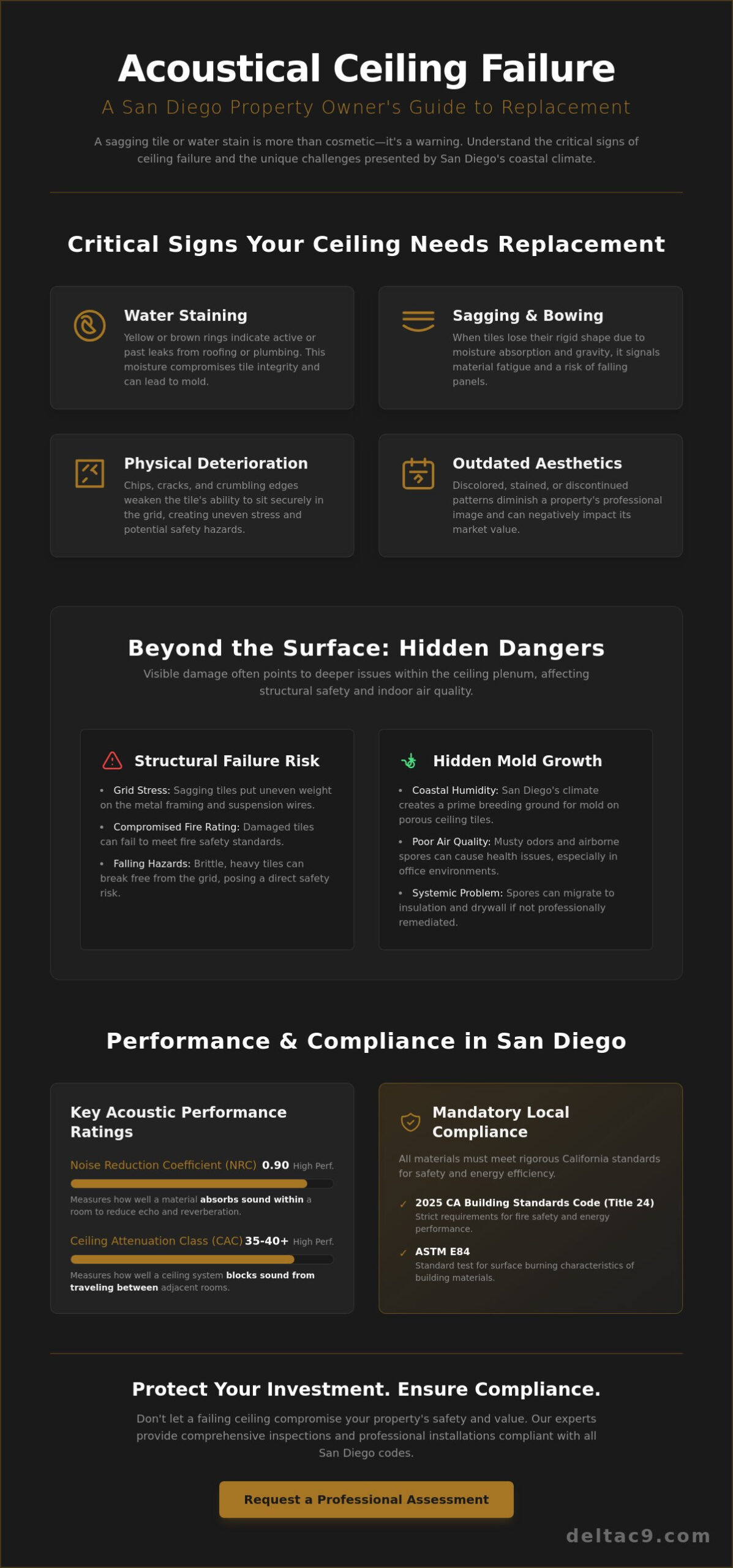
A ceiling serves as a critical layer of protection and insulation for any facility. When you begin searching for acoustical ceiling tile replacement near me, it’s often because the visual and structural integrity of this layer has been compromised. In San Diego, environmental factors like humidity and salt air accelerate the degradation of mineral fiber and fiberglass panels. Recognizing the early indicators of failure allows property owners to address issues before they escalate into safety hazards or costly structural repairs. These signs are often subtle at first. A small discoloration or a slight dip in the grid line can quickly evolve into a widespread failure if the environmental cause isn’t identified.
- Water Staining: Yellow or brown rings typically indicate an active or past leak from roofing systems or overhead plumbing.
- Sagging and Bowing: Gravity and moisture absorption cause tiles to lose their rigid profile, often indicating that the material’s structural limit has been reached.
- Physical Deterioration: Chips, cracks, and crumbling edges are common results of frequent maintenance access to the plenum space.
- Aesthetic Obsolescence: Discolored or outdated patterns negatively impact the professional image and market value of commercial real estate.
Aesthetic vs. Structural Damage
Differentiating between a cosmetic blemish and a structural failure is essential for a precise maintenance strategy. A stain might be a dry relic of a previous repair, but sagging usually points to “tile fatigue.” This occurs when the core material absorbs enough ambient moisture to become heavy and brittle. Understanding Dropped Ceilings involves recognizing that the grid and tiles work as a unified system; if tiles crumble at the edges, they no longer seat correctly within the metal framing. This misalignment puts uneven stress on the suspension wires. Immediate replacement becomes necessary when the material’s density is compromised, as the tiles can no longer provide the fire rating or acoustic dampening they were designed for.
The Hidden Risk of Mold in Drop Ceilings
Porous acoustic materials are highly susceptible to moisture retention. In San Diego’s humid coastal microclimates, damp tiles become a breeding ground for mold spores. Persistent musty odors often signal that growth is occurring in the plenum space, hidden from view. This is a significant concern for office environments where air circulation is managed through the ceiling cavity. If you observe dark spotting or experience a decline in indoor air quality, it’s critical to integrate mold remediation services into your replacement project. Replacing the tiles without addressing the underlying biological growth only provides a temporary solution to a systemic problem. A professional inspection will determine if the spores have migrated to the insulation or the surrounding drywall.
Understanding Modern Acoustic Ceiling Systems and Performance Ratings
Modern acoustical systems are engineered to solve specific environmental challenges. When you evaluate options for acoustical ceiling tile replacement near me, it’s vital to look beyond the surface pattern. You must consider how a material interacts with sound waves and fire safety requirements. Industry standards rely on two primary metrics: the Noise Reduction Coefficient (NRC) and the Ceiling Attenuation Class (CAC). These Acoustic Performance Ratings determine how effectively a tile absorbs sound within a room versus how well it blocks sound from traveling through the ceiling plenum into adjacent spaces. High performance tiles often reach an NRC of 0.90, but these ratings are only effective if the installation is airtight. Gaps in the grid or poorly fitted tiles allow sound to bypass the material entirely, rendering the technical specifications useless.
In San Diego, building code compliance is a non-negotiable factor. All materials used in commercial or residential projects must meet specific fire-spread and smoke-development standards, such as ASTM E84. The 2025 California Building Standards Code (Title 24) introduces even more rigorous requirements for energy efficiency and fire safety. Selecting a tile that meets these codes ensures your facility remains compliant and safe for all occupants. If you are unsure which rating fits your facility, a specialist in suspended ceilings can conduct a site audit to match materials to your specific building type.
NRC vs. CAC: Which Matters for Your Office?
Open-plan offices typically prioritize a high NRC. This rating measures the percentage of sound a tile absorbs; an NRC of 0.70 means the tile absorbs 70% of the sound energy hitting it, which significantly reduces echo and background chatter. Conversely, private boardrooms and medical exam rooms require a high CAC. This rating measures the tile’s ability to act as a barrier. A high CAC prevents confidential conversations from “leaking” over the wall and through the shared ceiling space into the next room. Matching the right performance metric to each specific zone is the key to a functional workspace.
Material Choices: Mineral Fiber vs. Fiberglass
Mineral fiber remains the industry standard due to its excellent fire resistance and durability. It provides a rigid structure that holds up well over time in controlled environments. However, fiberglass panels offer superior moisture resistance. This makes them an ideal choice for acoustical ceiling tile replacement near me in coastal San Diego communities where humidity is a constant factor. Fiberglass is also much lighter, reducing the load on the metal framing. For a more modern aesthetic, specialty finishes like perforated metal or wood-look acoustic panels provide high-end visual appeal without sacrificing the sound-dampening qualities of traditional materials.
The Local Advantage: Replacing Ceiling Tiles in San Diego’s Coastal Climate
San Diego’s geography demands a specialized approach to interior systems. When property managers look for acoustical ceiling tile replacement near me, they often overlook the impact of our local microclimates. In coastal communities like La Jolla and Del Mar, the high salt content in the air doesn’t just affect exterior paint; it penetrates the plenum space. This corrosive environment leads to premature oxidation of the suspended metal grid. If the grid becomes compromised by rust, simply swapping out tiles is a temporary fix. A professional assessment must verify the structural stability of the entire suspension system to ensure it meets the ASTM C636/C636M standards for metal ceiling installation. These local amendments to the building code are designed to address the specific challenges of our coastal environment.
Property owners should also consider the EPA Recommendations for Ceiling Tiles to ensure new materials support healthy indoor air quality. In humid regions, selecting tiles with low VOC emissions and high mold resistance is vital for maintaining a safe environment. This is particularly important for office spaces where occupant health directly correlates with productivity and facility value.
Humidity and Moisture Resistance
Standard mineral fiber tiles act like sponges in high-humidity zones. They absorb moisture, gain weight, and eventually sag, creating an unsightly and potentially hazardous “pillowing” effect. Selecting high-humidity rated tiles is essential for beachfront properties. The role of professional insulation is equally critical here. Proper insulation prevents temperature differentials that lead to condensation on the back of the panels. Without this thermal barrier, even the highest-rated tiles will eventually fail due to persistent moisture exposure. It’s a technical balance between material choice and thermal control.
Seismic Safety and Building Codes
Southern California’s seismic activity dictates strict engineering requirements for suspended ceilings. San Diego has specific local amendments to the 2025 California Building Standards Code (Title 24) that address how grids must be braced. These rules require heavy-duty main beams and specific perimeter attachment methods to prevent the ceiling from collapsing during an earthquake. When sourcing acoustical ceiling tile replacement near me, prioritizing a contractor who understands these regional safety mandates is a matter of liability and life safety. Secure grid attachment is particularly critical in high-traffic commercial zones where a failure could lead to significant injury or business interruption.
The Professional Process: Matching, Grid Repair, and Tile Installation
Successful acoustical ceiling tile replacement near me requires a methodical sequence that starts with the suspension system. Many property owners assume that simply swapping out a damaged panel is sufficient, but this ignores the underlying tension of the grid. A professional project begins with a comprehensive audit of the metal framework. We look for localized deflection in the cross-tees and oxidation in the perimeter channels. If the grid is misaligned, new tiles won’t sit flush, creating gaps that compromise both the fire rating and the acoustic seal. This systematic approach ensures that the replacement isn’t just a cosmetic fix, but a restoration of the ceiling’s functional performance.
Grid Inspection and Metal Framing Repair
The stability of a suspended ceiling depends entirely on the quality of its support. Identifying bent or rusted components is a critical safety step, especially in older San Diego buildings where seismic activity and humidity may have weakened the original wires. Our deep expert metal framing knowledge allows us to reinforce the primary suspension wires and repair the perimeter channel. This ensures a seamless wall-to-ceiling transition that remains level over time. A stable grid prevents the “chattering” of tiles during HVAC cycles and maintains the structural integrity required by local San Diego building codes. We prioritize the repair of the metal skeleton before a single tile is placed, ensuring a flat, professional finish across the entire plane.
Matching Discontinued Tiles
Sourcing tiles for partial replacements presents a unique challenge in San Diego’s diverse architectural landscape. Whether your facility uses 2×2 or 2×4 patterns, older buildings often feature textures or edge details that are no longer in mass production. Professionals use an extensive network of specialized suppliers to find “close-match” alternatives that mimic the fissured, perforated, or smooth finish of the original system. When an exact match is impossible, we employ “checkerboarding” or zone-replacement strategies. This involves moving existing, undamaged tiles to high-visibility areas and using the new tiles in a separate, dedicated zone to maintain visual intent and professional continuity.
The final installation phase demands extreme precision. Every cut around fire sprinklers, lighting fixtures, and HVAC vents must be clean and tight to prevent air leakage into the plenum. We use professional leveling tools to eliminate uneven surfaces that create distracting shadows or “lippage” at the tile joints. Once the tiles are seated, a final check ensures the acoustic performance matches the original design intent. For a comprehensive evaluation of your facility’s ceiling health, reach out to the experts at Delta C9 to discuss your project requirements.
Delta C9: San Diego’s Expert for Commercial and Residential Ceiling Solutions
Delta C9 has anchored its operations in San Diego for over 22 years, developing a deep understanding of the region’s specific construction demands. When you search for acoustical ceiling tile replacement near me, you require a partner who views the ceiling as a critical structural component rather than a simple cosmetic surface. Our extensive history in Southern California allows us to anticipate and mitigate the risks associated with coastal oxidation and seismic shifts. By managing the entire lifecycle of the project, from the initial metal framing and insulation to the final tile placement, we maintain absolute control over the quality and safety of your interior environment. Our approach involves a thorough verification of all suspension points, ensuring that the load-bearing capacity of the grid exceeds the requirements of the new high-performance material.
Professionalism at Delta C9 is defined by stability and proactive protection. We ensure every project complies with the 2025 California Building Standards Code, providing you with long-term security and peace of mind. Our team operates with a disciplined and structured workflow designed to minimize disruption to your business or residential life. We treat every commercial interior as a high-stakes engineering project, where the safety of your employees and the continuity of your business are the primary metrics of success. We don’t just solve immediate issues; we provide a foundation that supports the ongoing stability of your operations.
Why a Drywall and Framing Specialist is Better for Ceilings
The structural integrity of a suspended ceiling is inseparable from the walls that support it. By choosing the best drywall company that also masters ceiling systems, you gain a level of perimeter precision that standard installers often miss. This integrated knowledge is vital for the seamless installation of lighting and MEP fixtures, ensuring that every component of the plenum space works in harmony. We coordinate these technical details during the framing phase to prevent future misalignment or acoustic leaks. This holistic view of the building envelope ensures that your ceiling replacement integrates perfectly with your existing drywall and structural framing.
Get Your San Diego Ceiling Replacement Quote
Restoring your facility’s interior health begins with a transparent and data-driven evaluation. Delta C9 provides comprehensive quotes for commercial tenant improvements and residential remodels throughout San Diego County. Our pricing reflects a detailed project timeline and the high-performance materials required for lasting stability in our coastal climate. We invite you to contact Delta C9 today to discuss your specific project requirements and secure an environment that reflects the professional standards of your organization. Every estimate is backed by over two decades of local expertise, ensuring that your project is completed with the highest degree of technical accuracy and professional care.
Restoring Structural Integrity and Acoustic Performance
A high-functioning ceiling system is the foundation of a productive and safe facility. Beyond the immediate aesthetic fix, a proper replacement strategy addresses the underlying grid stability and thermal performance. This proactive approach prevents future sagging and ensures compliance with San Diego’s rigorous seismic bracing requirements. By prioritizing technical precision over a quick cosmetic patch, you secure the long-term value and safety of your property.
If you’re seeking acoustical ceiling tile replacement near me, trust a partner with a proven record of engineering-grade results. Delta C9 offers over 22 years of local experience as licensed and insured interior specialists. We possess the specific expertise in CA Building Codes and seismic safety necessary for successful commercial and residential projects. Request a Professional Ceiling Inspection and Quote from Delta C9 to restore your interior environment with confidence. Your facility deserves the stability and professional finish that only seasoned experts can provide.
Frequently Asked Questions
How much does acoustical ceiling tile replacement cost in San Diego?
Total project costs are determined by the square footage, the specific material selected, and the current condition of your suspension grid. High-performance tiles with specialized moisture resistance or high Noise Reduction Coefficient (NRC) ratings require a different investment than standard mineral fiber panels. Labor rates in the San Diego area also account for the technical precision needed to meet local seismic bracing requirements. A professional site audit is the only way to establish an accurate project scope.
Can I replace just a few stained tiles, or do I need a whole new ceiling?
You can replace individual tiles if the existing grid is structurally sound and you can source an exact match for the pattern. However, if more than 20% of your ceiling shows signs of sagging or moisture damage, a full replacement is usually the more stable choice. This ensures that the acoustic performance remains consistent across the space and prevents the visual distraction of mismatched textures or varying ages of material.
How do I identify the brand and model of my existing ceiling tiles?
Most manufacturers print the brand name and a specific item number on the back of each panel. You can find this information by gently lifting a tile out of the grid in a low-visibility area. If the markings are missing or unreadable, a professional can identify the model by analyzing the edge detail, surface texture, and material density. Proper identification is vital for maintaining the fire rating and sound attenuation of your current system.
Are acoustic ceiling tiles effective for soundproofing between floors?
Acoustic tiles are primarily engineered to absorb sound within a room to reduce echo and reverberation. To block sound from traveling between floors, you must select tiles with a high Ceiling Attenuation Class (CAC) rating. For the most effective results, we often recommend combining these high-CAC tiles with professional soundproofing insulation in the plenum space. This creates a comprehensive barrier that prevents noise from leaking through the ceiling cavity into adjacent levels.
How long does a typical commercial ceiling tile replacement take?
A standard commercial office project typically takes between one and three business days to complete. This timeline depends on the total square footage and the number of lighting or HVAC fixtures that require precision cutting. We utilize a disciplined and structured workflow that prioritizes minimal disruption to your operations. In many cases, we can phase the installation to allow your team to continue working in different zones while the replacement progresses.
What is the difference between a drop ceiling and an acoustical ceiling?
A drop ceiling refers to any secondary ceiling system that’s suspended below the structural floor or roof slab. An acoustical ceiling is a specific type of drop ceiling that uses panels designed for sound control. While all acoustical ceilings are technically dropped, not all drop ceilings are acoustical. Some systems use gypsum board or metal panels that focus purely on aesthetics rather than sound absorption or noise reduction.
Can ceiling tiles be painted to cover up water stains?
Painting is not a recommended solution because it clogs the pores of the material and ruins its acoustic properties. Standard paint also changes the fire-spread rating of the tile, which can lead to building code violations. If you’re dealing with unsightly stains, the most reliable way to restore your facility is to seek acoustical ceiling tile replacement near me. New tiles ensure that your space remains safe, quiet, and professionally maintained.
Do I need a permit for ceiling tile replacement in San Diego County?
Simple “like-for-like” tile replacements generally don’t require a permit in San Diego. However, if your project involves moving the suspension grid, changing the ceiling’s fire rating, or modifying the seismic bracing, a permit is usually mandatory. All commercial tenant improvements must align with the 2025 California Building Standards Code. It’s best to consult with a specialist who understands these local amendments to ensure your project remains fully compliant with regional safety laws.