
What if the most expensive boardroom in your San Diego office is actually a security liability? If you’re researching how to soundproof a conference room San Diego, you’ve likely realized that standard office walls don’t protect sensitive conversations. It’s a significant risk when proprietary data or HR discussions leak into common areas, undermining the professional environment you’ve built. We believe that true privacy is a structural necessity, not a cosmetic addition. You need a space that offers total containment and control.
This professional guide explores the structural and acoustic strategies used by San Diego pros to ensure total meeting privacy and eliminate office distractions. We’ll examine how specialized metal framing and high-performance drywall create a secure acoustic envelope. You’ll also learn to identify common weak links in office infrastructure and align your project with the 2026 California Building Standards Code. This systematic approach ensures your workspace remains a secure hub for high-stakes decision-making and professional collaboration.
Key Takeaways
- Distinguish between surface-level acoustic treatments that absorb echoes and structural soundproofing techniques designed to block sound transmission entirely.
- Learn how to soundproof a conference room San Diego by utilizing metal framing and high-density drywall to achieve professional-grade acoustic decoupling.
- Identify and secure common “weak links” in office construction, such as unsealed suspended ceilings and sound-leaking HVAC ductwork.
- Ensure your renovation remains compliant with the 2026 California Building Standards Code and local San Diego commercial permit requirements.
- Implement a proactive site assessment to detect acoustic vulnerabilities before they compromise the confidentiality of your executive meetings.
Why Conference Room Privacy is Critical for San Diego Businesses
Business leaders often mistake a quiet room for a private one. In a bustling San Diego office, a conference room that feels peaceful inside can still leak every word of a sensitive conversation to the hallway. Understanding the technical principles of Soundproofing is essential for distinguishing between acoustic comfort and speech privacy. While comfort involves reducing echoes within the space, true privacy requires structural barriers that stop sound from traveling through walls, ceilings, and floors. This is a critical distinction for any firm handling sensitive intellectual property or personal data.
For local firms in the legal, financial, and biotech sectors, this distinction is a matter of security. Eavesdropping isn’t always intentional; it’s often a byproduct of thin drywall or unsealed gaps. When you investigate how to soundproof a conference room San Diego, the objective is to create a controlled environment where proprietary data and HR discussions remain within the four walls. Protecting sensitive information is a proactive defense against liability and a core component of business continuity. It ensures that your strategic planning remains confidential and your executive decisions stay protected from unauthorized ears.
The impact of noise extends beyond privacy to the very core of office productivity. Open-concept floor plans are common in Southern California, but they present significant acoustic challenges. Without a properly isolated meeting space, the constant hum of office activity bleeds into your most important discussions. This creates a fragmented work environment where concentration is difficult to maintain and professional standards are harder to uphold. Investing in structural sound control is a commitment to the stability and efficiency of your daily operations.
The High Cost of Poor Office Acoustics
Noise distractions lead to a measurable decline in productivity and ROI. When employees overhear snippets of meetings, their focus breaks; it takes significant time to regain deep-work states. Beyond internal efficiency, client perception is vital. A professional environment suggests a high level of control and security. If a client can hear your team’s internal chatter from the lobby, their confidence in your firm’s professionalism may falter.
Meeting the Needs of Modern Hybrid Work
The 2026 standards for hybrid meetings demand more than just a fast internet connection. Poor room acoustics are a primary driver of fatigue for remote participants. Background noise from the office floor ruins the audio experience for those on the other side of the screen. Effective soundproofing ensures that microphones only pick up the intended voices, creating a quiet environment for high-quality audio and seamless communication.
Soundproofing vs. Acoustic Treatment: Understanding the Difference
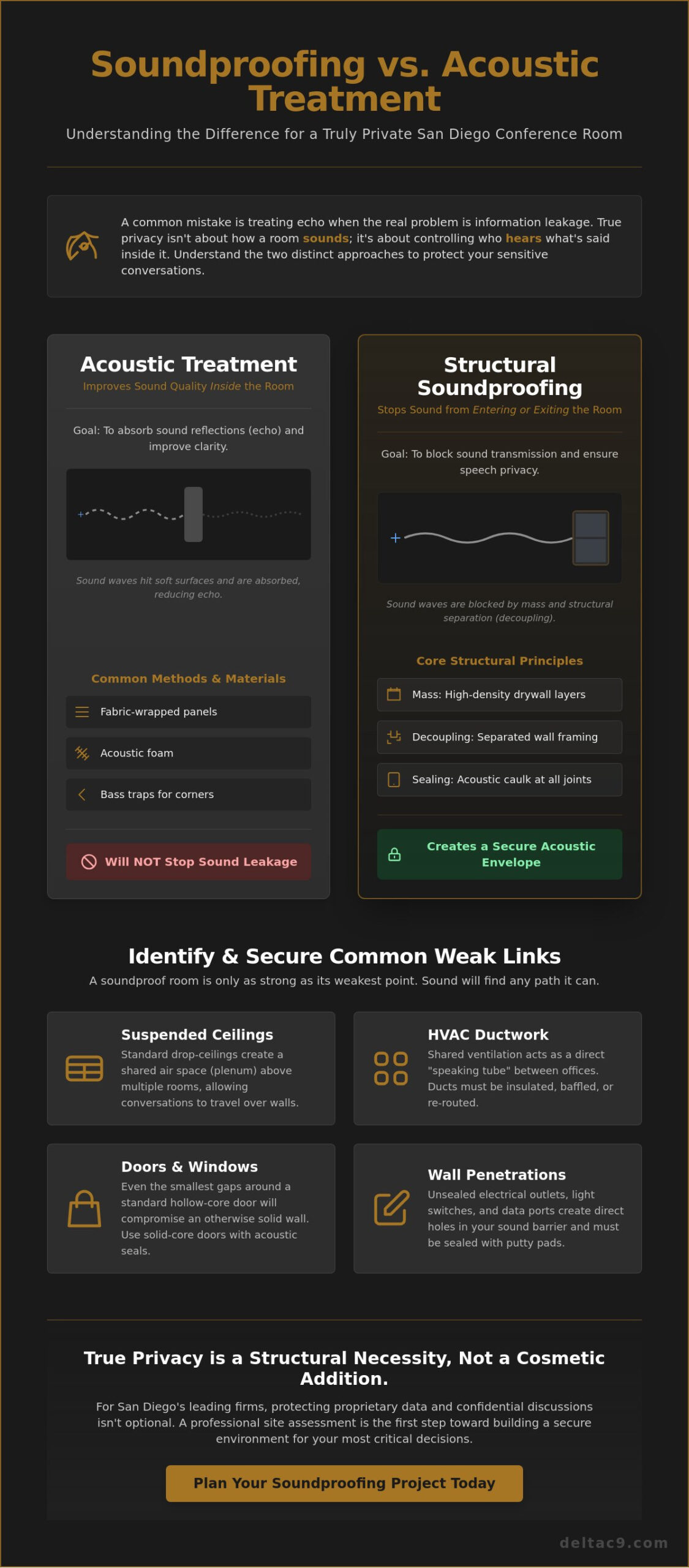
A common mistake in commercial renovations is treating echo when the real problem is leakage. Acoustic treatment and soundproofing are distinct disciplines with different goals. Acoustic treatment uses soft materials like fabric panels to improve the sound quality inside a room by absorbing reflections. Soundproofing, however, focuses on containment. It involves structural changes that prevent sound from entering or exiting a space. If your goal is to stop confidential conversations from being heard in the hallway, hanging foam panels on the wall will not be enough. You must address the physical structure of the room.
True noise containment relies on two fundamental principles: mass and decoupling. Sound travels through vibrations. To stop it, you need high-density materials that provide enough mass to resist those vibrations. Decoupling involves creating a physical break in the building’s framing to prevent sound from vibrating through the studs from one side of the wall to the other. For those evaluating how to soundproof a conference room San Diego, understanding these mechanical requirements is essential for a successful outcome. Professional soundproofing solutions prioritize these structural barriers to ensure that your business discussions remain secure.
Standard building practices often overlook these needs. A typical office wall might look solid, but without specific engineering, it acts as a drumhead that carries sound throughout the building. Historical data from the National Bureau of Standards on the Sound insulation of wall and floor constructions highlights how different material combinations affect transmission. Relying on facts and engineering rather than quick fixes is the only way to achieve lasting results.
What is STC and Why Does it Matter?
Sound Transmission Class (STC) is an integer rating that indicates how well a building partition attenuates airborne sound. A standard office wall usually has an STC rating of 30 to 35, which allows loud speech to be understood clearly on the other side. For executive boardrooms and HR offices, we target an STC of 50 or higher. At this level, loud speech is virtually inaudible. Even a high-rated wall can fail if there are structural gaps around electrical outlets or door frames. Precision in the finishing process is just as important as the materials used.
When to Choose Acoustic Panels vs. Structural Changes
Identifying the root cause of your noise issue is the first step in the decision-making process. If participants in a meeting find it hard to hear each other because of “boomy” audio or echo, acoustic panels are the right choice. However, if the problem is “leakage” where external noise disrupts calls or internal talk is overheard, structural remediation is required. Foam and fabric-wrapped panels have almost zero impact on blocking sound transmission. They are designed for internal clarity; they are not a security solution. True privacy requires a commitment to structural integrity and professional-grade installation.
Structural Solutions: Metal Framing and High-Density Drywall
When you move beyond surface treatments, the focus shifts to the skeleton of the building. Achieving total privacy requires a combination of mass and mechanical separation. Professional metal framing and drywall installation serves as the foundation for this containment. By creating a structural break, we stop sound waves from turning your walls into speakers. This is the most effective method for anyone looking at how to soundproof a conference room San Diego for high-security environments. These structural strategies ensure that sound energy is absorbed and dissipated before it reaches the adjacent office space.
For critical spaces like executive boardrooms, a “room-within-a-room” construction is the gold standard. This involves building a secondary wall structure that doesn’t touch the existing building frame. We use specialized materials like mass-loaded vinyl (MLV) and sound reduction drywall to add significant density without excessive thickness. This combination creates a sound-tight seal that is virtually impossible for airborne noise to penetrate. It provides the stability and control necessary for a professional office environment where confidentiality is a non-negotiable requirement.
The Role of Metal Studs in Sound Control
Metal studs offer superior acoustic performance compared to traditional wood framing. Wood is rigid and transmits vibrations efficiently, while metal studs are more flexible. This flexibility allows them to act like a spring, absorbing sound energy rather than passing it through the wall. When we integrate these studs with suspended ceiling systems, we create a comprehensive barrier. This approach is essential for breaking the path of sound vibrations through the building’s infrastructure, ensuring a quiet and secure meeting space.
High-Performance Drywall Techniques
Standard drywall installation isn’t enough for modern privacy needs. We often recommend double-layer drywall or staggered-stud configurations to maximize sound attenuation. Staggered studs involve two rows of studs on a single wide plate, so the drywall on one side doesn’t touch the studs supporting the other side. This physical decoupling is highly effective. To maintain the professional look of your office, we prioritize a level 5 finish. This ensures the walls aren’t just acoustically sound but also meet the highest aesthetic standards for your corporate environment.
Implementing these structural solutions requires a methodical approach and engineering precision. If you’re ready to secure your office, our team provides expert soundproofing services that focus on long-term stability and proactive protection.
Addressing Common Weak Links: Ceilings, HVAC, and Doors
Even the most robust wall construction fails if you ignore the “flanking paths” where sound bypasses structural barriers. Sound behaves much like water; it exploits the smallest vulnerability to travel between spaces. When businesses investigate how to soundproof a conference room San Diego, they often focus solely on the walls while overlooking the critical gaps in the ceiling and ventilation systems. Ensuring total speech privacy requires a methodical approach that seals every potential leak, from the gap under the door to the electrical outlets in the wall.
The 2026 California Building Standards Code emphasizes creating productive indoor environments, which implicitly includes managing these acoustic vulnerabilities. High-STC walls are only as effective as their weakest point. A one percent gap in a partition can reduce its sound-blocking effectiveness by as much as 50 percent. This is why we prioritize engineering precision during the finishing stages. Using non-hardening acoustical sealants and specialized putty pads for electrical boxes ensures that your acoustic envelope remains airtight and secure. For a comprehensive solution, our team provides an expert soundproofing assessment to identify these hidden leaks before they compromise your confidentiality.
Soundproofing Suspended and Acoustic Ceilings
Most commercial offices in Southern California utilize suspended grids with a shared plenum space above the tiles. This open area acts as a highway for sound, allowing voices to travel over the wall and drop into the adjacent room. To fix this, we install professional ceiling and drywall barriers that extend from the top of the wall to the structural deck above. Combining these physical barriers with high-NRC (Noise Reduction Coefficient) ceiling tiles ensures that sound is both blocked and absorbed, preventing it from echoing back into the workspace.
Managing HVAC and Electrical Penetrations
HVAC systems often create a “speaking tube” effect where metal ductwork carries sound directly between rooms. Since metal is highly conductive of vibrations, voices can travel through vents with surprising clarity. We mitigate this by using acoustic baffling and strategic duct routing to break the direct path of sound. Additionally, every light fixture and outlet represents a hole in your sound barrier. We seal these penetrations with specialized materials to maintain the integrity of the room. This proactive protection is essential for maintaining the stability of your professional environment and ensuring that sensitive strategic planning remains private.
Addressing these weak links isn’t just about comfort; it’s about business security. By focusing on the details that others miss, you create a space that meets the highest standards of professional privacy and operational efficiency.
Planning Your San Diego Office Soundproofing Project
Planning a professional acoustic remediation project requires more than selecting high-density materials; it demands a disciplined approach to logistics and local regulations. When you evaluate how to soundproof a conference room San Diego, the first step is always a comprehensive site assessment. This process identifies the specific structural vulnerabilities of your current layout, such as unsealed plenum spaces or thin partitions that compromise speech privacy. By diagnosing these issues early, you avoid the cost of retrofitting solutions later in the construction cycle. A methodical plan ensures that every structural change serves the dual purpose of aesthetic quality and acoustic security.
Effective soundproofing is most successful when it’s integrated into broader commercial construction projects. Coordinating the metal framing phase with the installation of specialized insulation and high-density drywall prevents common gaps that occur when these tasks are handled by separate, uncoordinated teams. This integrated approach maintains the integrity of the acoustic envelope throughout the build. You should expect a structured timeline that prioritizes the most disruptive structural work first, followed by precision finishing. This predictability allows your firm to maintain business continuity while the workspace is being upgraded for maximum privacy.
Local San Diego Compliance and Standards
Navigating the 2026 California Building Standards Code is a prerequisite for any office remodel in the region. These regulations, which took effect on January 1, 2026, emphasize the creation of comfortable and productive indoor environments. You must also account for specific building management or HOA rules that govern construction hours and material transport within commercial complexes. Working with a licensed and insured contractor ensures that your project meets these local standards and passes all necessary inspections without delay. This professional oversight is the best way to protect your investment and ensure long-term compliance.
Getting Started with Delta C9
Our team approaches every project with engineering precision and a commitment to your firm’s security. We begin by assessing your office’s specific noise leaks and identifying the most effective structural solutions for your space. We provide customized quotes for soundproofing and remediation that focus on long-term stability rather than temporary fixes. If you’re ready to secure your meeting spaces and eliminate distractions, contact Delta C9 for a professional acoustic evaluation. We take responsibility for the systems we build, ensuring your team can work with total peace of mind and the highest level of speech privacy.
Securing Your Corporate Privacy Through Engineering Precision
Transitioning from identifying acoustic vulnerabilities to executing a structural solution requires a partner who understands the total construction lifecycle. Your goal is a workspace where strategic planning remains internal and hybrid calls are free from the chaos of the open office. By addressing how to soundproof a conference room San Diego through structural remediation, you’re protecting your firm’s most valuable assets: its ideas and its reputation. This commitment to quality ensures that your office environment remains a stable foundation for business growth.
Delta C9 brings over 22 years of San Diego construction experience to every project. As a licensed, bonded, and insured general contractor, we specialize in the metal framing and high-performance drywall systems that define modern acoustic security. We provide the stability and proactive protection your executive team demands for their most sensitive discussions. Schedule a Professional Acoustic Assessment with Delta C9 to ensure your next meeting happens in a space built for absolute privacy and engineering excellence.
Frequently Asked Questions
How much does it cost to soundproof a conference room in San Diego?
Total project costs depend on the room’s square footage, the existing wall structure, and the level of speech privacy required. Factors such as the choice of specialized sound-reduction drywall and the complexity of the metal framing will influence the final budget. A professional site assessment is necessary to provide an accurate estimate based on your office’s specific acoustic vulnerabilities.
Can I soundproof an existing conference room without tearing down walls?
You can improve acoustic performance without a full demolition by adding a second layer of sound-reduction drywall over existing partitions. This method increases mass and reduces vibrations, especially when combined with a damping compound between layers. However, this approach may not address sound leaking through the ceiling plenum or HVAC ducts, which often requires structural remediation for total privacy.
What is the best type of drywall for commercial soundproofing?
High-density acoustic gypsum board is the industry standard for professional projects. These panels are engineered with a constrained-layer damping core that converts sound energy into heat. When investigating how to soundproof a conference room San Diego, we recommend these specialized materials over standard drywall to achieve a higher STC rating without significantly increasing the thickness of your walls.
Do acoustic panels stop sound from leaving the room?
Acoustic panels are designed to absorb sound reflections within a room; they do not block sound from exiting the space. While they are excellent for reducing echo during hybrid calls, they lack the mass required to stop sound transmission through walls. To prevent confidential conversations from being overheard in the hallway, you must implement structural solutions like metal framing and high-density partitions.
How long does a professional soundproofing installation take?
A typical professional soundproofing installation for a single conference room generally takes between three and five business days. This timeline accounts for framing adjustments, drywall installation, and the application of a high-quality finish. Larger projects or those involving complex HVAC baffling may require more time to ensure all acoustic seals are perfectly executed and compliant with professional standards.
What is the difference between NRC and STC ratings?
NRC (Noise Reduction Coefficient) measures how much sound a material absorbs within a space, which is vital for reducing internal echo. STC (Sound Transmission Class) measures how well a partition blocks sound from traveling between rooms. For executive privacy and security, the STC rating is the more critical metric to consider during your office renovation.
Do I need a permit for office soundproofing in San Diego?
Most structural soundproofing projects in San Diego require a commercial tenant improvement permit if you are modifying framing, HVAC systems, or electrical layouts. Local building codes, including the 2026 California Building Standards, dictate specific requirements for workplace safety and indoor environmental quality. When researching how to soundproof a conference room San Diego, it’s essential to ensure your contractor is licensed and familiar with current city ordinances.
Can soundproofing also help with mold and insulation in my office?
Professional soundproofing provides secondary benefits, including improved thermal insulation and moisture control. The high-density materials used to block noise also act as a barrier against heat transfer, which can enhance the energy efficiency of your workspace. If we identify existing issues during our initial assessment, we also offer mold remediation services to ensure your new acoustic environment is safe, stable, and durable.