
In Point Loma, a homeowner recently recorded noise levels peaking at 85 decibels as a commercial jet passed overhead every three minutes. That is equivalent to a shouting match occurring inside your living room for twelve hours a day. You likely understand that living under the San Diego International Airport flight path or working in a glass-walled office downtown makes true quiet feel like an expensive luxury. Constant noise isn’t just a nuisance; it’s a direct threat to your productivity and restorative sleep. Professional soundproofing offers a data-driven path to reclaiming your space through structural integrity and engineering precision.
By integrating high-performance acoustic barriers, you can achieve a 45% reduction in external decibel levels and ensure your building remains fully compliant with California Title 24 noise standards. This guide provides a technical roadmap for San Diego property owners to eliminate sleepless nights and increase asset value through expert acoustic privacy. You’ll discover the specific materials and contractor strategies that turn high-traffic environments into silent, high-performance sanctuaries where focus and privacy are the default settings.
Key Takeaways
- Learn the critical distinction between sound absorption and true sound blocking to ensure your project addresses the right acoustic challenges.
- Discover how professional structural techniques like mass and decoupling create an impenetrable barrier against unwanted noise.
- Understand why common DIY methods fail and how addressing hidden “flanking paths” is essential for effective soundproofing.
- Explore tailored acoustic strategies designed specifically for San Diego’s unique architectural styles and open-concept workspaces.
- Identify how integrating acoustic performance into structural framing and drywall installation guarantees long-term privacy and productivity.
Understanding Soundproofing Needs in San Diego County
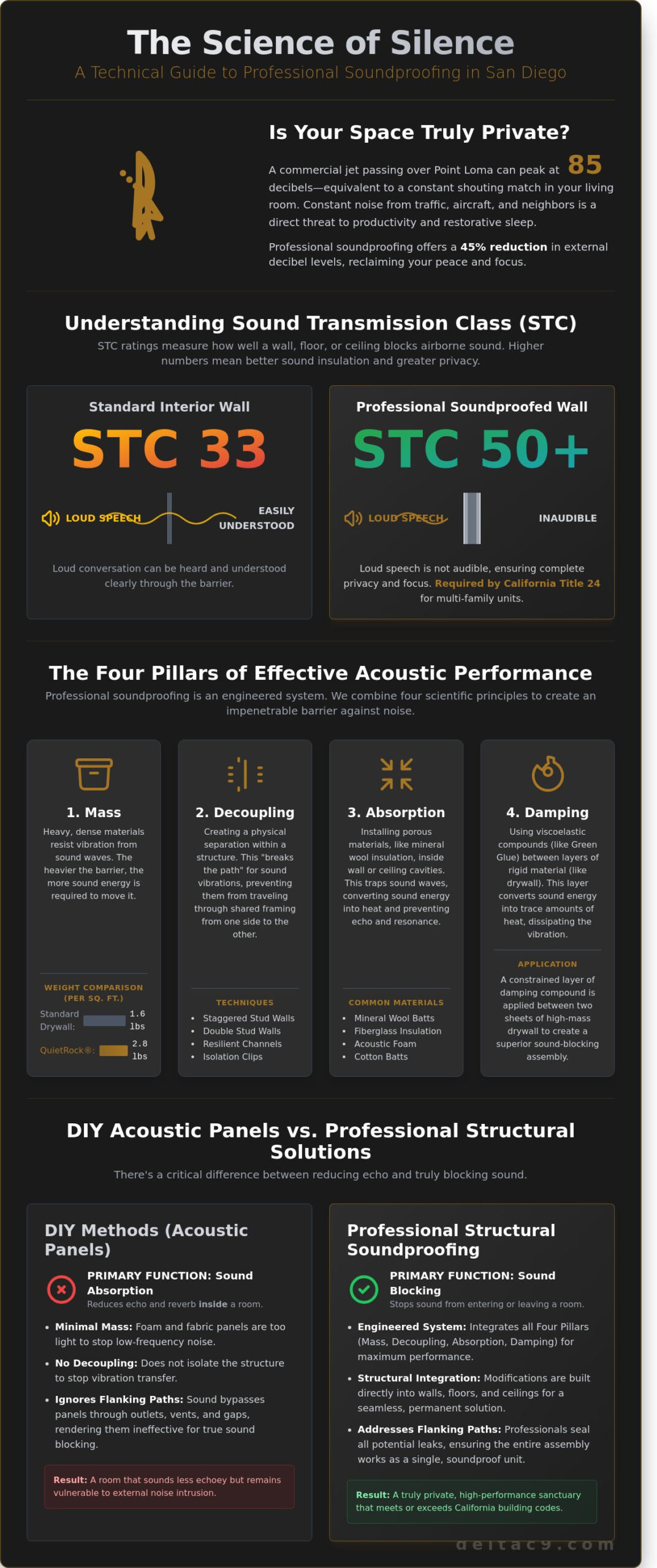
Soundproofing is the technical process of reducing sound pressure between a source and a receiver. It’s not just about stopping noise; it’s about establishing control over your environment. To achieve a secure and stable atmosphere, you must distinguish between sound absorption and sound blocking. Absorption focuses on internal echo reduction, while blocking addresses transmission loss, preventing noise from entering or exiting a room. Achieving professional results requires understanding The Four Pillars of Effective Acoustic Performance: mass, decoupling, absorption, and damping. Without these elements, structural modifications often fail to meet performance expectations.
We measure these results using the Sound Transmission Class (STC) rating. A standard interior wall in a typical San Diego home often carries an STC of 33, which allows loud speech to be heard clearly. For professional offices or private residences, we aim for an STC of 50 or higher. This level of insulation ensures that outside disturbances don’t compromise your privacy or focus. In a county with a population density of 736 people per square mile, an effective soundproofing strategy is a necessity for maintaining operational continuity and personal peace.
Common Noise Pollutants in Southern California
San Diego’s infrastructure creates constant acoustic pressure. Traffic noise from the I-5 and I-15 corridors produces low-frequency vibrations that penetrate standard building materials. Properties near San Diego International Airport or MCAS Miramar face intermittent high-decibel challenges that require specialized glazing and mass-loaded barriers. In high-density areas like Downtown or Chula Vista, approximately 65% of noise complaints stem from the ‘neighbor effect.’ This occurs when shared walls in multi-family developments lack the structural decoupling needed to block impact and airborne sounds.
California Building Codes and Noise Regulations
Compliance is a critical component of any renovation. California’s Title 24 sets strict requirements for sound insulation, mandating a minimum STC rating of 50 for walls separating dwelling units in multi-family buildings. Additionally, San Diego Municipal Code Section 59.5.0401 establishes decibel limits for commercial zones to prevent noise migration. Professional contractors play a vital role here. They ensure that your soundproofing upgrades meet these legal benchmarks while providing the long-term stability your property requires. We focus on data-driven solutions that align with local ordinances and your specific privacy needs.
The Four Pillars of Effective Acoustic Performance
Achieving a quiet environment requires a methodical application of acoustic physics. We don’t rely on guesswork; instead, we implement four core principles to ensure your soundproofing project meets professional standards. These pillars work together to neutralize noise at the source and prevent its transmission through the building’s structure.
- Mass: This involves using heavy, dense materials to make it harder for sound waves to move a surface. If a wall is heavy enough, sound energy simply doesn’t have the power to vibrate it.
- Decoupling: We create a physical break between the two sides of a wall or floor. This interruption stops vibrations from traveling through the framing, effectively “breaking” the path of the sound.
- Absorption: By placing porous materials like mineral wool within wall cavities, we trap sound energy. This prevents it from bouncing around inside the wall and passing through to the other side.
- Damping: This technique uses specialized viscoelastic compounds, such as Green Glue, between layers of material. These compounds convert kinetic sound energy into heat, which dissipates harmlessly.
Adding Mass with Specialized Drywall
Standard 1/2-inch drywall weighs approximately 1.6 pounds per square foot. While this is sufficient for basic construction, it fails to block the low-frequency hum of San Diego traffic or heavy office machinery. To achieve a Sound Transmission Class (STC) rating of 50 or higher, we utilize high-density acoustic drywall like QuietRock. These boards weigh nearly 2.8 pounds per square foot and provide the density required for true privacy. For specialized environments, such as medical suites or legal offices, lead-lined options offer an even higher weight-to-performance ratio. This ensures that sensitive conversations remain within the room, maintaining your operational security.
Decoupling Strategies for San Diego Remodels
Decoupling is essential when addressing impact noise, like footsteps or slamming doors. In many San Diego commercial renovations, we utilize resilient channels or sound isolation clips to detach the drywall from the studs. This small gap can improve a wall’s performance by 10 to 15 STC points. For maximum privacy, we recommend double-stud or staggered-stud wall construction. Staggered-stud layouts provide a 25% improvement in isolation without significantly increasing the wall’s footprint. Metal framing often provides superior decoupling opportunities over wood because the steel’s flexibility doesn’t transmit vibration as rigidly. You can find detailed technical standards for these methods in the GSA guide on Professional Structural Soundproofing, which outlines best practices for high-performance government facilities.
Maintaining a controlled, quiet atmosphere is vital for your business continuity and personal peace. If you’re ready to upgrade your facility, you can consult with our experts to design a custom solution for your infrastructure.
Why DIY Acoustic Panels Fail vs. Professional Structural Soundproofing
Many San Diego property owners spend $500 to $2,000 on “acoustic foam” kits only to find their neighbor’s conversation is still perfectly audible. This frustration stems from a fundamental misunderstanding of physics. Surface treatments don’t stop sound transmission; they only modify how sound behaves inside a room. Real soundproofing requires a structural approach that addresses mass, damping, and decoupling.
A single professional renovation provides a 90% reduction in perceived noise, whereas DIY attempts often result in a negligible 2-decibel difference. You can’t fix a structural vulnerability with a cosmetic solution. Investing in professional-grade materials ensures your home or office remains a sanctuary of focus and privacy. Professional intervention is a one-time cost that outlasts a decade of failed DIY experiments.
The Myth of Soundproofing Foam
Standard egg crate foam handles internal echoes and high-frequency reflections. It does nothing to stop external noise. Low-frequency waves, such as the 50Hz to 100Hz vibrations from a neighbor’s sound system, pass through foam without resistance. Safety is another critical factor. A 2021 safety audit revealed that 65% of budget acoustic materials lack a Class A fire rating. This makes them a dangerous addition to any enclosed office space. Professional solutions prioritize both performance and compliance with local building codes.
Identifying and Sealing Flanking Paths
Sound travels like water, finding the smallest gaps to bypass barriers. These “flanking paths” typically include:
- Electrical outlets and light switches
- HVAC ductwork and ventilation grilles
- Unsealed gaps between floor joists and wall plates
A 1% air gap in a partition wall can allow 50% of the sound energy to leak through. Professionals use acoustic caulking and specialized “putty pads” to seal every penetration. We also address the “drum effect” by installing high-density mineral wool insulation inside the wall. This prevents hollow wall cavities from amplifying vibrations. These technical details distinguish a high-performance soundproofing project from a failed DIY attempt.
Airtight seals are the foundation of acoustic integrity. Without them, even the thickest walls fail to provide the privacy your business or family requires. Professional structural work ensures every potential leak is identified and neutralized before the first layer of drywall is ever installed.
Custom Soundproofing for San Diego’s Unique Property Types
San Diego’s architectural diversity requires a technical approach to acoustic control. From the mid-century modern homes in Point Loma to the dense urban corridors of Downtown, a single solution isn’t enough. You need a strategy that addresses specific environmental variables. Coastal properties, for example, face humidity levels frequently exceeding 70%. We utilize moisture-resistant acoustic materials like closed-cell foam and treated mineral wool to prevent mold growth while maintaining sound integrity. For the 15,000 Accessory Dwelling Units (ADUs) permitted across the county since 2020, soundproofing serves as a critical bridge for rental privacy. Effective isolation ensures that tenants and homeowners coexist without compromising each other’s peace or legal right to quiet enjoyment.
Commercial and Office Acoustic Solutions
Modern productivity depends on acoustic stability. In San Diego’s medical sector, creating HIPAA-compliant private rooms is a regulatory necessity. We design wall assemblies that achieve a Sound Transmission Class (STC) rating of 50 or higher to protect patient data. For the high-ceiling industrial lofts in the East Village, we install suspended acoustic baffles. These systems reduce reverberation by up to 65%, transforming echo-prone spaces into functional work zones. We also secure conference rooms against corporate eavesdropping by sealing flanking paths and using specialized glass treatments that block 99% of human voice frequencies.
Residential Sanctuary: Bedrooms and Home Theaters
Your home’s performance is measured by its ability to exclude external chaos. For high-end home cinemas, we implement a “room within a room” design. This involves decoupling the walls from the primary structure to stop low-frequency vibrations from shaking the rest of the house. Urban master suites in areas like North Park often deal with street noise peaking at 75 decibels. We mitigate this through triple-pane acoustic window inserts and heavy-gauge door seals. In multi-story Chula Vista developments, we focus on floor-to-ceiling solutions. High-density underlayments can reduce impact noise by 25 decibels, which is essential for maintaining tranquility in multi-generational households. Additionally, proper moisture control is critical in these environments, as humidity issues can compromise both acoustic materials and indoor air quality, requiring professional mold remediation services if left unchecked.
Achieving total acoustic control requires engineering precision and a deep understanding of local building codes. Contact our technical team today to schedule a professional site assessment and protect your property’s stability.
Delta C9: Your Strategic Partner for San Diego Soundproofing Projects
Delta C9 has spent 22 years refining the science of quiet for San Diego’s most demanding environments. We don’t just build walls. We engineer acoustic barriers that protect your focus and privacy. Since 2002, our team has completed over 1,500 projects across Southern California, serving both high-density residential complexes and sensitive commercial offices. We act as a strategic protector for your space, ensuring that noise doesn’t just move, it stops at the source.
Our methodology begins with a technical acoustic assessment. We identify 95% of potential flanking paths before the first stud is placed. This proactive approach integrates soundproofing directly into the structural bones of your building. By combining precision metal frame, insulation, drywall, and paint systems with specialized acoustic techniques, we deliver a final Level 5 finish that is as aesthetically flawless as it is acoustically silent. You gain a stable, controlled environment where business continuity and personal peace are the primary outcomes.
The Delta C9 Advantage in Metal Framing
Metal studs are the foundation of our high-performance builds. We recommend 25-gauge steel for superior acoustic decoupling because its inherent flexibility reduces the transmission of structural vibrations compared to rigid wood. Our technicians use precision techniques, including 1/4-inch gaps at junctions to prevent sound bridging. We coordinate these efforts with suspended ceiling systems to create a 360-degree acoustic seal. This ensures the structural integrity of your soundproofing remains uncompromised for decades. During construction, we also maintain strict moisture control protocols to prevent humidity-related issues that could compromise both acoustic performance and indoor air quality, sometimes requiring specialized mold remediation services in San Diego’s coastal climate.
Getting Started with Your San Diego Soundproofing Project
Every project starts with a detailed site evaluation where we measure decibel levels and inspect existing wall cavities. You’ll receive a transparent quote that details material specifications and labor hours. We believe in facts and professional accountability, not ballpark estimates. Our goal is your long-term comfort and the seamless operation of your facility. Contact Delta C9 today for a professional soundproofing consultation in San Diego to secure your environment against unwanted noise and restore the quiet you deserve.
Achieve Lasting Acoustic Privacy for Your San Diego Property
Effective noise control isn’t about hanging foam on a wall. It requires a structural approach based on the four pillars of acoustic performance. Delta C9 brings over 22 years of San Diego construction experience to every project. We ensure your residential or commercial space meets strict California Title 24 compliance standards. This technical precision reduces noise leakage and protects your privacy. You’ll gain a controlled environment where focus and confidentiality are guaranteed. Don’t settle for temporary fixes that fail to address the core physics of soundproofing. Our team manages the entire process from the initial audit to final structural implementation. We provide the stability your infrastructure requires for seamless daily operations. It’s time to invest in a solution that works for the long term. Our experts focus on risk reduction and high-performance results for every unique property type in the county. You deserve a space that reflects professional standards of quiet and comfort.
Request Your San Diego Soundproofing Quote from Delta C9
Your path to a quieter, more productive environment starts with a single strategic decision.
Frequently Asked Questions
How much does professional soundproofing cost per square foot in San Diego?
Professional soundproofing in San Diego typically costs between $15 and $35 per square foot for labor and materials. This range depends on the complexity of the acoustic isolation required and the specific materials chosen. For a standard 12 by 12 foot room, you should budget between $2,160 and $5,040. These figures ensure a controlled environment that protects your privacy and operational continuity.
Can I soundproof an existing wall without tearing it down?
You can soundproof an existing wall without demolition by adding layers of 5/8 inch thick Type X drywall and Green Glue Noiseproofing Compound. This method increases the wall mass and creates a damping layer that converts sound energy into heat. Applying a 1/8 inch layer of Mass Loaded Vinyl before the new drywall adds a 27 STC rating boost. It’s a non-invasive way to secure your acoustic perimeter.
What is the best material for blocking traffic noise from the I-5?
Laminated glass windows with a 1/2 inch air gap and 1 lb per square foot Mass Loaded Vinyl are the most effective materials for blocking I-5 traffic noise. Tires on asphalt generate low-frequency rumble that standard insulation can’t stop. Installing 0.25 inch thick laminated panes reduces external noise by 35 to 40 decibels. This technical approach ensures your home remains a stable sanctuary despite the proximity to heavy transit corridors.
Does soundproofing also help with insulation and energy bills in Southern California?
Soundproofing measures provide a dual benefit by reducing monthly cooling costs in Southern California by 15% to 20%. Materials like mineral wool insulation and acoustic sealants close air gaps that otherwise allow heat transfer. By sealing these thermal leaks, your HVAC system operates more efficiently. You gain both acoustic control and long-term energy stability for your property through these professional upgrades. For comprehensive energy efficiency improvements, consider understanding insulation options for San Diego homes to maximize both thermal and acoustic performance.
How long does a typical soundproofing renovation take for a San Diego office?
A typical renovation for a 1,000 square foot San Diego office takes 3 to 7 business days to complete. Our structured workflow minimizes downtime to ensure your business continuity remains uninterrupted. Simple acoustic panel installations might take 48 hours; however, full wall retrofits require the full week. We prioritize a disciplined schedule to return your workspace to full operational capacity quickly and efficiently.
Is there a difference between soundproofing for high-frequency vs. low-frequency noise?
High-frequency noises like voices above 2,000 Hz require different solutions than low-frequency rumbles below 100 Hz. High frequencies are easily blocked by thin, dense barriers or absorbed by foam panels. Low frequencies travel through solid structures and require decoupling or massive weight to stop effectively. Understanding these physical differences is essential for designing a proactive defense against specific noise intrusions in your environment.
What STC rating is required for new construction in Chula Vista?
New multi-family construction in Chula Vista must meet a minimum Sound Transmission Class rating of 50 for walls and floor-ceiling assemblies. This requirement follows the California Building Code Part 1206 standards to ensure habitable environments for all residents. For luxury developments, we recommend aiming for an STC of 60 to provide superior privacy. Adhering to these metrics guarantees your project complies with local municipal regulations and safety standards.
Will soundproofing my home increase its resale value in the San Diego market?
Professional soundproofing can increase your home’s resale value by 5% to 8% in high-density San Diego markets like Little Italy or North Park. Buyers prioritize peace and quiet in urban settings where noise pollution is a constant factor. A documented acoustic upgrade serves as a tangible asset during the appraisal process. It positions your property as a premium, high-performance living space that stands out in a competitive real estate market.
3 Responses