
Is a small water stain on your ceiling just a cosmetic nuisance, or is it a structural liability hiding a substandard health hazard? In San Diego, where coastal humidity often accelerates moisture intrusion, ignoring the root cause of a leak can lead to “substandard conditions” under California law. You likely want a quick fix that doesn’t break the bank, but you also need the peace of mind that hidden mold isn’t compromising your indoor air quality. Professional water damage drywall repair San Diego requires more than a simple patch; it demands a strategic restoration that preserves your property’s value.
We understand that dealing with contractors during an emergency is stressful. You deserve a partner who prioritizes structural stability and technical precision. This guide masters the process of identifying, remediating, and repairing damage to restore your property’s integrity. You will learn how to navigate the 2025 California Building Standards Code (Title 24), which took effect on January 1, 2026, and how to achieve a flawless Level 5 finish. We’ll explore moisture detection techniques, cost expectations around the $500 average, and the exact steps to ensure your walls are both mold-free and aesthetically perfect.
Key Takeaways
- Learn to identify the technical indicators of drywall saturation and how San Diego’s specific humidity levels affect gypsum durability.
- Master a systematic 5-step approach to water damage drywall repair San Diego that prioritizes structural stability and moisture mitigation.
- Discover the precision required for Level 5 finishing and texture matching to ensure seamless repairs in luxury residential and commercial spaces.
- Understand the critical role of mold remediation in protecting indoor air quality and complying with California’s health and safety regulations.
- Explore how integrating metal framing and soundproofing during restoration can improve your property’s long-term value and functionality.
Identifying Water Damage in San Diego Drywall: Signs and Causes
Drywall is more than just a surface; it’s a porous system. In San Diego, the interaction between gypsum and coastal humidity creates a unique challenge for property owners. When water enters this system, the drywall composition and characteristics change on a molecular level. The gypsum core absorbs water like a sponge, leading to structural softening that often goes unnoticed until the damage is extensive. Professional water damage drywall repair San Diego begins with understanding this science. Once the paper backing is saturated, the material loses its ability to hold weight or resist fungal growth.
Visual indicators are your first line of defense. You might notice bubbling paint, “alligatoring” textures, or yellow-brown staining. These aren’t just aesthetic flaws. They are signals that moisture has already saturated the core and is trying to escape through the non-porous paint layer. If the wallboard feels soft or yields to light thumb pressure, the structural integrity is compromised. It’s a common reality that the back of the drywall is in much worse condition than the front. The wall cavity lacks ventilation, which creates a dark, stagnant incubator for microbial colonies.
San Diego properties face specific regional threats. Slab leaks in older homes in Rancho Bernardo or pinhole leaks in copper piping across North County are frequent culprits. Additionally, seasonal rain intrusion can bypass aging window seals or roof flashing. These leaks often go undetected for weeks, slowly wicking moisture through the wall system until a major failure occurs.
Visual vs. Structural Damage
Distinguishing between a superficial splash and deep-seated rot requires precision. You can perform a “tap test” as a preliminary check. A healthy wall produces a crisp, hollow sound; a water-damaged section results in a dull, heavy thud. For a definitive assessment, professional inspectors use moisture meters. These devices provide a percentage-based reading of the water content within the material. This data allows us to see beyond the surface. While a stain might be dry to the touch, a high moisture reading indicates a persistent source that requires water damage drywall repair San Diego experts to remediate.
The Impact of Southern California Climate
The San Diego marine layer plays a significant role in the restoration timeline. High humidity levels can slow down the natural evaporation process, which extends the time materials stay damp. In coastal areas like Chula Vista, these conditions can lead to rapid mold blooms within 24 to 48 hours of a leak. Capillary action is the process where liquid flows into the narrow pores of the drywall material without the assistance of, or even in opposition to, external forces like gravity. This means a leak at the floor level can wick moisture several inches up the wall, which necessitates a larger repair area than the initial wet spot suggests.
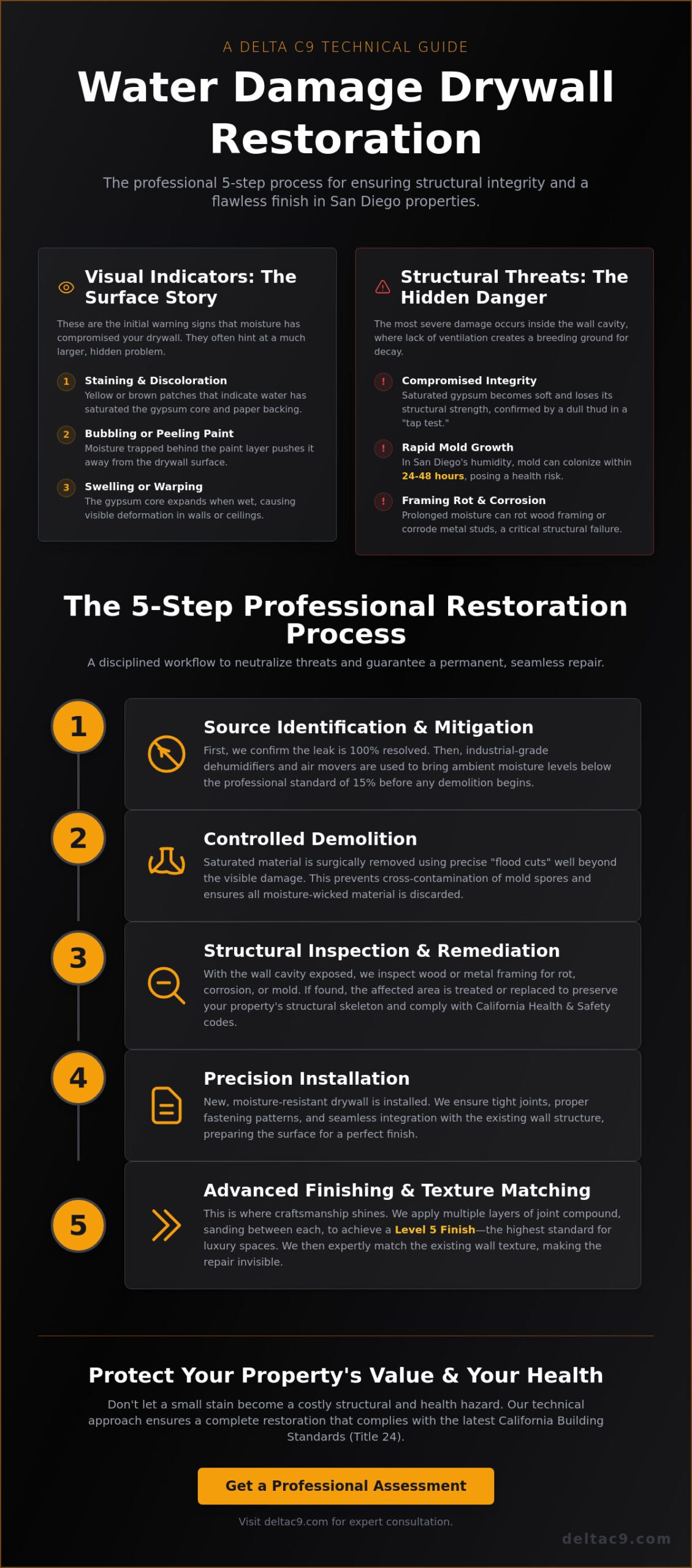
The 5-Step Professional Drywall Restoration Process
Restoration is a methodical sequence that prioritizes long-term stability over temporary aesthetics. When performing water damage drywall repair San Diego, a professional team doesn’t just patch a hole; they execute a structural reset. This process ensures that the underlying causes of decay are neutralized before any new finishes are applied. Following a disciplined workflow prevents the recurrence of mold and ensures the wall returns to its original load-bearing capacity.
- Step 1: Source Identification and Moisture Mitigation. We verify the leak is completely resolved. Whether the issue was a failed gasket or a pinhole copper leak, the “dry-out” phase uses industrial dehumidifiers to bring ambient moisture levels below 15% before proceeding.
- Step 2: Controlled Demolition. Saturated gypsum is removed using precision “flood cuts.” This prevents cross-contamination and ensures that only compromised materials are discarded, saving time and resources.
- Step 3: Structural Inspection. Once the wall cavity is exposed, we inspect the framing for rot or corrosion. This is the critical moment to verify the integrity of your property’s skeleton.
- Step 4: Precision Installation. We hang new, moisture-resistant drywall, ensuring tight joints and proper fastening to the framing.
- Step 5: Professional Finishing. The final phase involves multi-stage mudding, sanding, and texture matching to make the repair invisible.
Structural Integrity: Metal Framing and Insulation
During the inspection phase, the choice of framing material dictates the repair strategy. While wood framing is susceptible to rot and requires extensive drying, metal studs offer superior resistance to moisture and fire. If your San Diego property uses metal components, we check for rust and structural deflection. This is also an ideal time to upgrade your insulation. Replacing old fiberglass with modern mineral wool can improve your R-value and provide enhanced soundproofing. For a deeper look at these technical requirements, consult our Metal Framing and Drywall in San Diego: The Ultimate Contractor’s Guide.
Mitigation and Safety Standards
Safety is a non-negotiable component of our delivery. Before removing a single sheet of drywall, we establish containment zones using heavy-duty plastic sheeting and negative air pressure. This keeps dust and spores from migrating to unaffected areas of your home. We strictly adhere to EPA guidelines on mold remediation, utilizing HEPA air scrubbers throughout the demolition process. This rigorous approach ensures your indoor air quality remains protected. If you’re currently facing a moisture crisis, you can request a professional assessment to secure your property’s future.
Advanced Finishing: Erasing the Evidence of Water Damage
A successful water damage drywall repair San Diego project concludes with a finish that’s visually indistinguishable from the original wall. Many contractors treat finishing as a secondary concern, yet this phase determines your property’s aesthetic value. Achieving a seamless transition requires a deep understanding of light reflection and material absorption. Without precision, the repaired area will “flash” or show a different texture when viewed under the bright, natural light common in Southern California coastal homes. We focus on technical accuracy to ensure the repair doesn’t just fix the problem but enhances the room’s appearance.
We utilize advanced skim coating techniques to bridge the gap between old and new surfaces. This involves applying a thin, uniform layer of joint compound across the entire repair zone. It’s essential to use high-quality, stain-blocking primers before painting. Water damage often leaves behind mineral deposits that can bleed through standard latex paint. By sealing the surface, we ensure the repair remains permanent. As outlined in the EPA guide to mold and moisture, controlling the environment and ensuring materials are fully sealed is a critical part of long-term property health. This proactive approach prevents future staining and maintains the integrity of the finish.
The Level 5 Finish Explained
In the world of high-end construction, Level 5 is the gold standard. While a Level 4 finish is standard for most residential applications, it often leaves the subtle texture of the drywall paper visible. A Level 5 finish involves a final, thin skim coat over the entire wall. This creates a perfectly flat, monolithic surface that eliminates “joint banding.” This technique is mandatory for walls that’ll receive gloss or semi-gloss paint, or those exposed to critical lighting from large windows or recessed LEDs. It provides the smooth, museum-quality surface that San Diego’s luxury interiors demand.
Popcorn Ceiling Removal and Texture Updates
Water damage to a ceiling often provides an opportunity for modernization. Many older San Diego neighborhoods still feature acoustic “popcorn” textures that trap dust and date the interior. During the restoration process, we can remove these outdated textures and replace them with modern knockdown or smooth finishes. Matching the unique plaster styles of historic homes in areas like North Park or Mission Hills requires a specialized touch. If you’re comparing local specialists, our Choosing the Best Drywall Company in San Diego County: 2026 Professional Guide provides the criteria needed to select a team capable of this level of craftsmanship.
Mold Remediation: Protecting Your Health and Property
Mold isn’t just a surface stain; it’s a biological hazard that compromises the structural integrity of your property. In San Diego, the persistent marine layer provides the exact moisture levels required for fungal spores to thrive. Attempting water damage drywall repair San Diego without first addressing microbial growth is a recipe for failure. California Health and Safety Code Section 17920.3, which was updated on January 1, 2016, explicitly states that visible mold growth renders a dwelling a substandard condition. This means property owners have a legal and ethical obligation to remediate before they reconstruct.
Our white-glove approach involves more than just scrubbing surfaces. We utilize EPA-approved antimicrobial treatments to neutralize spores at the source. Once the area is cleaned, we apply encapsulation sealants to the remaining framing members. This creates a barrier that prevents dormant spores from reactivating if moisture levels rise again. This proactive protection is the only way to ensure the long-term safety of your building. If you’re concerned about the air quality in your building, you should schedule a mold remediation consultation today to secure your environment.
Signs of Hidden Mold Growth
Mold often hides where you least expect it. A persistent musty odor is often the only indicator of a colony growing behind a seemingly dry wall. Because drywall is porous, spores can easily migrate through wall cavities and into your HVAC system, spreading the contamination throughout the entire structure. While DIY kits are available at local hardware stores, they often provide false negatives. Professional moisture mapping and air quality testing provide the data needed to confirm your home is safe for occupancy. We use calibrated sensors to detect these hidden threats before they become a major liability.
Moisture-Resistant Solutions
Prevention is a core component of our restoration strategy. When we replace damaged sections, we don’t just use standard wallboard. In high-moisture environments like laundry rooms or kitchens, we recommend fiberglass-faced drywall, often referred to as Purple board. This material lacks the paper face that mold uses as a food source. For a full breakdown of material options, see our Ceiling and Drywall Solutions in San Diego: A Comprehensive Guide. Greenboard is essential in San Diego bathrooms because its wax-impregnated core provides a critical moisture barrier that prevents steam from penetrating the gypsum. Integrating these specialized materials during the repair phase ensures your property is better equipped to handle future moisture exposure.
Why Delta C9 is San Diego’s Premier Drywall Repair Partner
For over 22 years, Delta C9 has operated as a strategic protector for San Diego’s residential and commercial infrastructure. Our expertise spans from the technical nuances of metal framing to the delicate art of high-performance soundproofing. We don’t view water damage drywall repair San Diego as a simple cosmetic fix. Instead, we treat it as an engineering challenge that requires a full restoration of both form and function. Our “Move-In Ready” philosophy ensures that when our team leaves, your property is indistinguishable from its pre-damage state, both in structural integrity and aesthetic value.
Our long-standing presence in the region has given us a deep understanding of the specific challenges faced by local property owners. From the salt-laden air of La Jolla to the intense heat of Inland North County, we’ve seen how different microclimates affect material longevity. We don’t just patch walls; we provide a comprehensive interior solution. This includes everything from the initial moisture mitigation to the final application of a museum-quality Level 5 finish. By maintaining control over every phase of the project, we ensure that the security and stability of your building are never compromised.
Commercial and Residential Versatility
Delta C9 bridges the gap between large-scale industrial projects and high-end residential remodeling. We provide Commercial Construction Services for California Corporations in San Diego, handling complex tenant improvements with the same rigor we apply to a home repair. Our specialized metal framing expertise is a key differentiator. Metal framing provides a stable, rot-resistant skeleton that’s essential for long-term structural durability in San Diego’s coastal environment. By utilizing these materials, we significantly reduce the risk of future moisture-related failures and ensure your interior walls remain straight and secure for decades.
Our Peace-of-Mind Guarantee
Trust is earned through transparency and technical competence. San Diego property managers and homeowners rely on our deep knowledge of local building codes, including the 2025 California Building Standards Code (Title 24). We handle the complexities of code compliance so you don’t have to. Our commitment to your business continuity or household peace of mind is reflected in our disciplined project timelines and clear communication. We provide a precise roadmap from the initial moisture assessment to the final texture match. You can request a professional assessment for your water damage today to ensure your property remains a safe, high-value asset.
Securing Your Property’s Future with Technical Precision
True restoration requires a disciplined approach that extends far beyond a simple surface patch. By prioritizing rigorous moisture detection and adhering to California’s strict mold remediation standards, you eliminate the hidden risks that compromise indoor air quality and structural stability. A successful water damage drywall repair San Diego project isn’t complete until the framing is secure and the surface achieves a flawless Level 5 finish. These technical steps ensure your property retains its aesthetic value and provides a safe environment for all occupants.
Delta C9 brings over 22 years of local experience to every restoration project. As a fully licensed and insured California contractor, we specialize in the high-stakes integration of mold remediation and precision finishing. We understand the specific demands of the San Diego climate and the engineering required for long-term durability. Don’t let a minor leak evolve into a permanent structural liability. Restore your property with San Diego’s drywall experts; Contact Delta C9 today to begin your comprehensive restoration. Your property’s integrity is our primary focus, and we’re here to ensure your peace of mind.
Frequently Asked Questions
How long does it take for mold to grow on wet drywall in San Diego?
Mold growth typically begins within 24 to 48 hours after moisture exposure. In San Diego’s coastal environment, the persistent marine layer keeps humidity levels high, which can accelerate this biological process. Once spores find an organic food source like the paper backing of drywall, they colonize rapidly. This is why professional water damage drywall repair San Diego must include an immediate dry-out phase to prevent long-term health risks to your family or tenants.
Can I repair water-damaged drywall myself or should I hire a pro?
You can patch minor cosmetic dents, but water-damaged drywall often involves hidden structural and health risks. Professionals use moisture meters to detect water that isn’t visible to the naked eye. If the damage involves more than 25% of a load-bearing wall, the City of San Diego may require specific permits as of the March 2026 local amendments. Hiring a professional ensures the source of the leak is fully mitigated and all mold remediation follows EPA standards.
Does insurance typically cover water damage drywall repair in California?
Most standard California homeowner’s insurance policies cover sudden and accidental water damage, such as a burst pipe. However, they typically exclude damage caused by gradual leaks or lack of maintenance. You should document all damage with photos and videos immediately for your claim. Industry data shows that insurance claims are more likely to be approved when you have a professional assessment proving the damage was a sudden event rather than a long-term maintenance issue.
What is the average cost of drywall repair after a leak in San Diego?
The average cost for water damage drywall repair San Diego is approximately $500. Depending on the severity, costs typically range from $279 for minor patches to over $1,200 for larger structural projects. These figures reflect labor rates between $40 and $100 per hour as of May 2026. Major restoration involving mold remediation and structural framing can increase these costs significantly, often ranging from $7,000 to $15,000 for extensive damage requiring full wall replacement.
Do I need to replace the insulation if the drywall gets wet?
You should almost always replace fiberglass or cellulose insulation if it becomes saturated. These materials lose their R-value when wet and trap moisture against the framing, which creates a prime environment for mold growth. While some closed-cell spray foam insulation is water-resistant, traditional batts act as a sponge. Replacing insulation during the drywall repair process ensures your home remains energy efficient and prevents moisture from lingering inside the wall cavity where you can’t see it.
How can I tell if a leak is still active behind my drywall?
An active leak is best identified using a professional moisture meter or infrared camera. If you don’t have these tools, look for “weeping” paint or a stain that continues to expand over a 24-hour period. You can also check your water meter; if the dial moves while all faucets are off, you likely have a slab leak or pipe failure. Active moisture will often feel cool to the touch compared to the surrounding dry wall areas.
What is the difference between a patch and a full sheet replacement?
A patch is used for localized damage under 12 inches, while a full sheet replacement is necessary when the core of the gypsum is saturated or moldy. If more than 15% of a wall panel is soft, the structural integrity is gone. Full sheet replacement allows us to inspect the framing and insulation properly. This method ensures a flatter finish and prevents the cracking that often occurs with large, unsupported patches over time.
Can you match the existing ‘orange peel’ texture on my walls?
We can precisely match orange peel, knockdown, and smooth finishes using calibrated spray equipment and varied joint compound consistencies. Texture matching is a technical skill that involves adjusting the air pressure and nozzle size to mimic the original application. This process is essential for making the repair invisible under San Diego’s bright critical lighting. Our goal is a seamless transition that restores the wall to its original aesthetic value without any visible borders.