
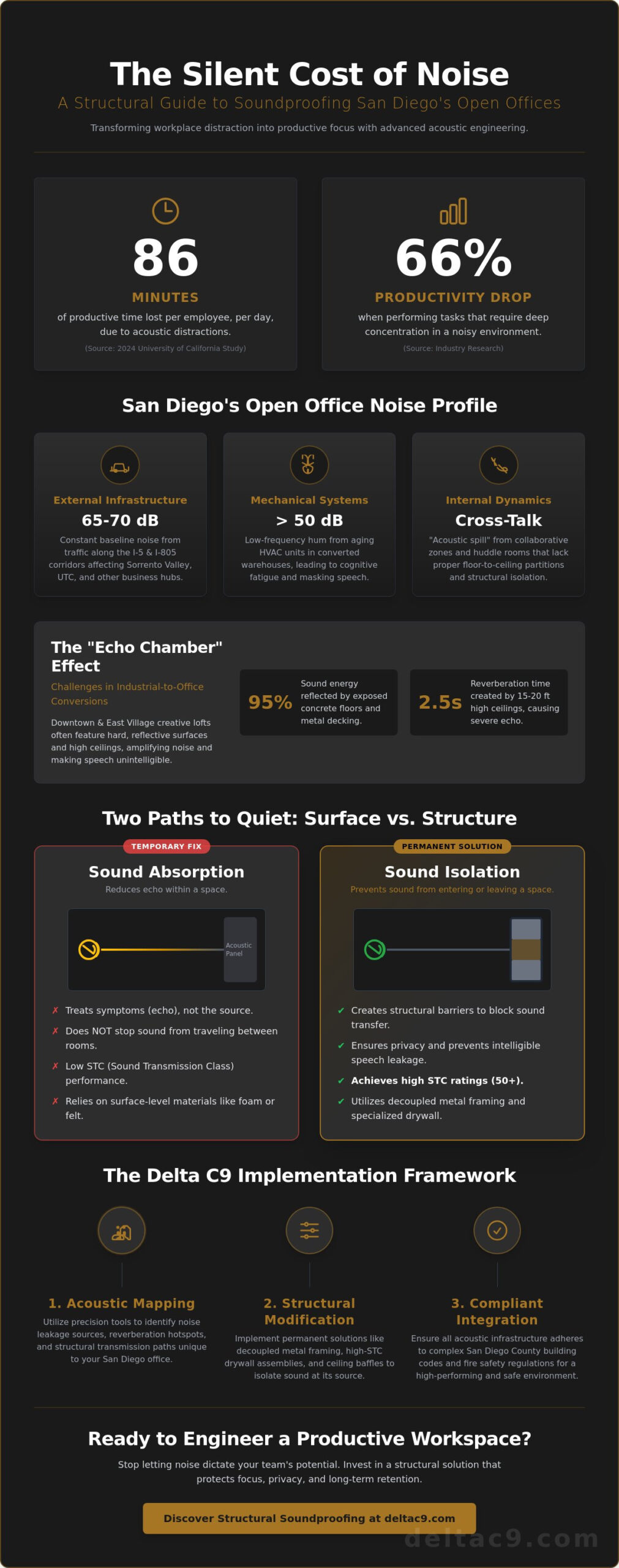
A 2024 study by the University of California found that office workers lose up to 86 minutes of productive time every day due to acoustic distractions. In the high-ceiling industrial conversions common across the Gaslamp Quarter and Sorrento Valley, sound energy bounces off hard surfaces, creating a constant layer of disruptive noise. Implementing effective soundproofing for open office plans San Diego is no longer a luxury; it’s a structural requirement for business continuity. You likely feel that the collaborative benefits of your open layout are being undermined by a lack of privacy and focus.
We understand that maintaining a professional environment requires more than just hanging a few acoustic panels. You need a space where sensitive client conversations remain confidential and where your team can focus without the interference of ambient echoes. This 2026 structural guide will show you how to transform your workplace into a quiet, focused sanctuary using advanced engineering techniques. We’ll explore high-performance ceiling baffles, sound-masking systems, and structural modifications that ensure your office remains a high-functioning asset for your organization.
Key Takeaways
- Understand why San Diego’s leading tech and biotech hubs are transitioning to structural acoustic solutions to protect employee focus and long-term retention.
- Learn to distinguish between temporary surface treatments and permanent structural modifications like decoupled metal framing for superior Sound Transmission Class (STC) performance.
- Discover how professional soundproofing for open office plans San Diego utilizes precision acoustic mapping to identify and eliminate noise leakage at the source.
- Explore a methodical implementation framework that ensures minimal operational disruption while upgrading your office’s structural insulation and framing.
- Navigate complex San Diego County building codes and fire safety regulations to ensure your acoustic infrastructure is both high-performing and fully compliant.
The Open Office Noise Crisis in San Diego Businesses
San Diego’s innovation hubs in Torrey Pines, UTC, and Sorrento Valley are undergoing a structural recalibration. While the open office was once hailed as the pinnacle of collaboration, 2026 data indicates a 30% increase in local firms retrofitting these spaces to combat “acoustic leakage.” For tech and biotech sectors, this isn’t merely a comfort issue; it’s a matter of operational security and employee retention. When sensitive data or proprietary research is discussed, a lack of privacy becomes a liability. Effective soundproofing for open office plans San Diego requires moving beyond aesthetic panels to address the structural integrity of the workspace.
Noise pollution in Southern California offices stems from three primary vectors:
- External Infrastructure: Traffic along the I-5 and I-805 corridors creates a consistent 65-70 decibel (dB) baseline in Sorrento Valley office parks.
- Mechanical Systems: Older HVAC units in converted warehouses often produce a low-frequency hum that exceeds 50 dB, masking human speech but increasing cognitive fatigue.
- Internal Dynamics: Cross-talk and “acoustic spill” from huddle rooms that lack floor-to-ceiling partitions.
To solve these issues, we must distinguish between sound absorption and sound isolation. Sound absorption uses soft materials to reduce echoes within a room, whereas sound isolation involves structural barriers that prevent sound from traveling between spaces. Understanding the science of architectural acoustics is essential for any business owner looking to maintain a professional environment where confidential conversations stay private and focus remains sharp.
The Productivity Tax of the “Modern” Office
In high-stress San Diego industries, noise pollution acts as a hidden tax on cognitive resources. Research shows that office noise can reduce worker productivity by 66% when tasks require deep concentration. This has led many firms to adopt Activity-Based Working (ABW), a model that provides zones for different tasks. For an environment to support deep work, the ambient noise level shouldn’t exceed a threshold of 48 dB, a standard that most “pure” open offices fail to meet without intervention. Managing this threshold ensures your team stays in a state of flow, protecting the business’s output and employee well-being.
Acoustic Challenges in Industrial-to-Office Conversions
Downtown San Diego and the East Village are home to numerous “creative lofts” that were originally industrial warehouses. These spaces typically feature exposed concrete floors and metal decking, materials that reflect up to 95% of sound energy. High ceilings, often reaching 15 to 20 feet, amplify this effect, creating a 2.5-second reverberation time that makes speech unintelligible. One case study of a Downtown SD creative agency revealed that without structural soundproofing, the “echo chamber” effect was so severe that employees had to wear noise-canceling headphones for 80% of their workday. Proper soundproofing for open office plans San Diego in these buildings requires targeted structural interventions to break the path of sound and dampen the natural resonance of the building’s shell.
Structural Solutions: Beyond the Acoustic Panel
Effective soundproofing for open office plans in San Diego begins with the skeleton of the building. While surface level treatments like felt clouds or foam panels help with echo, they don’t stop sound from traveling between rooms. To achieve true privacy, we focus on the Sound Transmission Class (STC) rating. This numerical value represents how many decibels a wall assembly stops. For a standard 2026 commercial partition, an STC rating of 50 is the baseline for preventing intelligible speech from leaking into adjacent spaces.
The foundation of a high STC rating lies in decoupling. Metal framing serves as a critical component here because light-gauge steel studs are more flexible than traditional wood. This flexibility allows the wall to absorb sound energy rather than passing it through the structure. When we integrate professional metal framing and drywall, we create a system that acts as a shock absorber for acoustic vibrations. Relying on the WBDG acoustic comfort guidelines ensures these structural choices meet rigorous performance standards for modern workspaces.
High-STC Drywall and Framing Techniques
Standard 5/8-inch gypsum board is often insufficient for high-traffic San Diego offices. We recommend sound-dampened gypsum board, which incorporates a viscoelastic polymer layer to dissipate sound waves. To push performance further, we utilize staggered-stud or double-stud framing. These methods ensure that the drywall on one side of the wall isn’t physically connected to the same studs as the other side, breaking the direct path for vibration. A Level 5 finish is also vital; this premium level of finishing involves a skim coat that seals microscopic pores and gaps, ensuring the acoustic integrity of the partition remains intact.
Commercial Insulation and Sound Batts
Insulation is the hidden engine of soundproofing for open office plans in San Diego. While fiberglass is a common choice, mineral wool is the superior option for acoustic isolation. Mineral wool has a density of approximately 2.5 to 3 pounds per cubic foot, which is significantly higher than standard fiberglass. This mass is essential for stopping low-frequency noise from mechanical systems or heavy foot traffic.
- Mineral Wool: High density for maximum sound absorption and fire resistance.
- Fiberglass: Cost-effective for basic thermal needs but less effective for dB reduction.
- Flanking Paths: We seal wall-to-ceiling junctions with acoustic sealant to prevent sound from “leaking” over the top of the wall.
The NRC (Noise Reduction Coefficient) rating measures how much sound a material absorbs on a scale from 0 to 1, where a 1.0 rating indicates 100% sound absorption. Choosing materials with high NRC ratings for the interior cavity of your walls ensures that sound energy is trapped rather than reflected. If you’re looking to optimize your workspace for 2026, you can consult with our infrastructure experts to design a partition system that guarantees long-term operational quiet.
Comparing Open Office Soundproofing Strategies
Selecting the right method for soundproofing for open office plans San Diego requires a clear distinction between sound absorption and sound isolation. Surface treatments, such as acoustic clouds or wall-mounted felt panels, focus on Noise Reduction Coefficient (NRC) to minimize echo within a space. While these are effective for reducing “chatter,” they don’t prevent noise from traveling between rooms. Structural modifications, including high-STC (Sound Transmission Class) partitions and reinforced floor-to-ceiling barriers, provide the necessary isolation for confidential meetings and deep focus work.
The cost-benefit analysis for 2026 favors permanent structural Tenant Improvements (TI) over temporary fixes. A 2025 workplace productivity study found that employees in acoustically optimized environments show a 23% increase in cognitive performance compared to those in standard open layouts. For San Diego property managers in hubs like Sorrento Valley and Downtown, structural soundproofing increases the long-term asset value. Temporary solutions often require frequent replacement and don’t offer the same level of speech privacy that modern labor markets demand.
Structural TI ensures business continuity by creating a controlled environment. This approach reduces the risk of information leakage and minimizes the daily distractions that lead to employee burnout. Investing in permanent infrastructure is a proactive strategy to stabilize workforce retention in a competitive economy.
The “Zoning” Strategy for Open Plans
Effective zoning transforms a chaotic floor plan into a series of functional “Quiet Zones” and “Active Zones.” We achieve this by installing high-STC glass partitions and metal-framed walls that reach the structural slab. These partitions typically require an STC rating of 45 or higher to effectively block human speech. Huddle rooms are the cornerstone of this strategy. They utilize ceiling and drywall synergy to ensure that private conversations remain private. Strategic placement of phone booths and focus pods provides employees with immediate access to silence without disrupting the collaborative flow of the main office. This logical layout provides the stability and control necessary for high-stakes business operations.
Suspended Ceilings and Acoustic Clouds
The overhead environment is often the primary source of noise complaints. HVAC hum and mechanical vibrations can create a constant baseline of stress for employees. Suspended ceilings, or drop ceilings, address this by creating a plenum space that traps mechanical noise. San Diego office managers favor acoustic tiles because they allow for easy utility access, which is critical for IT infrastructure and cabling maintenance. By combining these structural elements with aesthetic acoustic clouds, firms can achieve a balanced soundscape. This dual approach manages overhead noise while maintaining the architectural appeal of the 2026 modern workspace. It’s a calculated investment in both efficiency and employee well-being.
Implementation: The Delta C9 Soundproofing Process
Effective soundproofing for open office plans San Diego requires a transition from general noise reduction to precision structural engineering. We don’t guess where sound travels; we map it. Our process begins with a comprehensive site assessment that treats your office as a unified acoustic ecosystem. By identifying specific failure points in the existing structure, we develop a custom framing and insulation plan designed to raise your Sound Transmission Class (STC) ratings without halting your daily operations. This engineering-first approach ensures that the final result provides the stability and focus your team requires.
The Site Audit: Identifying Acoustic Leaks
Acoustic leaks are often found in the most overlooked areas. Our technicians use high-precision frequency analyzers to detect sound flanking through electrical outlets, ductwork, and gaps in door seals. Even a 1% gap in a wall’s surface can reduce its acoustic effectiveness by 50%. During this phase, we collaborate with a professional drywall company to verify that the underlying structural integrity supports high-density acoustic materials. This technical audit ensures that every dollar spent on insulation translates into measurable decibel reduction. We focus on three critical areas during the audit:
- Structural Penetrations: Checking where cables and pipes breach acoustic barriers.
- Seal Integrity: Evaluating the compression of door gaskets and automatic drop seals.
- Frequency Mapping: Identifying if the noise is low-frequency mechanical hum or high-frequency speech.
Clean Construction and Remediation
Modifying an active office environment demands a “Zero-Dust” approach to protect sensitive IT infrastructure and employee health. We utilize HEPA-filtered extraction systems that capture 99.97% of airborne particles during the soundproofing process. This stage often reveals hidden issues, such as degraded 1990s-era fiberglass insulation or moisture-related mold growth within wall cavities. Delta C9 remediates these hazards immediately, replacing them with modern, fire-rated acoustic mineral wool. Our phased construction schedule allows your team to remain productive while we isolate and upgrade specific zones of the office. We maintain a controlled environment to ensure your business continuity remains undisturbed throughout the remodel.
Once the structural work is complete, we perform secondary frequency testing to verify the results. We calibrate the environment to ensure the final STC targets meet the 2026 industry standards for speech privacy. This data-driven verification provides the peace of mind that your investment has successfully mitigated the acoustic challenges of your workspace. By following a structured, phased implementation, we deliver a soundproofing for open office plans San Diego solution that is both scientifically valid and minimally invasive.
San Diego Compliance and Local Considerations
Implementing effective soundproofing for open office plans San Diego requires more than just high quality materials. It demands strict adherence to the San Diego Municipal Code Chapter 14, which governs commercial tenant improvements (TI). All acoustic installations must comply with the California Fire Code, specifically regarding the use of Class A fire-rated materials. These materials must maintain a flame spread index of 0 to 25 and a smoke-developed index of 0 to 450 according to ASTM E84 standards. Delta C9 ensures that every metal framing and drywall assembly meets these safety benchmarks to protect your assets and personnel.
The permitting process in San Diego County can be complex for large scale acoustic retrofits. Delta C9 manages the technical documentation and submission requirements for cal corporation office upgrades, ensuring that structural changes align with local zoning laws. We focus on minimizing downtime. Our team coordinates with city inspectors to verify that acoustic baffles, heavy duty insulation, and specialized drywall configurations meet all seismic and fire safety requirements before the final walkthrough.
Local Regulations for Office Remodeling
California Title 24 Part 11, also known as CALGreen, sets the standard for environmental and acoustic quality in commercial spaces. In San Diego, new office developments and major renovations often target LEED v4.1 or WELL Building Standard certifications. These frameworks require specific decibel (dB) reduction targets and reverberation time limits. We help you meet these goals by integrating sound dampening technology that satisfies both state energy codes and local business park management requirements. Whether your office is located in Sorrento Valley or a high rise in Downtown, we coordinate with HOAs and property managers to ensure work hours and material deliveries comply with building specific bylaws.
Why Delta C9 for San Diego Soundproofing?
With 22+ years of experience in framing and drywall, Delta C9 acts as a strategic protector of your office environment. We don’t just install walls; we engineer acoustic barriers that ensure business continuity and employee focus. Our approach combines technical precision with a deep understanding of how sound travels through San Diego’s unique commercial architectures. We take responsibility for the entire structural process, from the first permit application to the final acoustic test. This proactive management style keeps your project on schedule and prevents costly compliance errors. Your peace of mind is our primary metric for success.
Ready to transform your workspace into a high performance environment? Take the first step toward a quieter, more productive office today.
Future-Proof Your San Diego Workspace for 2026
Achieving a productive work environment requires moving beyond surface-level acoustic panels to address the structural root of noise transfer. By 2026, standard office designs must evolve to incorporate high-STC metal framing and specialized drywall layers that provide measurable decibel reduction. Implementing professional soundproofing for open office plans San Diego companies need ensures your facility remains compliant with local building codes while protecting staff from the cognitive load of ambient distractions. Delta C9 leverages over 22 years of San Diego construction expertise to deliver these results. We’re licensed, bonded, and insured for commercial Tenant Improvements, specializing in the high-STC assemblies that traditional contractors often overlook. Your office’s structural integrity is the primary defense against the noise crisis. It’s time to transition from temporary fixes to permanent, engineering-backed solutions that prioritize your team’s focus. Request Your Professional Acoustic Audit from Delta C9 to secure your operational stability. We look forward to helping you build a quieter, more efficient future.
Frequently Asked Questions
How much does it cost to soundproof an open office in San Diego?
Commercial acoustic upgrades typically range between $15 and $60 per square foot based on 2024 industry benchmarks. The final price depends on whether you’re installing surface panels or modifying internal wall structures. We focus on providing a clear ROI by reducing distractions and increasing employee focus. Every project starts with a technical assessment to ensure we address your specific noise challenges effectively.
Can I soundproof my office without tearing down existing walls?
You can improve your office’s acoustics without removing any existing walls. Adding 1/8 inch mass-loaded vinyl or acoustic clouds provides a measurable reduction in ambient noise. Installing 5/8 inch drywall over your current walls with a damping compound can increase sound isolation by 40%. These non-invasive methods are ideal for soundproofing for open office plans San Diego when you need results without a full renovation.
What is the difference between soundproofing and acoustic treatment?
Soundproofing stops noise from traveling between rooms, while acoustic treatment controls sound within a single space. Soundproofing uses heavy materials like lead-lined drywall to block vibrations. Acoustic treatment uses porous materials to soak up echoes and improve speech clarity. Most San Diego offices require a combination of both to achieve a 0.75 Noise Reduction Coefficient (NRC) rating for optimal performance.
How long does a typical commercial soundproofing project take?
Most commercial projects finish within 5 to 10 business days for a standard 3,000 square foot space. We plan each stage of the installation to prevent bottlenecks and ensure a predictable timeline. Our technical team follows a structured workflow that prioritizes your project’s security and efficiency. This disciplined approach means you’ll have a quieter, more productive office without long periods of construction chaos.
Do I need a permit for office soundproofing in San Diego County?
You won’t need a permit for hanging acoustic panels, but structural changes require approval from the City of San Diego Development Services. According to the San Diego Municipal Code, any modification to fire-rated assemblies or load-bearing walls needs a building permit. We manage the technical documentation to ensure your office stays compliant with the latest 2026 safety standards. This keeps your project legal and secure.
Will soundproofing also help with office temperature and energy bills?
Soundproofing materials like mineral wool have an R-value of 3.8 to 4.3 per inch, which significantly boosts your building’s thermal efficiency. By sealing air gaps to block noise, you also prevent conditioned air from escaping. Industry data indicates that high-performance acoustic insulation can lower monthly cooling costs by 12% in the San Diego climate. It’s a strategic investment that improves both worker comfort and your bottom line.
Is metal framing better than wood for office soundproofing?
Metal framing is the better choice for soundproofing for open office plans San Diego because steel studs are more flexible than wood. This flexibility prevents sound waves from traveling easily through the wall’s skeleton. Using 25-gauge steel studs can increase the Sound Transmission Class (STC) rating by 4 points over traditional timber. We recommend metal for commercial environments where fire safety and acoustic precision are the top priorities.
Can Delta C9 work after hours to avoid office disruption?
We provide after-hours and weekend installation services to ensure your business operations remain completely undisturbed. Our team works according to a strict schedule that aligns with your security protocols and operational needs. We treat your office as a critical environment, maintaining a clean and organized site throughout the process. This proactive approach allows you to focus on your core business while we handle the technical infrastructure.