
The “soundproof” paint you found online won’t stop the sound of your neighbor’s television, no matter how many layers you apply. True acoustic privacy requires a strategic approach to mass, damping, and structural decoupling. If you’re struggling with distracting noise in a high-density condo or a lack of privacy in an open-plan office, you aren’t alone. Achieving effective sound insulation for interior walls San Diego requires moving beyond superficial fixes to meet the rigorous STC 50 standards mandated by the 2025 California Building Standards Code.
We understand that navigating conflicting advice is frustrating, especially with new local amendments like Ordinance O-22080 N.S. becoming effective on April 22, 2026. This guide simplifies the process by providing a clear, engineer-approved material list and explaining the structural changes needed to guarantee results. You’ll learn how to maximize your acoustic performance without sacrificing valuable square footage. We’ll cover everything from resilient channels to the latest mass-loaded vinyl applications, ensuring your San Diego property remains a sanctuary of quiet and professional focus.
Key Takeaways
- Learn the technical distinction between sound absorption and noise transmission to ensure your project blocks sound rather than just softening echoes.
- Identify the density requirements for high-performance materials like mineral wool and specialized drywall to outperform standard construction methods.
- Master the structural decoupling techniques essential for effective sound insulation for interior walls San Diego, including the use of resilient channels and metal framing.
- Align your property with the 2025 California Building Standards Code and local San Diego noise ordinances to guarantee long-term compliance and privacy.
- Understand the precision required for acoustic success, where a 1% gap in your wall assembly can lead to a 50% loss in total sound protection.
What is Sound Insulation for Interior Walls?
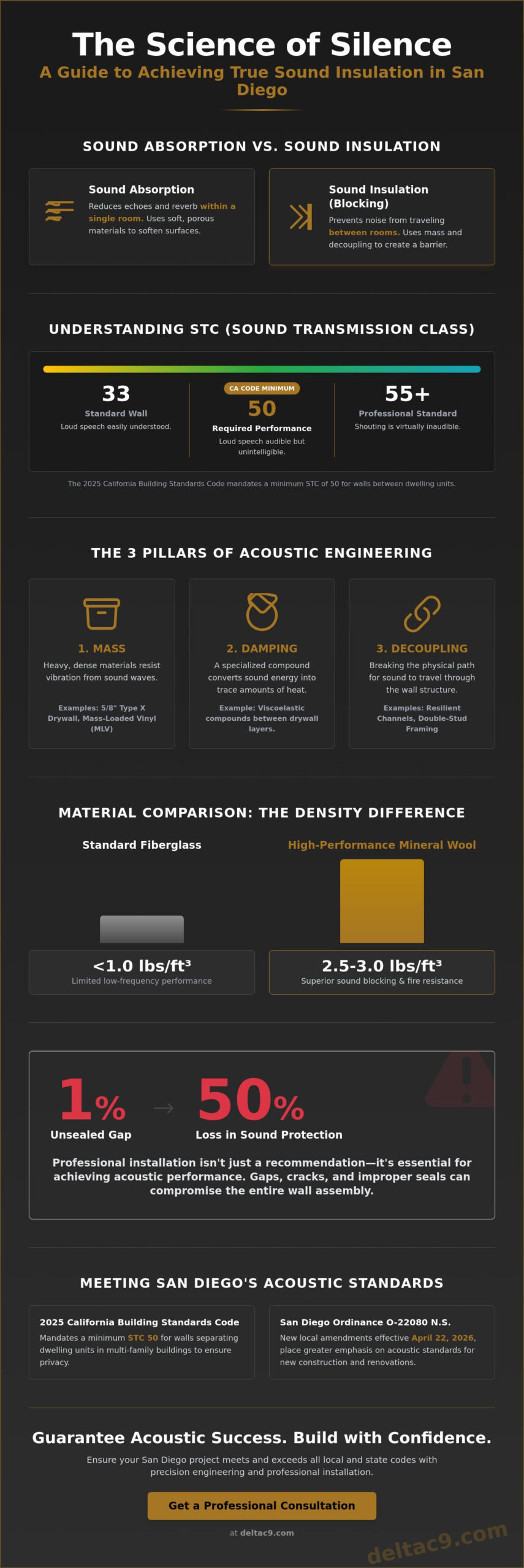
Sound insulation is the engineering practice of creating a barrier that prevents noise from traveling from one room to another. Many property owners confuse this with sound absorption. While absorption uses soft materials to reduce echoes within a single room, insulation focuses on blocking transmission through the wall assembly itself. Understanding What is Sound Insulation? is the first step toward achieving a truly private environment. In a high-density environment, sound insulation for interior walls San Diego has become a structural necessity. As of April 22, 2026, new local amendments to the building code, including Ordinance O-22080 N.S., have placed even greater emphasis on these standards. Whether you are managing a biotech lab in Sorrento Valley or a condo in Little Italy, these regulations ensure your space remains functional and protected.
To achieve professional results, we rely on the three pillars of acoustic engineering: mass, damping, and decoupling. Mass involves using heavy, dense materials like 5/8-inch Type X drywall or mass-loaded vinyl (MLV) to make it harder for sound waves to vibrate the surface. Damping uses specialized compounds to convert sound energy into heat before it can pass through the assembly. Decoupling is often the most critical step; it involves breaking the physical connection between the two sides of a wall to stop vibrations from passing through the studs. This “room-within-a-room” logic is what separates professional construction from DIY attempts that often fail to meet expectations. Using a combination of these strategies ensures your project remains a secure and quiet environment.
Understanding Sound Transmission Class (STC)
The Sound Transmission Class (STC) is a single-number rating used to measure how effectively a wall assembly attenuates airborne sound. A standard interior wall with 1/2-inch drywall on both sides typically offers an STC of 33, where loud speech is easily understood. By contrast, an STC of 55 ensures shouting is virtually inaudible. The 2025 California Building Standards Code requires a minimum STC of 50 for walls separating dwelling units in multi-family buildings. This rating isn’t just a suggestion; it’s a benchmark for the stability and privacy of your living or working space.
Airborne vs. Impact Noise
Noise is categorized by how it travels through a building. Airborne noise consists of sound waves traveling through the air until they hit a solid barrier. This includes music, office chatter, or a television. Impact noise results from physical contact with the structure, like footsteps or a door slamming. While interior walls primarily address airborne sounds, structural decoupling is required to stop vibrations from radiating through the framing. Professional installation ensures that both types of noise are controlled, protecting the business continuity of a busy office or the tranquility of a home.
Comparing High-Performance Soundproofing Materials
Standard fiberglass batts are often the default choice in local construction, but they offer limited protection against low-frequency sound. For superior sound insulation for interior walls San Diego, we recommend mineral wool, such as Rockwool. Mineral wool is significantly denser than fiberglass; it typically weighs 2.5 to 3 pounds per cubic foot, while standard fiberglass weighs less than 1 pound. This increased density allows mineral wool to trap sound waves more effectively, particularly the deep, vibrating frequencies from home theaters or mechanical equipment.
In commercial San Diego interiors, mineral wool provides an additional layer of security due to its high fire-resistance rating. It can withstand temperatures exceeding 2,000°F, which is a critical consideration for meeting local safety codes while simultaneously achieving acoustic goals. While the material cost is higher than fiberglass, the performance-to-cost ratio makes it the most logical choice for high-traffic residential areas where privacy is a priority. For those looking to upgrade their current infrastructure, choosing the best drywall company in San Diego County is the first step toward a successful installation.
The Power of Damping Compounds
Damping compounds work through a process called viscoelastic damping. These specialized materials never fully harden; instead, they remain flexible between layers of drywall. When sound waves hit the wall, the compound converts that vibrational energy into microscopic amounts of heat, effectively neutralizing the noise before it passes through the assembly. This technology is a cornerstone of modern acoustic engineering, providing a level of control that traditional materials cannot match.
The most effective application is the “Sandwich Method.” By applying a damping compound between two layers of 5/8-inch Type X drywall, you create a high-mass, high-damping barrier that rivals the performance of much thicker walls. This approach aligns with the WELL Building Standard for acoustics, which sets rigorous STC benchmarks for maintaining focus and comfort in professional environments. Our team utilizes these methods to ensure your office or home meets the highest standards of noise attenuation.
Specialized Drywall and Acoustic Sealants
For projects where square footage is at a premium, specialized products like QuietRock offer the same STC rating as multiple layers of standard drywall in a single 5/8-inch sheet. However, the most advanced materials will fail if the assembly isn’t airtight. Acoustic sealant is a non-hardening caulk used to seal the gaps around electrical outlets, baseboards, and wall perimeters. Without this precision sealing, sound will find the path of least resistance, bypassing your high-performance materials entirely. Our commitment to precision ensures that every penetration is sealed, protecting your business continuity and personal peace.
Structural Strategies: Decoupling and Metal Framing
Decoupling is the most sophisticated method for achieving sound insulation for interior walls San Diego. It involves breaking the direct mechanical connection between the two sides of a wall assembly. Sound travels through physical vibrations; if the drywall on one side is physically connected to the same stud as the opposite side, the vibration passes through the structure with ease. By using Resilient Channels (RC-1) or Sound Isolation Clips (RSIC-1), we create a physical break that stops this energy transfer. These components act as high-performance shock absorbers, effectively isolating noise between rooms. This strategy is essential in high-density San Diego neighborhoods like Little Italy or Downtown, where shared walls are a standard feature of residential life.
Some property owners worry that a decoupled wall assembly will feel flimsy or unstable. This is a misconception. Professional installation ensures the wall remains structurally sound and rigid to the touch while maintaining its acoustic flexibility. We use high-quality metal framing and precise spacing to ensure the assembly meets all California safety requirements without compromising on performance. The result is a solid partition that provides the silence of a much thicker structure. Our team ensures that every clip and channel is placed with engineering precision to maintain the stability of your home or office environment.
Metal Studs vs. Wood Studs for Acoustics
Metal studs are the preferred choice for commercial and high-end residential sound insulation for interior walls San Diego. Unlike rigid wood studs, metal framing is inherently more flexible. This flexibility helps dissipate sound energy rather than conducting it through the wall. For projects requiring the highest STC ratings, such as recording studios or executive boardrooms in Sorrento Valley, we often implement staggered stud or double stud configurations. These designs physically separate the framing for each side of the wall, providing the ultimate level of isolation. You can read more about these advanced techniques in our Metal Framing and Drywall in San Diego guide.
The Role of Suspended Ceilings in Wall Performance
Even the most advanced wall assembly will fail if sound can bypass it through flanking paths. In many San Diego office environments, sound travels over the top of the wall through the ceiling plenum. To prevent this, we recommend extending walls all the way to the structural deck above or installing specialized plenum barriers. Coordinating your wall construction with Ceiling and Drywall Solutions in San Diego ensures a completely sealed acoustic environment. This holistic approach protects your privacy and ensures your investment delivers the expected results, especially in sensitive environments like biotech labs or law firms where confidentiality is paramount.
San Diego Specific Applications: Residential and Commercial
San Diego’s urban density requires a specialized approach to acoustic engineering. Residents in high-rise developments in Downtown and Little Italy face constant exposure to shared-wall noise. Effective sound insulation for interior walls San Diego must account for both high-decibel neighbors and the city’s unique coastal climate. High humidity levels in neighborhoods like Pacific Beach or La Jolla can lead to moisture buildup within wall cavities. We utilize mold-resistant soundboards and moisture-tolerant sealants to ensure your acoustic investment remains durable and safe. Professional installation guarantees that your project meets the strict requirements of local HOAs or commercial property managers.
Condo and Multi-Family Soundproofing
Many condo owners complain about neighbor televisions or the sound of water rushing through plumbing. Retrofitting provides a cost-effective solution for these common issues. By adding a second layer of drywall with a viscoelastic damping compound, we can significantly improve STC ratings without a full demolition. This method is ideal for meeting San Diego HOA regulations. It minimizes construction debris and noise while delivering immediate results. We manage the technical documentation required by your board to ensure your project stays on schedule and in compliance with all community standards.
Office and Industrial Acoustic Privacy
The tech and biotech hubs in Sorrento Valley and UTC have unique privacy needs. Medical offices must maintain HIPAA compliance, which requires wall assemblies that prevent confidential conversations from being overheard. Industrial-style offices with exposed structures often lack the mass needed for privacy. We create specialized “Zoom rooms” and conference spaces that combine high-performance drywall with precision framing. Our team understands that acoustic leaks can compromise your business security. For companies looking to scale their infrastructure, our Commercial Construction Services in San Diego provide the technical foundation needed for secure and quiet operations. We ensure every partition is built to handle the rigorous demands of a modern workspace.
Whether you are upgrading a private residence or a commercial facility, the goal is the same: stability and control over your environment. We take responsibility for the technical details so you can focus on your work or enjoy your home in peace. Our strategic approach to sound insulation protects your privacy and enhances your property value.
Why Professional Installation is Vital for Acoustic Success
Sound behaves much like water. Just as a small hole in a bucket renders the entire vessel useless, a tiny gap in an acoustic barrier can compromise the entire project. In technical terms, we refer to this as the “1% Rule.” A 1% gap in a wall assembly can let 50% of the sound through. This is why professional installation is the only way to guarantee the performance of sound insulation for interior walls San Diego. Precision sealing around electrical outlets, light switches, and HVAC ductwork is where most DIY projects fail. Without professional-grade acoustic caulk and putty pads, these penetrations become sound leaks that bypass even the most expensive materials.
Delta C9 brings over 22 years of specialized experience to the San Diego interior construction market. We’ve seen property owners spend thousands on high-performance materials only to achieve mediocre results because of poor execution. Our role is to act as your strategic protector; we ensure that every layer of your wall assembly performs at its theoretical maximum. We take responsibility for the technical integrity of the barrier. This allows you to enjoy the tranquility and business continuity you expect from a high-end renovation or commercial build-out.
The Delta C9 Process
Our approach begins with a comprehensive site assessment. We identify flanking paths, such as shared floor joists or ceiling plenums, that often go unnoticed by less experienced contractors. Next, we tailor the material selection to your specific STC goals and budget constraints. We don’t believe in one-size-fits-all solutions. Finally, our team executes the plan with engineering precision. This includes expert metal framing, the meticulous installation of high-density insulation, and a Level 5 drywall finish that ensures your walls are as beautiful as they are quiet. This disciplined rhythm of work ensures that your sound insulation for interior walls San Diego meets every performance benchmark.
Get Your San Diego Acoustic Consultation
Achieving true acoustic privacy shouldn’t be a matter of guesswork. It requires a partner who understands the physics of sound and the realities of San Diego building codes. When you choose professional installation, you’re investing in long-term stability and peace of mind. Your interior will be move-in ready, meet all legal requirements, and provide a secure environment for your family or your professional team. Contact Delta C9 for a Sound Insulation Quote today to start your professional evaluation and secure the quiet environment you deserve.
Secure Your Acoustic Privacy Today
Achieving true acoustic privacy is a matter of structural engineering rather than quick fixes. You now understand that effective sound insulation for interior walls San Diego relies on the three pillars of mass, damping, and decoupling. By prioritizing high-density materials like mineral wool and utilizing metal framing for superior flexibility, you can create a space that meets the STC 50 standards of the 2025 California Building Standards Code. Precision is the final requirement, as even a minor gap can compromise your entire investment.
Delta C9 provides the technical expertise needed to execute these complex assemblies. With 22+ years of San Diego construction experience, we specialize in the precision required for acoustic drywall and metal framing. As a fully licensed and insured California contractor, we take responsibility for the integrity of your interior environment. We ensure that your business continuity or residential tranquility is never compromised by sound leaks or structural weaknesses. Our team is ready to provide the stability and control your property requires.
Take the first step toward a quieter, more productive space. Request a Soundproofing Estimate from Delta C9 to secure your professional consultation. We look forward to helping you reclaim the peace and privacy of your San Diego property with solutions built to last.
Frequently Asked Questions
How much does it cost to soundproof an interior wall in San Diego?
Professional soundproofing installation costs in San Diego depend on the specific structural strategy you select. As of April 30, 2026, a single wall rebuild utilizing resilient channels and double drywall typically ranges from $2,999 to $5,999. If your project requires mass-loaded vinyl (MLV) for a shared wall, costs generally fall between $1,499 and $3,999. These figures reflect the specialized labor and high-performance materials necessary to meet modern acoustic standards.
Can I soundproof an existing wall without removing the drywall?
You can improve sound insulation for interior walls San Diego without a full demolition by using a retrofit strategy. We often employ the “Sandwich Method,” which involves applying a viscoelastic damping compound directly to the existing surface followed by a second layer of 5/8-inch Type X drywall. This approach adds the necessary mass and damping to block noise without the debris and downtime associated with tearing down your original wall structure.
What is the difference between soundproofing and sound-absorbing panels?
Soundproofing is a structural solution designed to block noise from traveling between rooms, while sound-absorbing panels only reduce echoes within a single space. Think of soundproofing as a solid barrier and absorption as a sponge. To achieve true privacy and professional focus, you must focus on structural insulation and decoupling rather than relying on surface-level foam or fabric panels that do not stop transmission.
Does soundproof paint actually work for interior walls?
Soundproof paint lacks the mass and damping properties required to block significant noise transmission. While these products might slightly reduce high-frequency reflections inside a room, they cannot stop the sound of speech or low-frequency vibrations from passing through a wall. Professional acoustic engineering relies on structural density and damping compounds to ensure your privacy and business continuity rather than thin, ineffective coatings.
What is the best insulation for blocking noise between rooms?
Mineral wool is the gold standard for sound insulation for interior walls San Diego due to its high density. It typically weighs 2.5 to 3 pounds per cubic foot, which is nearly triple the density of standard fiberglass batts. This increased mass allows mineral wool to trap sound waves more effectively across a wider frequency range, providing the stability and silence required for both residential and commercial applications.
Will adding sound insulation help with my San Diego home’s energy efficiency?
Adding sound insulation provides the secondary benefit of increasing your property’s thermal resistance. Materials like mineral wool offer an R-value of approximately 3.0 to 3.3 per inch, which helps maintain a consistent interior temperature. This reduces the load on your HVAC system and contributes to better energy efficiency, ensuring your home or office remains comfortable while lowering your long-term utility costs.
How long does the installation process typically take for a standard room?
A standard soundproofing project for a single room usually takes 2 to 4 days to complete. This timeline accounts for the precision required in framing, insulation placement, and drywall installation. Complex projects that involve specialized decoupling clips or multiple layers of damping compounds may require additional time to ensure all sealants cure properly before we apply the final Level 5 drywall finish.