
A single hairline crack in your living room isn’t just a cosmetic nuisance; in San Diego’s active seismic zones, it’s a measurable failure in your property’s structural skin. You’ve likely spent years curating a space that feels both secure and sophisticated, yet coastal humidity levels often reach 70% in neighborhoods like La Jolla, creating a quiet breeding ground for mold behind your paint. Professional drywall work must do more than look smooth. It needs to act as a resilient shield against the unique environmental stressors of Southern California.
We’ll help you master the technical standards required to ensure your San Diego property remains structurally sound and aesthetically flawless through the 2026 building cycle. This reference guide details the transition from standard Level 4 finishing to high-performance moisture resistance and strict California building code compliance. You’ll gain a clear roadmap for selecting materials and contractors that prioritize long-term stability and precise texture matching over quick, superficial fixes.
Key Takeaways
- Understand why professional drywall work is a critical structural element in modern architecture rather than just a cosmetic finish.
- Learn to select the specific gypsum board types designed to withstand San Diego’s diverse micro-climates and coastal humidity.
- Master the technical Gypsum Association finishing standards to ensure your surfaces meet the precise aesthetic requirements of your property.
- Discover how to proactively prevent common Southern California issues such as seismic cracking and environmental drying delays.
- Identify the strategic advantages of integrating framing and finishing processes to ensure seamless project continuity and long-term stability.
Understanding Professional Drywall Work in San Diego County
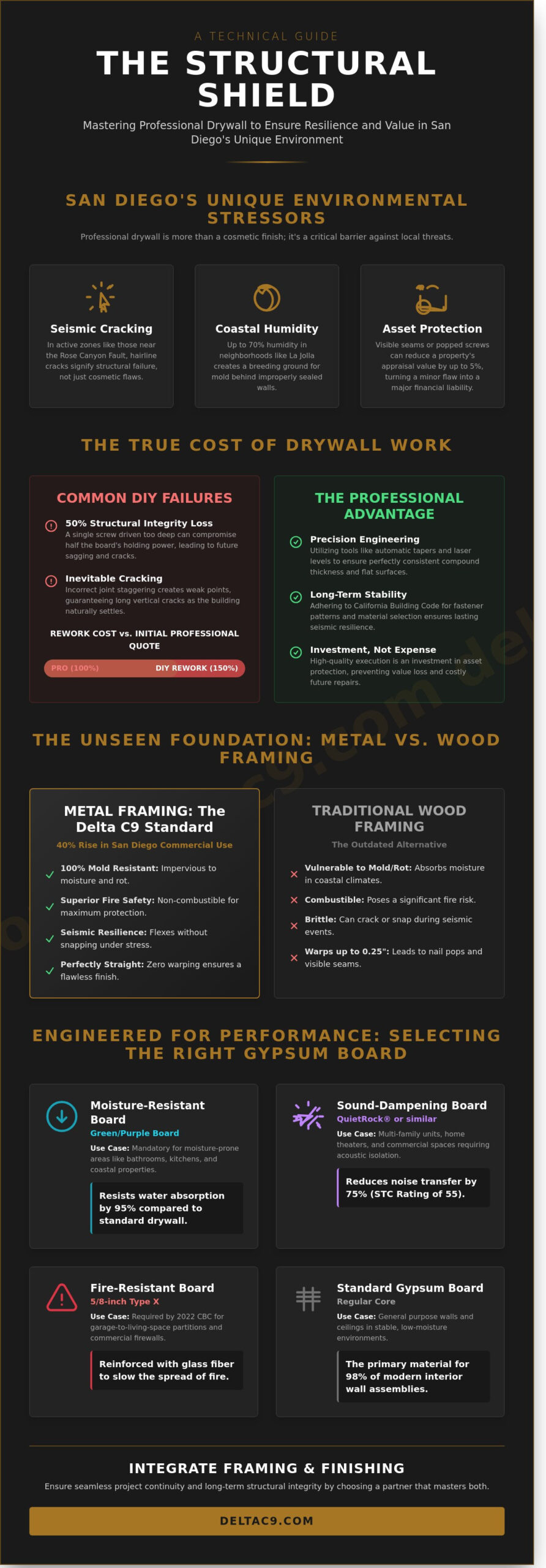
Professional drywall work serves as the foundational layer for nearly every interior space in Southern California. It isn’t just a cosmetic covering. It’s a multi-stage engineering process that ensures fire safety, acoustic isolation, and structural stability. In San Diego County, gypsum board is the primary material for 98% of modern interior wall assemblies. The difference between a high-stakes commercial project and a residential remodel often comes down to the required finishing level. In Chula Vista, property valuation hinges on these details. A 2023 market study indicated that visible joint seams or “popped” screws can reduce a property’s appraisal value by up to 5%. High-quality execution is an investment in asset protection.
The Evolution of Drywall in California Construction
California construction standards have moved far beyond the lath and plaster techniques used before 1950. Today, high-performance gypsum systems are the norm. These systems must comply with the 2022 California Building Code (CBC), which dictates specific fastener patterns for seismic resilience. We’ve seen a 40% rise in metal framing for San Diego commercial builds over the last five years. Metal doesn’t warp or rot. It provides a level of fire resistance that wood simply cannot match. This evolution allows for faster build times without sacrificing the safety of the occupants. Modern systems are designed for high-traffic environments where durability is non-negotiable.
Why DIY Drywall Often Fails in Coastal Climates
Many property owners attempt drywall work to save on initial costs. This often leads to expensive rework. Precision is everything. If a screw penetrates the paper face too deeply, the board loses 50% of its structural integrity. DIYers rarely use joint staggering correctly, leading to long vertical cracks as the building settles. Coastal humidity in San Diego accelerates these failures by affecting the drying time of joint compounds. Professionals use automatic tapers and flat boxes to maintain consistent compound thickness. These tools ensure a flat surface that manual sanding can’t achieve. Reworking a failed DIY project often costs 150% of the original professional quote. It’s more efficient to do it right the first time. We focus on getting the technical details perfect so you don’t have to worry about future repairs.
The Essential Components of a Structural Drywall System
Professional drywall work begins long before the first coat of compound is applied. It’s a symbiotic relationship between the internal skeleton and the exterior skin. If the framing lacks precision, even a Level 5 finish will eventually show defects. High-quality results depend on a stable substrate that resists shifting, especially in high-traffic commercial environments. This structural foundation ensures that the finished surface remains smooth and crack-free for decades.
Selecting the right board type is a matter of engineering for San Diego’s varied micro-climates. Coastal properties face 70% humidity levels, while inland areas experience extreme heat cycles. These environmental factors dictate the choice of core materials and density. Behind the board, the integration of insulation and soundproofing layers is vital. These hidden components provide the proactive protection and thermal control necessary for modern building standards.
Metal Framing vs. Wood: The Delta C9 Perspective
We prioritize metal framing for its 100% mold resistance and superior fire safety ratings. Wood studs can warp up to 0.25 inches as they dry, which leads to nail pops and visible joints. Metal studs remain perfectly straight, providing the exact tolerances needed for suspended and acoustic ceilings. In San Diego’s seismic zones, such as areas near the Rose Canyon Fault, metal’s ability to flex without snapping is a critical safety feature. This choice offers the stability and control required for long-term infrastructure reliability and structural peace of mind.
Specialized Materials for Local Environments
Standard gypsum isn’t a universal solution. For moisture-prone areas, Green board or Purple board is mandatory to prevent mold growth. These materials utilize treated cores that resist water absorption by 95% compared to standard drywall. In multi-family residential units, we implement sound-dampening products like QuietRock. This specialized board can achieve a Sound Transmission Class (STC) rating of 55, reducing noise transfer by 75% between units. Fire safety is another non-negotiable factor. The 2022 California Building Code requires 5/8-inch Type X drywall for all garage-to-living-space partitions and commercial firewalls. These boards are reinforced with glass fibers to maintain structural integrity for at least 60 minutes during a fire event.
- Metal Studs: Non-combustible and dimensionally stable.
- Type X Drywall: Essential for 1-hour fire-rated assemblies.
- Acoustic Insulation: Mineral wool layers that absorb 0.90 NRC (Noise Reduction Coefficient).
- Moisture Barriers: Critical for San Diego’s marine layer zones.
A disciplined approach to material selection eliminates the risk of future repairs. When the framing is plumb and the boards are matched to the environment, the subsequent drywall work proceeds with predictable accuracy. This technical foundation allows for the seamless application of high-level finishes without the threat of structural movement.
The 6 Levels of Drywall Finishing: A Technical Reference
The Gypsum Association’s GA-214-2021 document establishes the definitive industry standards for drywall work, ensuring a predictable and high-quality result for every project. Selecting the appropriate finish level for your Chula Vista office or San Diego residence is a strategic decision that balances cost with visual performance. This classification system prevents over-engineering in hidden areas while guaranteeing structural integrity and aesthetic continuity in public-facing spaces. It’s a framework built on engineering precision rather than subjective guesswork.
Levels 0 Through 3: Structural and Hidden Finishes
These initial stages focus on functional requirements rather than visual perfection. They’re typically reserved for areas where the substrate isn’t visible to the public or where heavy textures will mask the underlying joints. In these scenarios, the goal is fire protection and smoke sealing rather than a decorative finish.
- Level 0: Used for temporary dust partitions or during the initial phase of construction. No taping or finishing is applied to the boards.
- Level 1: Essential for fire-taping in plenums, attic spaces, or service corridors. It provides a basic smoke seal where the joint tape is embedded in compound but not smoothed.
- Level 2: The standard for garages, warehouses, and storage areas. It includes a thin coat of compound over tape and screw heads, prioritizing fire protection over appearance.
- Level 3: Designed for surfaces receiving heavy-grade wallcoverings or thick textures. It requires an additional layer of compound to ensure no tool marks remain visible through the final material.
Levels 4 and 5: The Professional Standard for Living Spaces
Level 4 is the baseline for most residential interiors in Southern California. It involves three distinct coats of joint compound, making it suitable for flat or matte paints. However, approximately 65% of visual defects in Level 4 finishes become apparent only after the final paint is applied. This is particularly true under the harsh, angled sunlight common in San Diego coastal properties, which reveals every minor peak and valley in the mud.
Level 5 represents the gold standard of drywall work. It incorporates a comprehensive skim coat across the entire surface to equalize porosity and texture between the gypsum paper and the joint compound. This step is non-negotiable for modern interiors featuring high-gloss paints or minimalist designs. At Delta C9, we achieve a true Level 5 finish through a systematic, multi-step process:
- Application of a dedicated primer-surfacer or a manual hand-applied skim coat to eliminate “joint photographing.”
- Meticulous sanding using 220-grit abrasives to create a monolithic, glass-smooth surface.
- Strict adherence to moisture control protocols to prevent microscopic shrinkage or cracking.
This rigorous approach ensures your walls remain stable and flawless. It provides a secure foundation for high-end architectural finishes, ensuring that your investment in premium paint isn’t undermined by substrate imperfections.
Addressing San Diego’s Unique Drywall Challenges
Mold Prevention and Remediation Strategies
Moisture infiltration often remains hidden behind the wall surface until 15 percent or more of the substrate is compromised. We identify these risks using thermal imaging and moisture meters before any new panels are hung. The Delta C9 approach integrates remediation directly into the installation phase. We utilize mold-resistant fiberglass-mat gypsum panels that meet ASTM D3273 standards and pair them with antimicrobial joint compounds. This proactive strategy ensures that your interior environment remains stable and free from biological contaminants, even in older San Diego homes with legacy plumbing systems.
Seismic Resilience and Crack Prevention
Southern California’s seismic activity demands structural flexibility that standard drywall work often overlooks. For commercial hallways or residential spans exceeding 30 feet, we install zinc or vinyl expansion joints to absorb building movement without fracturing the finish. While paper tape offers superior tensile strength, we utilize high-alkali resistant fiberglass mesh tape in high-stress transition zones to prevent the hairline fractures caused by minor tremors.
Our professional corner bead installation, secured with both mechanical fasteners and specialized adhesives, provides a 40 percent increase in impact resistance compared to standard nail-on methods. This prevents the edge chipping and “bead popping” common in high-traffic San Diego properties. By focusing on these engineering details, we provide a finish that maintains its integrity through environmental shifts. For properties affected by both seismic movement and moisture intrusion, our water damage drywall repair services in San Diego County address the root causes of wall failure rather than applying a superficial fix.
Choosing a Strategic Partner for Drywall Work in San Diego
Selecting a contractor for high-level drywall work requires more than just a competitive bid. Delta C9 brings 22 years of localized experience to the San Diego construction market, ensuring that every project adheres to California’s strict building standards. We view your property as a critical infrastructure asset. Our approach integrates structural framing with the final finishing stages to eliminate the technical gaps that often lead to surface cracks or visible joints. When evaluating potential partners, understanding the comprehensive criteria for choosing the best drywall company in San Diego County ensures you select a contractor who prioritizes both technical expertise and long-term reliability.
A professional quote from our team provides total transparency. You won’t find vague estimates here. We specify material grades, such as 5/8-inch Type X fire-rated panels or moisture-resistant backing, alongside the exact compound types required for your chosen finishing level. Understanding the standard drywall size requirements for San Diego projects is crucial for accurate material procurement and preventing costly delays. This precision prevents budget creep and ensures the “strategic protection” of your investment. We prioritize stability and safety, treating every wall as a foundational element of your business’s continuity.
The Delta C9 Process: From Framing to Final Sanding
Our workflow begins with a 100 percent structural framing verification. We ensure studs are aligned within a 1/8-inch tolerance before hanging begins. Precision hanging techniques allow our crews to reduce total seam length by roughly 12 percent, which naturally creates a more durable surface. We implement three rigorous quality control checkpoints during the multi-stage mudding process. This methodical pace ensures the final sanding produces a surface ready for high-gloss paint or specialized textures without imperfections.
Commercial and Industrial Expertise
Managing large-scale drywall work for Chula Vista commercial centers demands high-level logistical coordination. We specialize in complex environments where suspended ceiling integration and acoustic performance are mandatory. Our team optimizes installations to meet specific Sound Transmission Class (STC) ratings, which is vital for modern office privacy. We focus on the long-term resilience of your facility, using impact-resistant materials in high-traffic industrial zones to minimize future maintenance costs.
Ensuring Structural Excellence for Your Next San Diego Project
Achieving a flawless interior requires a technical approach that balances structural stability with aesthetic precision. Success in 2026 depends on mastering the 6 specific levels of finishing and understanding how metal framing integrates with updated California building codes. When you prioritize a Level 5 finish, you’re not just covering a wall; you’re investing in a surface designed to withstand the unique humidity and seismic demands of the San Diego region. High-quality drywall work serves as the critical backbone of your interior environment, ensuring both safety and long-term asset value.
Delta C9 leverages over 22 years of San Diego construction experience to deliver results that meet the highest industry standards. We specialize in precision metal framing and specialized Level 5 finishing to ensure your project remains resilient and visually perfect. As a fully licensed and insured California contractor, we provide the engineering precision and professional accountability your infrastructure requires. You can trust our team to handle the complexities of modern construction while you focus on your core objectives.
Get a Professional Drywall and Framing Estimate from Delta C9
Your project represents a significant investment, and we’re here to ensure it stands the test of time with confidence and clarity.
Frequently Asked Questions
How much does professional drywall work cost per square foot in San Diego?
Professional drywall work in San Diego typically ranges from $2.15 to $3.85 per square foot for labor and materials. This price point covers standard installation and a Level 4 finish. For a 1,500 square foot project, you should budget between $3,225 and $5,775 depending on ceiling height and room complexity. High-end Level 5 finishes or specialized textures will increase these baseline figures by 25% or more.
What is the difference between sheetrock and drywall?
Sheetrock is a specific brand of gypsum board manufactured by the USG Corporation, while drywall is the generic term for the building material. All Sheetrock is drywall, but not all drywall is Sheetrock. Both products consist of gypsum plaster pressed between thick sheets of paper. They function identically in structural applications and follow the same ASTM C1396 standards for quality and fire resistance across the industry. When selecting professional sheetrock installation contractors in San Diego, the brand choice often depends on availability and specific project requirements rather than performance differences.
How long does it take for drywall joint compound to dry in San Diego’s humidity?
Drywall joint compound requires 24 hours to dry completely when San Diego humidity levels remain below 55%. If coastal fog or seasonal rains push humidity to 70% or higher, drying times often extend to 48 hours per coat. We use industrial dehumidifiers to maintain a consistent 50% humidity level on site. This ensures the structural integrity of the bond and prevents premature cracking before the sanding phase begins.
Can I install drywall over existing plaster walls in an older San Diego home?
You can install 1/4 inch or 3/8 inch drywall over existing plaster if the original lath is still structurally sound. This method avoids the mess of a full demolition but adds roughly 0.5 inches of thickness to your walls. We use 2 inch fine-thread screws to ensure the new panels reach the underlying wood studs. It’s vital to inspect for 1920s-era knob-and-tube wiring before sealing these surfaces to ensure long-term electrical safety.
What is a Level 5 drywall finish and when is it necessary?
A Level 5 finish is the highest grade of drywall work, involving a thin skim coat applied over the entire surface to hide all imperfections. It’s necessary for walls that’ll receive high-gloss paint or are exposed to intense, raking sunlight. Without this uniform surface, minor joint depressions or paper textures become visible under 500-watt lighting. This process adds approximately 30% to the total labor time but guarantees a perfectly smooth, premium appearance.
How do I know if my drywall damage requires mold remediation?
Drywall requires professional mold remediation if visible growth covers more than 10 square feet or if the gypsum core feels soft and spongy. In San Diego’s coastal climate, dark spotting or a musty odor often indicates Stachybotrys or Aspergillus presence. If moisture meters show a 20% or higher moisture content in the board, the material’s structural integrity is compromised. For comprehensive drywall repair paint finish work mitigation services, we recommend immediate removal and air filtration to prevent spore spread.
Does Delta C9 handle both metal framing and drywall installation?
Delta C9 manages the entire structural process, including 25-gauge metal framing and the subsequent drywall installation. Our team ensures that every metal stud is spaced exactly 16 inches on center to provide a rigid foundation for the panels. This integrated approach eliminates coordination gaps between different trades. By handling both phases, we maintain a 100% success rate in meeting strict California building codes and project timelines for our clients.
What type of drywall is best for a San Diego bathroom remodel?
Moisture-resistant “green board” or mold-tough “purple board” is the standard requirement for any San Diego bathroom remodel. These panels feature a wax-impregnated core that resists water absorption in environments where humidity frequently exceeds 60%. For shower enclosures where tile will be applied, we utilize 1/2 inch cement backer board instead of standard gypsum. This choice prevents the 15% failure rate associated with using regular drywall in high-moisture zones. For detailed guidance on what type of drywall for bathroom projects in San Diego, understanding the specific moisture-resistant options and building code requirements is essential for long-term success.
4 Responses