
While San Diego is famous for its arid climate, nearly 47% of U.S. homes contain visible mold or persistent damp odors. Many property owners mistakenly believe the Southern California sun provides a natural defense; however, factors like coastal humidity and aging plumbing often create the perfect environment for hidden growth. If you’ve discovered dark spots on your drywall or noticed a musty scent, you’re likely concerned about the health effects on your family or the disruption to your business operations. Professional mold remediation is not merely a cleaning task. It’s a critical structural intervention designed to protect your investment and restore safety.
You deserve a clear path forward that balances regulatory compliance with engineering precision. This guide provides the technical roadmap needed to navigate professional restoration and return your property to a state of stability. We will examine California’s strict disclosure laws under Civil Code 1102, the 10 square foot rule for professional intervention, and the structural requirements for seamless drywall reconstruction to ensure your environment remains safe and productive.
Key Takeaways
- Distinguish between the industry myth of “mold removal” and the technical reality of returning indoor environments to safe, natural fungal levels.
- Identify how San Diego’s unique environmental factors, including coastal humidity and slab-on-grade foundations, contribute to hidden moisture intrusion.
- Apply the 10 square foot rule to evaluate when a structural issue requires professional mold remediation instead of simple maintenance.
- Explore the benefits of a unified build-back strategy that integrates containment with high-level drywall finishing to ensure long-term structural integrity.
What is Mold Remediation? Understanding the Structural Standards
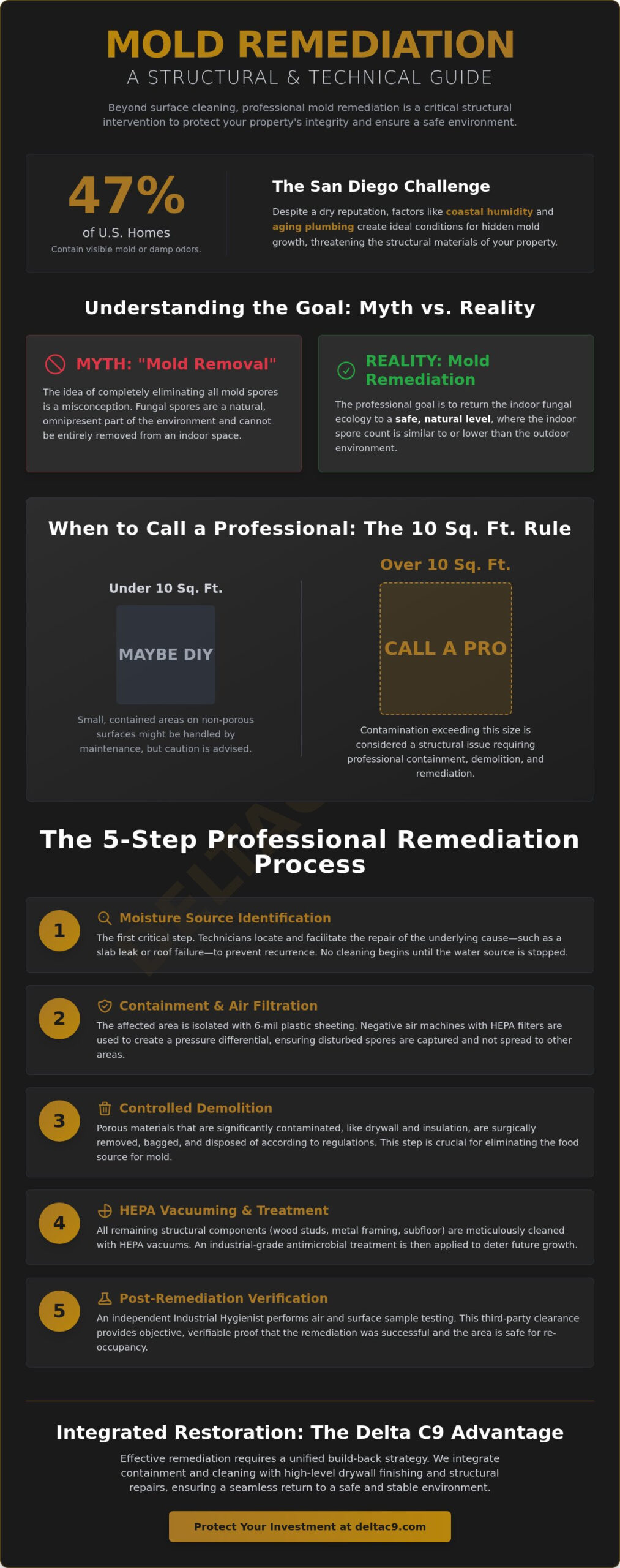
Mold remediation is the systematic process of cleaning and treating building materials to return an indoor environment to safe, natural fungal levels. Property owners often hear the term ‘mold removal’ in marketing, but it’s technically inaccurate. Fungal spores are omnipresent in nature. They enter buildings through open windows, doors, and HVAC systems. A professional objective is not to eliminate every spore. Instead, we aim to achieve a state where the indoor fungal ecology is similar to or lower than the outdoor environment.
Professional projects follow the IICRC S520 Standard for Professional Mold Remediation. This framework ensures that every step follows a rigorous protocol rather than relying on surface-level guesswork. Mold poses a direct threat to structural integrity. It consumes organic materials like the cellulose found in drywall paper and wood framing. Over time, this biological consumption weakens the load-bearing capacity of the material, leading to soft spots or structural failure.
Remediation vs. Cleaning: Why Bleach Isn’t the Answer
Bleach is frequently suggested as a household remedy, yet it’s ineffective on porous surfaces like drywall or wood. While it may change the color of the mold on the surface, the hyphae, or root structures, remain embedded deep within the material. Bleach can actually encourage mold growth by adding moisture to the material, providing the very fuel the fungus needs to thrive. True remediation requires the physical removal of the contaminated material or high-level HEPA vacuuming and antimicrobial treatment.
The Impact of Mold on San Diego Building Materials
San Diego’s coastal humidity creates a unique challenge for property owners. Constant moisture from the marine layer can keep gypsum board at a high enough water activity level to support rapid colonization. Utilizing metal framing and drywall offers a significant advantage in these environments because metal lacks the organic nutrients that support fungal growth. Professionals categorize contamination into three levels based on the IICRC standards. Condition 2 refers to an area with settled spores or fungal fragments. Condition 3 indicates actual growth with visible colonization. Understanding these distinctions is vital for a comprehensive guide to indoor mold and its structural impact on local properties.
The 5-Step Professional Mold Remediation Process
Professional mold remediation relies on a structured, five-step methodology to ensure long-term stability and health safety. This disciplined sequence prevents the spread of spores while addressing the root cause of the moisture intrusion. Following EPA guidelines on mold cleanup ensures that the project meets federal safety benchmarks and provides a verifiable path to a clean environment.
- Step 1: Moisture Source Identification. Fungi require water to grow. Technicians must locate and repair the underlying leak, whether it’s a slab leak or a roof failure, before any cleaning begins.
- Step 2: Containment and Air Filtration. We isolate the affected area using 6-mil polyethylene sheeting. Negative air machines create a pressure differential, ensuring that disturbed spores are captured by HEPA filters rather than drifting into unaffected rooms.
- Step 3: Controlled Demolition. Porous materials like drywall and insulation that exhibit significant growth are removed. This process must be surgical to minimize dust.
- Step 4: HEPA Vacuuming and Anti-Microbial Treatment. Once contaminated materials are gone, we clean the remaining structural components, such as wood studs or metal framing, using specialized vacuums and botanical or industrial-grade treatments.
- Step 5: Clearance Testing. An independent industrial hygienist conducts air and surface sampling. This provides objective proof that the environment is safe for occupancy.
Containment: Protecting the Rest of Your Property
Negative air pressure is the cornerstone of property protection. By exhausting filtered air outside, we ensure that air only flows into the containment zone, never out of it. Sealing HVAC registers is mandatory to prevent spores from entering the ductwork and spreading throughout the building. Technicians utilize specialized PPE and decontamination chambers to maintain a strict barrier between the work zone and your living space. This level of control is what separates professional intervention from amateur cleaning attempts.
Controlled Demolition and Material Disposal
The industry standard involves the ‘two-foot rule,’ which requires removing drywall two feet beyond the last visible sign of mold. This accounts for microscopic hyphae that often spread within the wall cavity before they become visible on the surface. All waste is double-bagged and sealed before leaving the containment area to prevent cross-contamination. Executing a ‘clean cut’ during this phase is essential to facilitate a seamless build-back and ensure the structural integrity of the final finish. For those ready to move from demolition to reconstruction, a professional drywall repair ensures the new materials are installed with engineering precision.
When to Call a Professional: The 10 Square Foot Rule
Determining whether a fungal issue requires professional intervention often starts with the size of the affected area. The EPA mold cleanup guidelines suggest that if the visible area is less than 10 square feet, a property owner might manage the cleanup. However, this measurement is often deceptive. In our experience with mold remediation in Southern California, surface growth is frequently just the visible tip of a much larger structural problem. If the mold is caused by a slow pipe leak inside a wall, the back of the drywall and the wooden studs are likely heavily colonized even if the front looks manageable.
Disturbing these colonies without the containment measures discussed in the previous section poses a significant risk. Without negative air pressure, scrubbing or tearing out even a small patch of drywall releases millions of spores into the air. These spores then settle in your carpets, upholstery, and HVAC system, turning a localized issue into a building-wide contamination. For commercial properties, the stakes are higher. Liability concerns and insurance requirements often mandate professional certification to ensure the building is legally safe for occupancy. Skipping professional verification can lead to denied insurance claims or legal challenges if health issues arise later.
Signs of Hidden Mold in San Diego Homes
Visible growth isn’t the only indicator of a problem. Persistent musty odors that don’t vanish after a deep clean often signal a colony hidden behind baseboards or within wall cavities. In San Diego’s coastal neighborhoods, bubbling paint or warped baseboards near windows are common red flags for moisture intrusion. We utilize specialized tools like thermal imaging cameras and moisture meters to see through surfaces. These devices detect temperature differentials and moisture pockets that aren’t visible to the naked eye. This allows for a non-invasive assessment, identifying exactly where the moisture is trapped before we ever make a cut in the wall.
The Cost of Improper DIY Remediation
Attempting to save money with a DIY approach often leads to higher long-term expenses. If the moisture source isn’t correctly identified and sealed, the mold will return within weeks. Many homeowners accidentally cross-contaminate their entire home by running the central air conditioning during an uncontained cleanup. This usually necessitates an expensive whole-house air scrubbing and professional duct cleaning. Ensuring the structural restoration is handled correctly from the start is vital for your peace of mind. This is why choosing the best drywall company for the build-back phase is just as important as the initial cleanup. A professional contractor ensures that the new installation is airtight and resistant to future moisture issues, maintaining the long-term value of your property.
Identifying Moisture Sources in Southern California
San Diego’s climate is often perceived as arid, yet the local environment presents specific moisture challenges that necessitate professional mold remediation. The most prevalent factor is the coastal ‘Marine Layer.’ This heavy, moisture-laden air can push indoor relative humidity levels significantly higher than recommended. When high humidity persists, surfaces like drywall absorb moisture, creating a substrate ready for fungal growth. This is especially true during the overnight hours when temperatures drop and the air reaches its dew point.
Older residential areas, particularly in Chula Vista, often face issues with slab-on-grade foundations. Hydrostatic pressure can force groundwater through microscopic cracks in the concrete slab. This capillary action saturates the bottom of wall plates and the base of the drywall. Since this moisture originates from beneath the flooring, it often remains undetected until significant structural damage has occurred. Identifying these leaks requires specialized equipment, as the source is rarely visible to the naked eye.
Seasonal rain events in Southern California, though infrequent, are often concentrated. Intense storms test the integrity of roofing systems and window seals. If these barriers fail, water enters the building envelope and becomes trapped within the wall cavity. Without proper ventilation in bathrooms and kitchens, daily activities like showering and cooking contribute to a high-moisture microclimate. These areas become primary fungal breeding grounds if air is not actively circulated or dehumidified.
Coastal Humidity and Condensation Issues
Maintaining indoor relative humidity below 50% is the primary defense against airborne fungal colonization. Dehumidifiers are effective tools, but they must work in tandem with high-quality insulation to be truly efficient. Proper thermal barriers help regulate interior surface temperatures. This prevents the condensation that typically forms on cold studs or the backside of drywall when warm, moist air meets a cooler surface. Fungi thrive in these hidden pockets of condensation where air movement is restricted.
Structural Prevention Strategies
Selecting the right materials during a remodel or new construction is a proactive step toward prevention. In moisture-prone areas like laundry rooms and bathrooms, we recommend installing mold-resistant ‘green board’ or ‘purple board.’ These products feature treated cores and water-resistant paper. For commercial interiors, metal framing provides a superior alternative to wood. Metal is inorganic and cannot serve as a food source for fungi. Additionally, ensuring proper exterior drainage and grading directs water away from the foundation. This simple engineering step reduces the risk of hydrostatic intrusion. If you suspect moisture is compromising your building’s integrity, our team provides professional mold remediation services to restore and protect your property.
Integrated Restoration: The Delta C9 Build-Back Advantage
Hiring separate entities for mold remediation and subsequent reconstruction often creates operational friction. Communication gaps between a cleanup crew and a general contractor can lead to scheduling delays, mismatched material specifications, and increased costs. Delta C9 eliminates this fragmentation by providing an integrated restoration model. We manage the transition from a sterile, remediated environment to a fully restored interior with engineering precision, ensuring that the structural integrity of your property is never compromised during the hand-off between phases.
Our approach centers on the philosophy that a project isn’t complete until the space is move-in ready. This requires a deep understanding of how various interior systems interact. Once the environment is cleared for reconstruction, we move immediately into structural stabilization. This includes the precise reinstallation of metal framing and insulation to meet or exceed original building codes. By controlling both the cleanup and the build-back, we maintain a consistent chain of custody over the project’s safety and quality standards.
Seamless Transitions from Remediation to Reconstruction
Delta C9 coordinates the transition from ‘clean’ to ‘build’ to save property owners significant time. In commercial environments, where every day of closure impacts the bottom line, this efficiency is vital. We specialize in reinstalling metal framing, which offers superior resistance to future fungal growth compared to traditional wood. Our technicians also restore specialized overhead systems, providing expert installation of suspended and acoustic ceilings. This ensures that the acoustic performance and aesthetic continuity of your office or industrial space are fully restored to professional standards.
Why Professional Finishing Matters for Safety
The final stages of restoration are where the history of the repair is erased. Professional drywall finishing is a technical requirement, not just a cosmetic one. We provide Level 3 through Level 5 finishing to ensure that new patches blend seamlessly with existing walls. During this phase, we utilize antimicrobial primers and mold-resistant joint compounds. These materials provide a proactive defense against the high humidity levels common in San Diego’s coastal zones. Achieving a flawless wall texture requires a disciplined application process that amateurs simply can’t replicate. Delta C9’s commitment to business continuity and residential peace of mind means we handle everything from the initial mold remediation to the final coat of paint and trim. We don’t just clean your property; we restore its value and ensure its long-term stability.
Restoring Structural Stability and Peace of Mind
Managing a fungal intrusion requires more than temporary surface cleaning. It demands a disciplined engineering approach to protect your building’s long-term value. Effective mold remediation ensures that moisture sources are permanently sealed and contaminated materials are replaced with precision. By prioritizing structural integrity through integrated build-back strategies, you eliminate the friction of coordinating multiple contractors and secure a move-in ready environment.
Our team brings over 22 years of San Diego construction experience to every project. We specialize in the technical intersection of environmental cleanup and high-end reconstruction, providing expertise in both commercial and residential interior services. We focus on business continuity and residential safety, ensuring every wall and ceiling meets the highest standards of stability. Contact Delta C9 for Professional Mold Remediation and Structural Restoration in San Diego to secure your property’s future. You can move forward with the confidence that your environment is controlled, safe, and professionally restored.
Frequently Asked Questions
How much does mold remediation cost in San Diego?
Costs vary based on the extent of the colonization and the structural materials involved. A small localized area in a bathroom costs significantly less than a project involving slab leaks that have saturated multiple wall cavities. You should also account for the reconstruction phase; restoring drywall and finishing to a professional standard is a separate structural requirement from the initial cleanup.
Can I stay in my house during the mold remediation process?
Occupants can often remain in the building if the affected area is small and isolated with professional containment. We use 6-mil poly sheeting and negative air pressure to ensure spores don’t migrate to living quarters. However, if the mold has entered the HVAC system or requires extensive demolition of primary living spaces, temporary relocation is usually recommended for comfort and safety.
Does homeowners insurance typically cover mold remediation?
Insurance coverage for mold remediation depends largely on the underlying cause of the moisture. Most policies cover fungal growth resulting from sudden and accidental water discharge, such as a burst pipe. Conversely, mold caused by long-term humidity, lack of maintenance, or gradual seepage is frequently excluded. It’s vital to review your specific policy’s endorsements for fungi and dry rot.
How long does the professional mold remediation process take?
A standard project typically requires three to seven days to complete. The first phase focuses on moisture stabilization and containment. This is followed by the physical removal of materials and specialized cleaning. The timeline also accounts for the drying period and the mandatory 24 to 48 hours required for third-party clearance testing to verify the environment is safe.
What is the difference between black mold and other types of mold?
The color of mold isn’t a definitive indicator of its toxicity. While “black mold” often refers to Stachybotrys chartarum, many common and less harmful molds also appear dark. All indoor fungal growth is considered a contaminant that should be addressed regardless of its specific species. Professional testing is the only way to identify the exact type of mold present in your building.
Is it safe to just paint over mold if it’s a small area?
Painting over mold is never a recommended solution. Standard paint or even mold-resistant coatings won’t kill an existing colony; they simply hide it while the fungus continues to consume the drywall paper underneath. This approach often leads to more extensive structural decay and higher costs when the mold eventually bubbles through the new layer of paint.
How do I know if the mold remediation was successful?
Success is verified through Post-Remediation Verification conducted by an independent industrial hygienist. This professional performs air and surface sampling to ensure fungal levels inside the containment zone are lower than or equal to outdoor levels. A successful project also includes a visual inspection to confirm all dust and debris have been removed from structural components like metal framing.
Can mold grow back after professional remediation?
Mold won’t return if the underlying moisture source is permanently repaired. Fungi require three elements to thrive: food, a suitable temperature, and water. Since building materials provide the food and San Diego’s climate provides the temperature, controlling moisture is the only way to prevent regrowth. Professional mold remediation focuses on this root cause to ensure long-term stability.