
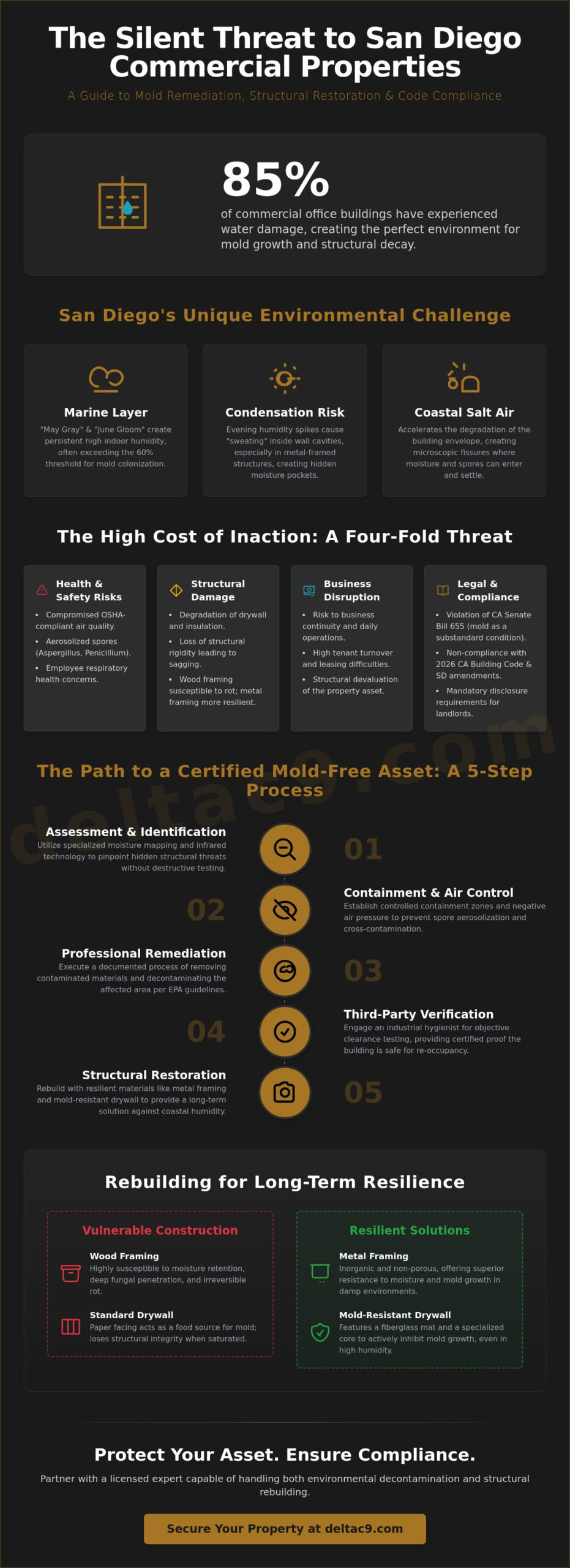
Did you know that 85% of commercial office buildings have experienced water damage at some point? In our coastal environment, this moisture frequently leads to the growth of mold in commercial buildings San Diego property owners must manage to remain compliant with the 2025 California Building Standards Code. You likely recognize that a mold discovery is more than a maintenance hurdle; it’s a significant liability concern that threatens both employee respiratory health and your daily business continuity. It’s natural to feel uncertain about whether the growth is merely on the surface or if it has begun to degrade your building’s internal structure.
This guide provides a professional roadmap to help you identify, remediate, and structurally restore properties affected by San Diego’s unique humidity. You’ll learn how to move from a failed inspection to a mold-free certification while ensuring your metal framing and drywall are restored to a professional standard. We will walk through the technical requirements of the 2026 local amendments and the specific prevention strategies needed to combat the persistent moisture of May Gray and June Gloom weather patterns.
Key Takeaways
- Understand how the 2026 California Building Standards Code and local San Diego amendments mandate professional intervention for visible mold to ensure legal compliance.
- Learn why the San Diego marine layer and coastal salt air necessitate specialized moisture mapping and infrared technology to identify hidden structural threats.
- Discover how to manage mold in commercial buildings San Diego through a controlled five-step process that prioritizes business continuity and air quality.
- Recognize the importance of structural restoration using metal framing and mold-resistant drywall installation to provide a long-term solution against coastal humidity.
- Identify the critical licensing and commercial construction credentials required to select a partner capable of handling both environmental decontamination and structural rebuilding.
Understanding the Impact of Mold in San Diego Commercial Buildings
Commercial mold remediation represents a sophisticated intersection of environmental science and structural engineering. It isn’t a simple janitorial task. For property managers, addressing mold in commercial buildings San Diego requires a protocol that secures the building envelope while protecting the asset’s market valuation. Since the 2025 California Building Standards Code became mandatory on January 1, 2026, the threshold for professional intervention has shifted. Local San Diego amendments that took effect on April 22, 2026, now align city regulations with these strict state mandates. Ignoring visible growth isn’t just a maintenance oversight; it’s a violation of Senate Bill 655, which classifies mold as a legally actionable substandard condition.
The economic consequences of deferred action are measurable and often severe. Statistics show that 85% of commercial office buildings have experienced water damage at some point. This moisture leads to structural devaluation and high tenant turnover. In high-density office environments, Understanding Mold Growth and its biological requirements is essential for effective risk management. When air quality is compromised, business continuity is immediately at risk.
The Hidden Costs of Commercial Mold Growth
Liability risks extend far beyond visible damage. Maintaining OSHA-compliant air quality is a non-negotiable standard for California corporations. When mold takes root, it compromises the core integrity of commercial drywall and industrial insulation. In San Diego’s humid coastal air, moisture-saturated drywall loses its structural rigidity, leading to sagging or total failure. While wood framing is highly susceptible to rot and deep fungal penetration, metal framing offers a more resilient alternative in damp environments. Protecting these internal systems is vital to avoiding the high costs of a complete structural teardown.
San Diego Health and Safety Standards
San Diego County health department guidelines emphasize that visible mold is a mandatory disclosure requirement for landlords and commercial property owners. A professional approach typically involves coordination with a third-party industrial hygienist. These experts provide the objective clearance testing needed to confirm a building is safe for re-occupancy. Attempting “DIY” cleaning in a commercial setting is a significant liability. It frequently aerosolizes spores like Aspergillus and Penicillium, which studies have found in significantly higher concentrations in “unclean” San Diego buildings compared to outdoor air. A documented, professional remediation process is the only way to ensure long-term stability and legal protection.
Why San Diego Commercial Properties are Vulnerable to Mold
San Diego’s coastal microclimates present a specific set of environmental stressors that differ significantly from inland regions. The persistent marine layer, often referred to as May Gray or June Gloom, maintains high indoor humidity levels that can exceed the 60% threshold required for fungal colonization. When managing mold in commercial buildings San Diego owners must account for this atmospheric moisture, which often bypasses standard dehumidification systems in older structures. Coastal salt air further complicates the issue by accelerating the degradation of the building envelope, creating microscopic fissures where moisture and spores can settle.
The Coastal Climate Factor
In high-moisture zones like Mission Bay or La Jolla, evening humidity spikes create a cycle of condensation on cool surfaces. This is particularly prevalent in metal-framed structures where thermal bridging occurs. Without high-performance insulation, the temperature differential between the exterior and interior creates “sweating” within wall cavities. This hidden moisture often goes undetected until it begins to affect the structural integrity of the assembly. Following established EPA Mold Remediation Guidelines is the most reliable way to ensure these environmental factors are addressed before they lead to recurring growth. Selecting the right insulation material is a critical engineering decision that can prevent these thermal imbalances from fostering mold growth.
Older office parks in areas like Sorrento Valley often suffer from “sick building syndrome.” This phenomenon is frequently driven by poorly maintained commercial HVAC systems that act as distribution hubs for spores. When filters aren’t replaced or drain pans become clogged, the system circulates contaminated air throughout the entire facility. This leads to widespread respiratory complaints among staff and potential liability for the property owner.
Common Moisture Entry Points in Commercial Structures
Flat-roof commercial buildings are especially vulnerable following San Diego’s concentrated winter rain events. Minor ponding can quickly turn into a significant leak that saturates suspended ceilings and insulation. In multi-story office complexes, plumbing failures in shared restrooms or breakrooms can cause water to migrate vertically through floor plates. This moisture often accumulates as condensation behind quality drywall in zones with restricted airflow. Identifying these entry points early is a core part of protecting your investment. If you suspect hidden moisture is compromising your facility, professional drywall repair and structural assessment can prevent a localized leak from becoming a building-wide remediation project.
Professional remediation of mold in commercial buildings San Diego follows a disciplined protocol designed to minimize risk and restore structural integrity. This process isn’t merely about surface cleaning; it’s a multi-stage engineering project that requires technical precision. By following a structured approach, property managers can ensure that the underlying moisture source is neutralized before any reconstruction begins.
The first phase involves professional inspection and moisture mapping. Technicians use infrared technology to identify thermal anomalies behind wall surfaces, locating hidden water pockets that visual inspections miss. Step two establishes advanced containment using 6-mil poly sheeting and negative air machines to create a sealed environment. This pressure differential ensures that no contaminants escape the work zone. During step three, HEPA air filtration captures microscopic spores that become airborne. Step four consists of controlled demolition where we remove non-salvageable materials such as saturated drywall and insulation. Finally, step five involves antimicrobial treatment and thorough structural drying of the building skeleton.
Addressing these spores is critical because of the documented Health Effects of Mold Exposure, which can significantly impact employee well-being and productivity. When the structural drying is complete, the framing is ready for the reinstallation of high-performance materials.
Containment Strategies for Active Businesses
Business continuity is a primary concern during any remediation project. We utilize ICRA (Infection Control Risk Assessment) barriers to isolate work zones from active employee areas. These rigid or semi-rigid partitions prevent dust and spores from migrating through common spaces. By managing airflow and sealing HVAC ducts within the affected zone, we ensure that the rest of the facility remains operational. This strategic protection allows your team to continue their work without exposure to the remediation process.
Advanced Decontamination Technology
Effective decontamination of mold in commercial buildings San Diego relies on high-volume HEPA vacuums and industrial air scrubbers. These machines are essential for processing the large air volumes found in commercial warehouses and office suites. In specialized environments like commercial kitchens or medical spaces, we follow strict safety protocols for biocide application to ensure no residues interfere with your operations. The process concludes with Post-Remediation Verification (PRV) testing. This independent analysis confirms that spore counts have returned to baseline levels, providing the documentation necessary for your records. Once cleared, the facility is ready for professional commercial construction and finishing services.
Structural Restoration: Rebuilding for Long-Term Resilience
Decontamination removes the immediate biological hazard, but it often leaves the building skeleton exposed and vulnerable. Successful management of mold in commercial buildings San Diego requires more than just removal; it demands a strategic reconstruction phase. This is where many property owners fall short by treating restoration as an elective finish rather than a structural necessity. High-quality metal framing and drywall installation provides the structural backbone necessary to withstand San Diego’s coastal humidity. By selecting inorganic materials during this phase, you eliminate the primary food source for future fungal colonies.
The restoration window is also the ideal time to integrate performance upgrades. We can install advanced soundproofing and specialized insulation to improve the acoustic privacy and thermal efficiency of your office suites. These additions don’t just restore the space; they increase the asset’s overall value and tenant appeal. Professional drywall finishing ensures that no microscopic air pockets remain where moisture could collect in the future.
Choosing Mold-Resistant Materials
In commercial wet zones or areas with high humidity, we’ve seen a decisive shift toward fiberglass-faced drywall, often referred to as purple or green board. Unlike traditional paper-faced products, these materials don’t provide organic nutrients for spores to consume. Metal studs are superior to wood in our coastal environment because they don’t warp, rot, or absorb moisture. During the rebuild, selecting the right insulation is vital to prevent vapor transmission and maintain the thermal performance of the building envelope. This engineering-first approach prevents the “sweating” that often triggers recurring mold issues.
Level 5 Drywall Finishing for Commercial Aesthetics
Restoring an office or retail space to a “like-new” condition requires a Level 5 drywall finish. This process involves a thin skim coat of joint compound over the entire surface, creating a perfectly smooth texture that eliminates the microscopic crevices where spores can hide. We utilize specialized primers and mold-inhibiting paints to provide a final layer of defense against mold in commercial buildings San Diego. This meticulous approach ensures your structural integrity meets the 2026 California building codes while restoring the professional aesthetic your tenants expect. If your property requires a professional transition from decontamination to a move-in ready state, our team provides expert commercial drywall and framing restoration tailored to San Diego’s unique climate.
Selecting a Commercial Mold Expert in San Diego
The selection of a remediation partner is the final safeguard for your property’s long-term stability and compliance. Addressing mold in commercial buildings San Diego requires a firm that understands the technical nuances of both environmental decontamination and structural rebuilding. You should prioritize contractors who hold active California Contractors State License Board (CSLB) licensing and specialized certifications. A partner with a dual background in remediation and commercial construction ensures that the restoration phase is handled with the same engineering precision as the initial cleanup. This integrated approach prevents the logistical friction that often occurs when handing off a project between different vendors.
Localized experience is equally vital. San Diego County’s microclimates, ranging from the humid coastal fog of Carlsbad to the drier heat of Escondido, dictate different moisture management strategies. An expert should be able to evaluate your building’s specific environmental stressors and provide detailed documentation for insurance adjusters. This transparency is essential for liability protection and ensures that every step of the process aligns with the 2026 local building amendments.
Questions to Ask Your Remediation Contractor
Before signing a service agreement, verify that the contractor can provide a comprehensive plan that covers both the removal of contaminants and the structural rebuild. Inquire about their protocol for air quality testing and whether they provide independent clearance reports. You should also ask about their specific experience with industrial projects in San Diego. Understanding how they manage large-scale volumes and specialized environments like medical suites or tech hubs will give you confidence in their operational capacity.
- Does your team provide a documented moisture mapping report before starting work?
- How will you maintain business continuity and isolate the work zone from my employees?
- Are you prepared to handle the reconstruction of metal framing and Level 5 drywall finishing?
The Delta C9 Advantage
With over 22 years of specialized expertise in San Diego’s commercial interior sector, Delta C9 offers a refined approach to managing mold in commercial buildings San Diego. We provide a seamless transition from environmental decontamination to high-end drywall and framing restoration. Our team understands that for a business owner, quiet execution and professional conduct are just as important as technical accuracy. We focus on maintaining your business continuity while delivering a structural environment that is resilient, compliant, and aesthetically restored. By choosing a partner that prioritizes the stability of your critical systems, you ensure the peace of mind that comes with a professionally certified, mold-free facility.
Securing Your Commercial Asset for the Future
Managing mold in commercial buildings San Diego requires a transition from reactive cleaning to proactive structural engineering. The 2026 California Building Standards Code and our persistent coastal humidity demand a dual-track approach. You must ensure that decontamination is followed immediately by a high-quality rebuild using inorganic materials like metal framing and fiberglass-faced drywall. This strategy doesn’t just resolve a current health hazard; it builds long-term resilience into your property’s envelope and protects your market valuation.
Successful restoration depends on a partner who understands both the environmental science of remediation and the technical requirements of commercial construction. With over 22 years of localized experience, Delta C9 operates as a Licensed California General Contractor specializing in the seamless restoration of drywall and framing systems. We prioritize your business continuity by delivering quiet, professional execution that meets the highest industry standards. Protect your property and tenants with Delta C9’s expert remediation services. We’re ready to help you maintain a safe, compliant, and productive workspace for years to come.
Frequently Asked Questions
How long does mold remediation take in a commercial building?
Remediation timelines vary based on the extent of the moisture damage and the size of the facility. A standard commercial office suite typically requires three to seven business days for the full cycle of containment, removal, and structural drying. Larger industrial projects or multi-story complexes may require an extended schedule. We coordinate these timelines to ensure minimal disruption to your operational flow and business continuity.
Can my employees stay in the building during mold removal?
Employees can often remain in the building if professional ICRA containment and negative air pressure are utilized. These physical barriers isolate the affected zone and prevent the migration of spores through the HVAC system. If the mold discovery is extensive or affects essential common areas like primary entrances or central air hubs, a temporary relocation of staff in those specific zones might be necessary to maintain safety standards.
Does commercial insurance typically cover mold remediation in San Diego?
Coverage for mold in commercial buildings San Diego usually depends on the underlying cause of the moisture. Most policies cover remediation if the growth resulted from a sudden and accidental event, such as a burst pipe. However, growth caused by long-term humidity or deferred maintenance is often excluded unless you have a specific mold endorsement rider. You should review your policy’s pollution exclusion clause with your broker to confirm your coverage limits.
What is the difference between mold removal and mold remediation?
Mold removal refers only to the physical act of disposing of contaminated materials, while remediation is a comprehensive engineering process. Remediation includes identifying the primary moisture source, establishing advanced containment, and performing structural restoration. The goal of remediation is to return the indoor environment to a baseline “clean” state and prevent recurrence through specialized antimicrobial treatments and inorganic material selection.
How can I tell if the musty smell in my office is actually mold?
A persistent musty odor is a reliable indicator of hidden microbial growth, even if no visible spots are present. This scent is caused by microbial volatile organic compounds (mVOCs) released during the mold’s metabolic cycle. To confirm the presence of mold in commercial buildings San Diego, we recommend professional moisture mapping and air sampling to identify hidden pockets behind drywall or within suspended ceiling systems.
Is black mold more common in San Diego commercial properties?
While “black mold” (Stachybotrys chartarum) is a frequent concern for tenants, Aspergillus and Penicillium are more commonly documented in Southern California commercial structures. These species thrive in the high-humidity environments created by our coastal marine layer. Regardless of the specific species, any fungal growth in a high-density workspace requires professional intervention to maintain OSHA-compliant air quality and protect the building’s structural integrity.
What are the legal requirements for commercial mold disclosure in California?
California law classifies visible mold as a substandard building condition under Senate Bill 655. Landlords and property owners are legally required to disclose the presence of known mold to prospective tenants before a lease agreement is finalized. This applies to both residential and commercial properties. Failure to address visible growth or provide these disclosures can result in significant legal liability and tenant disputes regarding the habitability of the space.
How much does commercial mold remediation cost per square foot in 2026?
Commercial remediation costs are determined by the complexity of the containment and the types of structural materials that require replacement. Every project requires a unique assessment of the affected square footage, the height of the ceilings, and the level of decontamination needed. We recommend a professional site evaluation to provide an accurate scope of work that is tailored to your building’s specific structural requirements and the 2026 building codes.