
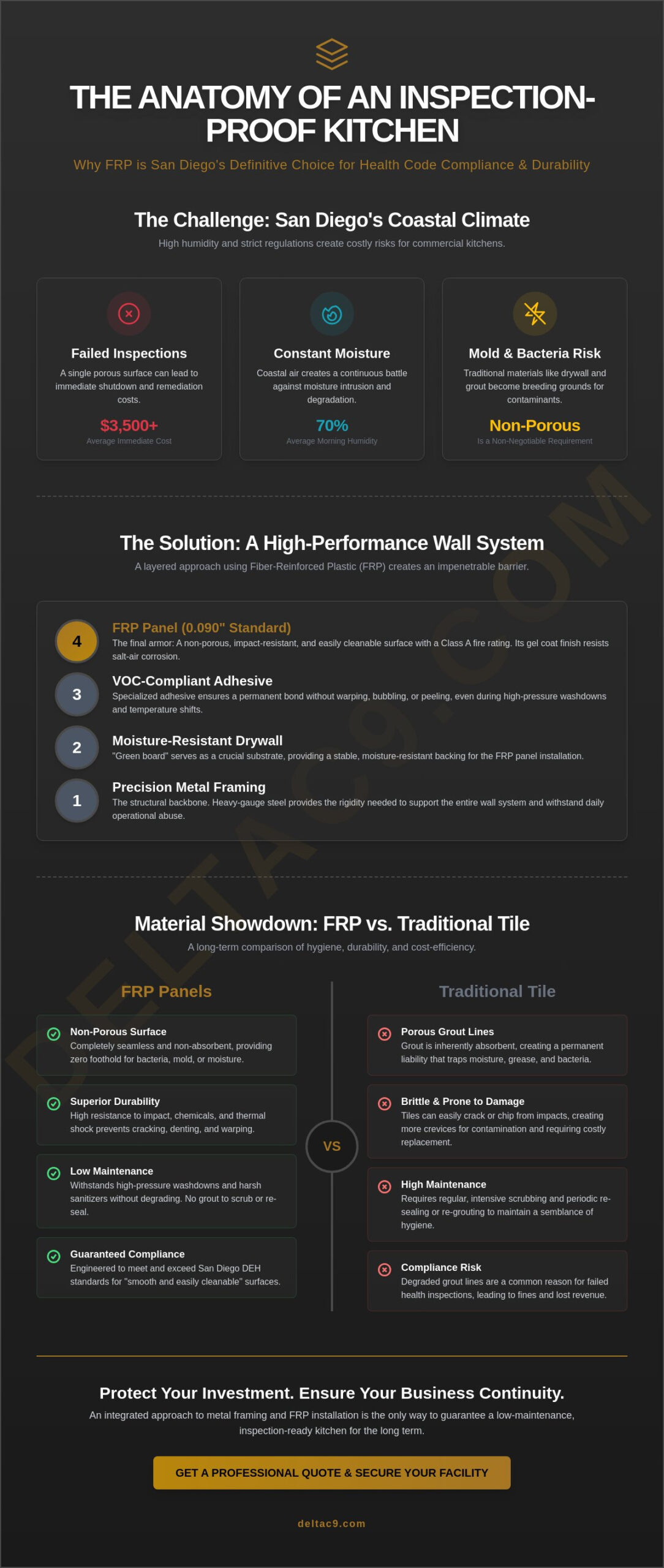
A single porous wall surface can trigger a failed San Diego Department of Environmental Health (DEH) inspection, which often results in more than $3,500 in immediate remediation costs and lost operational hours. For operators of frp comercial kitchens, maintaining a sterile environment in the 70% average humidity of San Diego’s coastal climate is a constant battle against moisture and mold. It’s a challenge where any compromise in material quality or installation precision can jeopardize your entire operation.
You deserve the peace of mind that comes from a facility built to withstand the rigors of a high-volume environment. This guide explains why FRP is the definitive choice for your facility. We’ll show how professional installation ensures your walls remain impervious to high-pressure washdowns without peeling or bubbling. We’ll examine the technical requirements for 2026 health code compliance and the specific engineering advantages of integrating Fiber Reinforced Plastic with professional metal framing. This overview provides a clear roadmap for securing a low-maintenance, inspection-ready kitchen that protects your long-term business continuity.
Key Takeaways
- Learn how to navigate San Diego County DEH surface requirements to ensure your facility meets the mandatory “smooth and easily cleanable” standards.
- Understand why frp comercial kitchens are the strategic choice for coastal environments where high humidity makes non-porous materials a non-negotiable requirement.
- Identify the critical pre-installation steps, including precision metal framing and the selection of adhesives that comply with California VOC regulations.
- Compare the long-term cost-efficiency of FRP against traditional tile to eliminate the hygiene liabilities associated with porous grout lines.
- Discover how an integrated approach to kitchen interiors provides the stability and professional finishing necessary for long-term health code compliance.
What are FRP Wall Panels for San Diego Commercial Kitchens?
In the high-stakes environment of San Diego’s food service industry, structural integrity begins with the surfaces you can’t see through. Fiber-Reinforced Plastic (FRP) is a high-strength composite engineered from polymer resin and glass fibers. This material provides the technical backbone for modern frp comercial kitchens because it solves the unique challenges of a coastal climate. San Diego’s average morning humidity often reaches 69 percent, which makes traditional porous materials like wood or standard drywall a liability for business continuity.
For installations planned in 2026, the industry standard for thickness remains 0.090 inches, though heavy-duty applications might require 0.120 inches. These panels must meet California’s strict building codes and maintain a Class A fire rating under the ASTM E-84 test. Moving away from traditional drywall in high-moisture zones isn’t just a trend; it’s a regulatory necessity. San Diego health inspectors prioritize non-absorbent surfaces that won’t support mold growth or structural rot over time.
The Anatomy of a High-Performance Kitchen Wall
A professional wall system involves a layered approach to protection. It starts with heavy-gauge metal framing, followed by a layer of moisture-resistant “green board” drywall. The FRP panel serves as the final, impenetrable armor. A specialized gel coat finish protects the substrate from San Diego’s salt-air corrosion, which can degrade lesser materials within 24 months. FRP functions as a non-porous barrier that prevents bacteria from colonizing the wall cavity.
Key Material Properties for Southern California
Durability is a core requirement for frp comercial kitchens in high-traffic areas like Chula Vista or the Gaslamp Quarter. The material properties are designed for three specific stressors:
- Impact resistance: These walls handle the daily abuse from heavy utility carts and stainless steel prep tables without cracking or denting.
- Chemical resistance: The surface remains intact even when exposed to the aggressive pH levels of industrial degreasers used in high-volume San Diego eateries.
- Thermal expansion: Since temperatures on a commercial cooking line can fluctuate by 40 degrees in minutes, FRP’s low expansion coefficient ensures the panels won’t warp or pop their rivets during peak service hours.
By choosing these specialized composites, owners ensure their facility remains compliant and operational. The transition from drywall to FRP represents a shift toward long-term stability and reduced maintenance costs. This proactive choice protects the physical infrastructure while supporting the overall safety of the food preparation environment.
San Diego Health Code Compliance: Why FRP is Essential
San Diego’s culinary landscape operates under rigorous regulatory oversight. The County of San Diego Department of Environmental Health and Quality (DEHQ) mandates that all food facility surfaces remain durable, non-absorbent, and easily cleanable. This is where compliance with the San Diego health code becomes a structural necessity rather than a design choice. For owners of frp comercial kitchens, installing Fiber Reinforced Plastic (FRP) panels ensures that walls withstand high-pressure cleaning and chemical sanitizers without degrading over time.
Federal benchmarks from the USDA and FSIS reinforce these local requirements. These standards require surfaces to resist moisture penetration, which is the primary catalyst for structural decay and bacterial colonies. By utilizing high-quality FRP, facilities effectively mitigate the risk of moisture saturation. This proactive approach prevents the need for invasive mold remediation services that can halt business operations for weeks. Maintaining a sterile environment is about protecting your business continuity and ensuring consumer safety through disciplined infrastructure management.
Meeting San Diego DEH Standards
San Diego inspectors prioritize high-moisture zones during their walkthroughs. You’ll find that FRP is essential in dishwashing areas, food preparation stations, and walk-in refrigeration units where humidity levels remain constant. DEH guidelines emphasize the transition between the wall and the floor, requiring specific trim and coving details to eliminate 90-degree angles where debris accumulates. To ensure a passing grade on the wall-surface portion of your inspection, follow this checklist:
- Install non-porous panels using moisture-resistant adhesive.
- Utilize matching division bars and corner moldings to seal all joints.
- Implement integral coved bases that extend a minimum of 4 inches up the wall.
- Seal all penetrations around plumbing and electrical conduits with silicone.
Fire Safety and Building Codes in California
Compliance extends beyond hygiene into the critical area of fire suppression. The California Building Code (CBC) Title 24 requires kitchen wall assemblies to meet strict safety benchmarks. Professional installation focuses on ASTM E-84 Class A fire ratings. This specific classification ensures a flame spread index of 25 or less and a smoke developed index under 450. These metrics aren’t just suggestions; they’re legal requirements for commercial kitchen environments in 2026. Choosing a Class A rated system provides a layer of protection that safeguards your physical assets and your staff. You can ensure your facility’s long-term stability by choosing materials that exceed these safety thresholds.
FRP vs. Alternatives: Stainless Steel, Tile, and PVC
Selecting the right wall material is a strategic decision that impacts both hygiene and the bottom line. For frp comercial kitchens, the choice usually comes down to durability and ease of maintenance. While ceramic tile and stainless steel are traditional options, they introduce specific challenges that FRP (Fiberglass Reinforced Plastic) is designed to solve. Tile remains a common choice, yet the grout lines represent a significant liability. Grout is inherently porous; it absorbs moisture, grease, and organic matter over time. This creates a breeding ground for bacteria that high-pressure washing often fails to reach. San Diego health inspectors focus heavily on these surfaces during routine checks.
Stainless steel is the gold standard for heat resistance and is essential for specific zones. However, installing it across an entire kitchen is rarely cost-effective. Operators typically reserve stainless steel for high-heat areas behind charbroilers or ovens. PVC panels are another alternative, often chosen for their low weight. However, PVC lacks the impact resistance required in high-traffic environments. FRP’s glass-reinforced structure prevents the denting and cracking common with standard PVC when struck by heavy carts or equipment. This structural integrity ensures long-term stability and reduces the need for frequent repairs.
The Cost-Benefit Analysis for San Diego Business Owners
FRP offers a superior ROI for mid-to-large scale facilities because it reduces labor costs during both installation and daily operations. Unlike custom stainless steel fabrication, which requires specialized welding and heavy mounting, FRP panels are lightweight and adhere directly to most existing substrates. This speed of installation is critical for businesses looking to minimize downtime. Maintenance schedules are also simplified; FRP only requires a simple wipe-down with soap and water. In contrast, tile requires periodic, intensive scrubbing of grout lines to remain compliant. To ensure your facility meets all local standards, consult San Diego County’s official construction guide for food facilities for specific wall finish requirements.
Aesthetic vs. Functional Requirements
Modern frp comercial kitchens don’t have to sacrifice appearance for utility. Designers are no longer limited to the traditional white “pebble grain” texture. Current manufacturing allows for smooth or decorative panels that mimic high-end finishes while retaining industrial strength. Many San Diego establishments use decorative tile for front-of-house areas where customers have a direct line of sight, then transition to FRP for the back-of-house to maximize efficiency. Using color-matched trim and moldings ensures a professional, seamless look that resists moisture infiltration. This approach provides a clean, uniform appearance that signals a commitment to quality and safety to both staff and inspectors.
Professional FRP Installation: The Delta C9 Process
Delta C9 approaches the installation of frp comercial kitchens with the same engineering mindset used in critical infrastructure management. We recognize that a panel is only as reliable as the substrate beneath it. Our process prioritizes structural stability and adherence to California’s evolving building codes, ensuring your facility remains operational and compliant for years to come.
Structural Preparation and Framing
The foundation of a sanitary wall system begins with high-quality metal framing and drywall. We utilize heavy-gauge metal studs because they resist the warping and moisture absorption common in wood-framed commercial kitchens. Before any adhesive is applied, our technicians verify that the wall surface is level within a tolerance of 1/8 inch over a 10-foot span. This precision prevents “air pockets” where the adhesive fails to bond, which is the primary cause of panel delamination.
Thermal expansion is a physical reality in high-heat San Diego kitchens. A 1/8 inch expansion gap is vital for temperature swings to ensure the panels don’t buckle when the line hits peak capacity. Without this calculated space, the panels will expand against each other, causing the rivets to shear or the adhesive to fail.
Adhesive Selection and Compliance
Adhesive choice is dictated by both performance and regional regulations. In San Diego, we strictly follow SCAQMD Rule 1168 regarding VOC (Volatile Organic Compound) limits. While solvent-based adhesives offer a fast initial tack, they often exceed California’s 2026 environmental thresholds and can leave lingering odors in food prep areas. Delta C9 utilizes high-tack, water-based adhesives that provide superior long-term bonding while maintaining 100% compliance with local air quality standards. This choice protects your staff’s health and your facility’s certification status.
Sealing and Finishing for Longevity
The final phase focuses on creating an impenetrable barrier against moisture. We install specialized division bars and outside corners to bridge the gaps between panels. Every joint and trim piece receives a bead of professional-grade silicone sealant to prevent water from reaching the substrate. Our team pays particular attention to the junction points, ensuring a seamless transition to the ceiling and drywall systems. This holistic approach eliminates the “dead zones” where bacteria typically accumulate in frp comercial kitchens.
Our post-installation inspection includes a 20-point checklist to verify that every rivet is secure and every seal is airtight. This rigorous quality control ensures your kitchen meets the highest standards of the San Diego County Department of Environmental Health.
Why Delta C9 is San Diego’s Choice for Kitchen Interiors
Delta C9 has spent over 22 years refining commercial construction across San Diego County. We understand that a kitchen’s success depends on the structural integrity behind the walls as much as the surfaces on them. Our team specializes in high-durability environments, ensuring every installation of frp comercial kitchens meets the rigorous standards of the San Diego County Department of Environmental Health and Quality (DEHQ). We don’t just install panels; we build the foundation for your business continuity. Our history in the region includes hundreds of successful interior build-outs, ranging from high-volume restaurants to institutional cafeterias.
Full-Service Interior Execution
Managing multiple subcontractors often leads to communication gaps and project delays. Delta C9 eliminates this friction by providing a single point of accountability. Our integrated metal frame, insulation, and drywall service ensures that the substrate is perfectly prepared for FRP application. This precision prevents common issues like panel bubbling or adhesive failure caused by uneven drywall. By handling the project from framing to the final professional finish, we reduce remodeling downtime for San Diego business owners. We’ve seen that a unified workflow can shave days off a construction schedule, allowing your staff to get back to work sooner.
This holistic approach results in a “move-in ready” interior. We focus on several critical factors during execution:
- Structural Alignment: Ensuring metal studs are perfectly plumb to allow for seamless FRP joint alignment.
- Thermal Control: Installing high-grade insulation that meets California Title 24 requirements.
- Moisture Resistance: Using moisture-rated drywall as a base to prevent mold growth behind the frp comercial kitchens surfaces.
Get a Professional Kitchen Assessment
Efficiency starts with a clear understanding of your site’s specific challenges. Whether you’re launching a new restaurant in Chula Vista or upgrading a facility in the Gaslamp Quarter, our team provides a comprehensive site walk to identify potential risks. We focus on the strategic protection of your business assets by recommending materials that exceed local building codes. We don’t believe in temporary fixes; we believe in proactivity. Our assessments evaluate wall conditions, drainage points, and ceiling transitions to ensure a water-tight environment.
A professional assessment helps you avoid the 40% of kitchen failures that stem from poor substrate preparation. Our magisterial approach to construction ensures that your facility remains operational and compliant for years to come. You can Contact Delta C9 for a Commercial Kitchen Quote to begin your project with a partner who prioritizes stability and engineering precision. We’re ready to secure your infrastructure and provide the peace of mind your business deserves.
Secure the Future of Your San Diego Culinary Space
Maintaining a high-traffic kitchen requires more than just quality ingredients; it demands an infrastructure that meets strict 2026 safety standards. FRP wall panels provide the necessary non-porous surface to ensure your facility remains resistant to moisture and bacteria. By choosing frp comercial kitchens for your build, you’re investing in a solution that withstands the daily rigors of a professional environment while satisfying San Diego Department of Environmental Health (DEH) requirements. A well-planned installation today prevents costly downtime and compliance failures tomorrow.
Delta C9 brings over 22 years of San Diego County experience to every project. We specialize in commercial metal framing and drywall, ensuring your installation is structurally sound from the inside out. Our team acts as your strategic partner, navigating complex local codes so you can focus on your operations. We take responsibility for the technical details to guarantee your business continuity and long-term stability. We’re ready to help you build a kitchen that remains efficient, safe, and fully compliant for years to come.
Request a Professional FRP Installation Quote for Your San Diego Kitchen
Frequently Asked Questions
Do San Diego health codes require FRP in all commercial kitchens?
San Diego health codes require all wall surfaces in food preparation and warewashing areas to be smooth, non-absorbent, and easily cleanable. The San Diego County Department of Environmental Health (DEH) approves FRP as a standard material for 100% of these high-moisture zones. It’s the most reliable way to meet local sanitary regulations and pass initial occupancy inspections without structural delays.
Can FRP panels be installed directly over existing tile or drywall?
You can install FRP panels over existing tile or drywall provided the substrate is structurally sound and flat. For drywall installations, we use a specific solvent-based adhesive to ensure a permanent bond. If we’re working over tile, the surface must be sanded to achieve 100% adhesion. This approach often reduces demolition time by 48 hours during a typical kitchen renovation.
How long does a typical FRP installation take for a San Diego restaurant?
A standard installation for a 1,500 square foot San Diego restaurant typically takes between 2 and 4 business days. This timeline includes surface preparation, adhesive application, and the installation of all necessary trim pieces. We often schedule 75% of the labor during off-peak hours or overnight to ensure your kitchen operations remain functional throughout the process.
Is FRP fire-rated for use behind ovens and high-heat cooking lines?
Standard FRP panels carry a Class A fire rating according to ASTM E-84 standards for flame spread and smoke development. While they’re fire-resistant, they shouldn’t be in direct contact with high-heat cooking equipment. You must maintain a 12-inch clearance from open flames or install stainless steel backsplashes behind ranges to comply with 2026 fire safety protocols and local building codes.
How do I clean and maintain FRP panels to ensure they pass inspection?
Clean your frp comercial kitchens using a mild detergent and warm water with a soft cloth. You should avoid abrasive cleaners or high-pressure washers that exceed 1,200 PSI, as these can compromise the surface finish. Consistent maintenance ensures your facility passes the 6-month health inspection cycle without citations for grease buildup or surface degradation.
What is the difference between pebbled and smooth FRP finishes?
Pebbled finishes provide superior impact resistance and effectively hide minor scratches or scuffs in high-traffic prep zones. Smooth finishes are often preferred for sterile environments because they lack the texture where microscopic bacteria could potentially settle. Most San Diego operators choose pebbled panels for their durability, which can extend the aesthetic life of the walls by 5 years or more.
Does FRP help with mold prevention in coastal San Diego environments?
FRP is a non-porous material that doesn’t absorb moisture, making it an excellent barrier against mold growth. In coastal San Diego areas where humidity levels frequently reach 70%, this moisture resistance is essential for structural integrity. By sealing every seam with professional-grade silicone, we create a waterproof shield that protects your walls from fungal spores and rot.
Can Delta C9 handle the metal framing and the FRP installation together?
Delta C9 manages both the structural metal framing and the final panel installation to provide a single point of accountability for your project. This integrated approach eliminates coordination gaps between separate trades, which typically reduces project delays by 15%. Our team ensures the framing is perfectly plumb to guarantee a seamless, professional finish for your frp comercial kitchens.