
In the seismic landscape of Southern California, a T-bar ceiling is a structural safety system first and an aesthetic choice second. While many see a drop ceiling as a way to hide unsightly ductwork, the reality is that every grid for a T-bar ceiling installation San Diego must now meet the eight distinct site classifications mandated by the 2025 California Building Standards Code. You’ve likely felt the frustration of a noisy workspace or the confusion of navigating the San Diego Municipal Code amendments that became effective on April 22, 2026. It’s a complex environment where precision isn’t just preferred; it’s required for your project’s approval.
We recognize that you need a solution that balances acoustic performance with strict legal compliance. This guide provides the technical clarity required to achieve a professional finish that’s fully aligned with current San Diego building inspections. You’ll discover the specific requirements for suspended systems, including updated seismic bracing standards and acoustic optimization strategies. We’ll also break down the current market data, where labor costs typically range from $2 to $5 per square foot. This overview ensures you have a clear roadmap for transforming your interior into a quiet, professional, and legally sound environment.
Key Takeaways
- Learn how the 2025 California Building Standards Code and the April 2026 San Diego Municipal Code amendments dictate specific seismic bracing for all suspended systems.
- Understand the structural differences between 15/16-inch and 9/16-inch grids to choose the right aesthetic and load-bearing capacity for your space.
- Discover the precision-driven steps of a professional T-bar ceiling installation San Diego, including laser-leveling and the secure fastening of perimeter wall molding.
- Identify the best acoustic tile materials to improve soundproofing and conceal exposed infrastructure while ensuring full compliance with local building inspections.
- Explore the efficiency of an integrated interior solution where metal framing, drywall finishing, and ceiling installation are managed through a single, expert provider.
What is T-Bar Ceiling Installation and Why Use It in San Diego?
A T-bar ceiling is a secondary surface suspended from the structural slab by a high-strength wire system. Often called a drop or suspended ceiling, it creates a “plenum” space between the grid and the roof or floor above. Understanding What is a T-Bar Ceiling? starts with its modular nature. The structure relies on four core components: main runners that carry the weight, cross tees that snap into place to form the grid, wall mold for a clean perimeter finish, and acoustic tiles that provide the final surface. This system has become the definitive choice for T-bar ceiling installation San Diego projects because it balances utility with a professional aesthetic.
Local businesses prioritize these systems for their unrivaled flexibility. In a city where tenant improvements happen frequently, having immediate access to plumbing, HVAC, and electrical lines is a strategic advantage. You don’t have to tear down drywall to reach a leaking pipe or a faulty wire; you simply lift a tile. Because the T-bar system provides a versatile, fire-rated solution that meets California’s strict safety standards, it remains the primary choice for San Diego’s commercial interiors.
Commercial vs. Residential Applications
In the commercial sector, functionality is the priority. Office spaces in Sorrento Valley or Kearny Mesa rely on T-bar systems to meet stringent fire codes and manage acoustic privacy. With approximately 2.6 million square feet of office space currently under construction in the region, the demand for T-bar ceiling installation San Diego services is constant. Residential applications are also shifting. Homeowners in San Diego’s modern lofts or luxury home theaters use suspended ceilings to hide structural elements while maintaining an industrial look. Adding a high-quality ceiling system can improve property value by providing a finished, professional appearance in otherwise utility-heavy areas.
Key Benefits of Suspended Systems
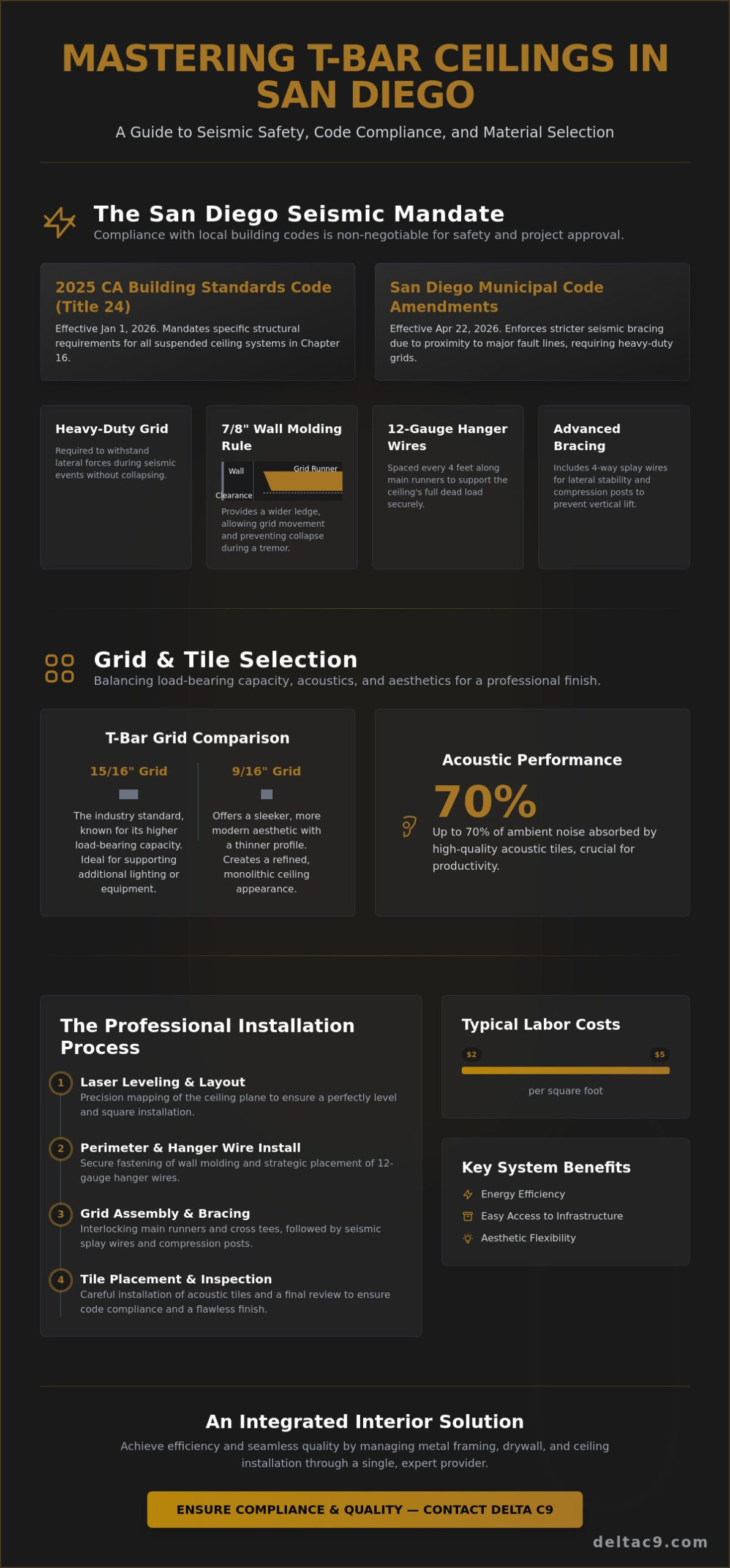
- Sound Reduction: Acoustic tiles are designed to absorb up to 70% of ambient noise. This is essential for maintaining productivity in open-plan San Diego offices.
- Energy Efficiency: By lowering the ceiling height, you reduce the total volume of air that needs to be cooled. It’s a practical way to manage utility costs during San Diego’s warmer months.
- Aesthetic Flexibility: You aren’t limited to standard white panels. Modern options include wood veneers, metallic finishes, and various textures that elevate the overall interior design.
San Diego Seismic Requirements and Building Codes
San Diego’s seismic environment demands more than just a level grid. Since January 1, 2026, all new permit applications must comply with the 2025 California Building Standards Code (Title 24). Chapter 16 of the CBC specifically addresses suspended systems, and because San Diego sits near major fault lines, the city adopted local amendments effective April 22, 2026. These regulations make seismic bracing non-negotiable for any T-bar ceiling installation San Diego project. For these Southern California projects, you must use a “heavy-duty” grid classification. This rating ensures the system can withstand the lateral forces generated during a tremor without collapsing.
One of the most critical safety details is the 7/8-inch wall molding rule. In seismic zones, the grid cannot be tightly fixed to the wall on all sides. Instead, it must have enough clearance to move. The 7/8-inch molding provides a wider ledge that prevents the grid runners from falling off their supports during an earthquake. This technical requirement is a frequent point of failure during local building inspections if not handled by an expert team.
Seismic Bracing and Hanger Wires
Safety starts with 12-gauge hanger wires. These wires must be spaced every 4 feet along the main runners to support the ceiling’s dead load. However, vertical support isn’t enough. We also install splay wires, which are tensioned wires pulled in four directions to provide lateral stability. To prevent the ceiling from “bouncing” or lifting during a seismic event, we use vertical compression posts, also known as struts. These rigid members connect the grid directly to the structural slab above, locking the entire system into a stable position. Every component we select meets or exceeds the established Acoustic Tile Standards for safety and performance.
Permits and Inspections in San Diego County
Permit fees for ceiling installations in San Diego typically range from $50 to $300, depending on the project’s complexity. You’ll need a permit for most commercial tenant improvements and significant residential remodels. During the inspection, San Diego officials look for specific wire wraps, at least three tight turns within three inches, and independent supports for light fixtures. They don’t allow heavy lights or HVAC vents to be supported solely by the ceiling grid. Delta C9 maintains a strict commitment to these safety protocols, ensuring your space is both beautiful and fully compliant. If you’re ready to upgrade your facility, our team can help you navigate these San Diego building requirements while ensuring a seamless installation process.
Choosing the Right Materials: Grids and Acoustic Tiles
Material selection is the foundation of a durable T-bar ceiling installation San Diego. The grid acts as the skeleton of the entire system, and its specifications dictate both the aesthetic and the load-bearing capacity. Most industrial and commercial projects utilize the standard 15/16-inch galvanized steel grid. It’s a robust, cost-effective choice that provides maximum stability. However, many modern San Diego office interiors now favor the slim 9/16-inch “fine-line” grid. This narrower profile offers a minimalist, architectural look that integrates seamlessly with contemporary design. While galvanized steel is the standard, aluminum grids are the preferred choice for coastal properties or high-moisture environments where corrosion resistance is a primary concern.
The tiles you select must perform as well as they look. Every tile used in a professional San Diego project should carry a Class A fire resistance rating to ensure full compliance with California safety codes. Humidity resistance is equally important. San Diego’s coastal air can cause inferior mineral fiber tiles to sag over time. High-performance tiles are engineered to resist moisture, maintaining their structural flatness for decades. You should also consider the “reveal” or edge detail. A square edge tile sits flush with the grid for a smooth, continuous surface. In contrast, a tegular edge tile features a routed perimeter that allows the tile to drop slightly below the grid, creating a shadow line that adds depth and texture to the ceiling.
Acoustic Ratings: NRC and CAC Explained
Acoustics are measured by two primary metrics: NRC and CAC. The Noise Reduction Coefficient (NRC) indicates how much sound a tile absorbs, with ratings typically ranging from 0.50 to 0.90. A high NRC is essential for open-plan San Diego offices to reduce echoing. The Ceiling Attenuation Class (CAC) measures how much sound is blocked from traveling through the ceiling plenum into adjacent rooms. For medical offices or legal firms where privacy is a priority, a CAC rating of 35 or higher is recommended to prevent confidential conversations from being overheard in the next suite.
Specialty Ceiling Tiles for Unique Spaces
- Washable Tiles: These are mandatory for San Diego restaurant kitchens and food prep areas. They feature a vinyl-faced surface that resists grease and allows for frequent sanitization.
- High-NRC Fiberglass: Ideal for recording studios or noisy call centers, these tiles provide maximum sound absorption to create a controlled acoustic environment.
- Impact-Resistant Tiles: In high-traffic hallways or gymnasiums, these reinforced tiles withstand physical contact without cracking or denting, ensuring the longevity of your T-bar ceiling installation San Diego.
The Professional T-Bar Installation Process
Precision is the cornerstone of a successful T-bar ceiling installation San Diego. The process begins with a comprehensive site survey where we use high-performance laser levels to establish a perfectly horizontal datum line across the entire perimeter. Even a variance of 1/8 inch can compromise the visual alignment of the grid and the fit of the acoustic tiles. Once the height is verified, we secure the L-shaped wall molding. We select fasteners specifically for the substrate, ensuring a rigid connection to metal studs or concrete walls that provides the necessary support for the outer edges of the system.
With the perimeter set, we focus on the structural suspension. We attach 12-gauge hanger wires to the structural deck above, typically spaced every 4 feet along the main runners. These wires are pre-stretched to prevent future sagging. We then install the main runners, followed by the cross tees that snap into place to form the final 2×2 or 2×4 grid pattern. Before any tiles are dropped in, we perform a final “squaring” of the grid. This step is vital to ensure that every tile fits snugly and that the grid remains stable during the integration of lighting and HVAC components.
MEP Coordination (Mechanical, Electrical, Plumbing)
Seamless integration with other trades is what separates a professional installation from a problematic one. We coordinate closely with electricians to ensure that LED troffers or recessed lighting cans are supported independently from the grid when required by code. HVAC registers and diffusers must be positioned so they don’t exert excessive weight on the cross tees. Additionally, we ensure that fire sprinkler heads are perfectly centered within the ceiling tiles. This meticulous planning prevents the need for costly adjustments after the ceiling is closed, ensuring your project stays on schedule.
Final Finishing and Tile Cutting
The final phase focuses on the aesthetic details that define a high-quality interior. We use specialized cutting tools to ensure clean, razor-sharp edges on perimeter tiles, especially around complex features like columns or curved walls. For tegular tiles, we utilize a “shadow line” cutting technique to maintain a consistent reveal across the entire room. After the tiles are seated, we conduct a thorough inspection to verify alignment and surface cleanliness. If you are ready to secure a stable and professional interior finish, you can request a quote for T-bar ceiling installation San Diego from our expert team.
Why Delta C9 is San Diego’s Choice for Ceilings and Drywall
Delta C9 operates with a philosophy defined by professionalism and engineering precision. With over 22 years of industry experience in San Diego’s commercial and residential sectors, we’ve developed a reputation as a strategic protector of our clients’ investments. We understand that a ceiling is not a standalone feature. It’s a critical component of a building’s infrastructure that must be safe, compliant, and durable. Our team doesn’t just install grids; we provide a controlled environment where stability and proactive protection are the standard for every T-bar ceiling installation San Diego project.
Choosing Delta C9 means choosing a single-source interior solution. Most contractors specialize in only one trade, which often creates friction between the framer, the drywaller, and the ceiling installer. We eliminate these communication gaps by managing the metal framing and drywall alongside the suspended system. This unified approach ensures that every structural element is perfectly aligned to support the ceiling grid. It also allows us to implement advanced soundproofing and insulation strategies that are often overlooked when trades are fragmented.
Integrated Interior Solutions
Our expertise in metal framing is the foundation of a high-quality ceiling. We ensure that the structural attachment points for hanger wires are located with engineering accuracy, preventing future sagging or grid misalignment. This synergy continues through the final drywall finishing stages. We coordinate the project flow so that all dust-heavy sanding is completed before the acoustic tiles are placed. This meticulous planning protects your materials and reduces the overall construction timeline by managing multiple trades under one disciplined roof.
Commitment to San Diego Clients
We are locally owned and operated, which gives us a nuanced understanding of the San Diego County building departments. We stay ahead of local code changes, such as the April 2026 amendments, to ensure your T-bar ceiling installation San Diego is fully compliant from day one. Our crews maintain professional, clean job sites that respect your ongoing business operations or home life. We provide transparent quoting and reliable scheduling, ensuring that the final result is a seamless operation that brings you peace of mind and long-term value.
Secure Your San Diego Interior with Professional Precision
Managing a commercial or residential project in Southern California requires a partner who understands that safety and aesthetics are inseparable. You’ve seen how the 2025 California Building Standards Code and local April 2026 amendments have transformed the requirements for suspended systems. From selecting the correct NRC-rated tiles to ensuring heavy-duty grid stability, every detail matters for long-term durability. A successful T-bar ceiling installation San Diego isn’t just about hanging a grid; it’s about creating a compliant, high-performance environment that protects your business or home.
Delta C9 brings over 22 years of local experience to every job site. Our integrated approach covers everything from metal framing and drywall to final ceiling finishing, ensuring a seamless transition between trades. We handle the technical complexities of seismic bracing and MEP coordination so you can focus on your daily operations with confidence. If you’re ready to achieve a quiet, professional, and fully inspected interior, we’re here to help. Get a Professional Quote for Your San Diego Ceiling Project today and experience the peace of mind that comes with expert craftsmanship. We look forward to securing your space for the years ahead.
Frequently Asked Questions
How much does T-bar ceiling installation cost in San Diego?
Standard installations typically range between $9 and $13 per square foot according to national averages for 2026. Labor costs for T-bar ceiling installation San Diego usually fall between $2 and $5 per square foot. You should also account for San Diego permit fees, which can range from $50 to $300 depending on the complexity and square footage of your project.
Are T-bar ceilings safe in an earthquake?
Yes, provided they are installed according to the 2025 California Building Standards Code. San Diego’s local amendments require heavy-duty grid classifications and specific splay wire bracing to manage lateral forces. We utilize 12-gauge hanger wires and vertical compression struts to ensure the system remains stable and fully compliant with the safety regulations that became effective on April 22, 2026.
Can I install a T-bar ceiling myself or do I need a pro?
Professional installation is recommended to ensure your project passes strict San Diego building inspections. While DIY kits are available, they often lack the heavy-duty components required for seismic safety in Southern California. Professionals use precision laser levels and specialized tensioning tools to ensure the grid is perfectly flat and structurally capable of supporting integrated lighting and HVAC systems.
What is the difference between a drop ceiling and a suspended ceiling?
There’s no functional difference between these two terms. Both describe a secondary ceiling hung from a structural slab to create a plenum space for utilities. “Suspended ceiling” is the technical term used by architects and in building codes, while “drop ceiling” is the common phrase used by property owners and tenants.
How long does it take to install a T-bar ceiling in a standard office?
A standard 1,000-square-foot office space typically takes two to three business days to complete. This timeline includes the initial site survey, grid layout, and the final placement of acoustic tiles. Projects requiring complex MEP coordination for fire sprinklers or recessed lighting may take longer to ensure all components are properly aligned and supported.
Can T-bar ceilings be used in moisture-heavy areas like bathrooms?
You can use these systems in humid environments if you choose moisture-resistant materials. We recommend aluminum grids to prevent corrosion and vinyl-faced tiles that don’t absorb water. These specialty materials are essential for San Diego coastal properties where salt air and humidity can cause standard mineral fiber tiles to sag or deteriorate over time.
What should I do if my ceiling tiles are sagging or stained?
You must first identify and repair the source of the moisture, such as a leaking pipe or HVAC condensation. Stained tiles are often a sign of a plumbing issue, while sagging usually results from high humidity or poor material quality. We offer comprehensive repair services, including mold remediation and the installation of high-performance tiles that resist future moisture damage.
Do T-bar ceilings meet fire code requirements for San Diego businesses?
T-bar systems are the standard for meeting fire codes in commercial interiors. Most professional-grade acoustic tiles carry a Class A fire rating, which is a requirement for office buildings and retail spaces. Our T-bar ceiling installation San Diego process ensures that every component, from the grid to the tiles, aligns with the fire-resistive standards mandated by local building departments.