
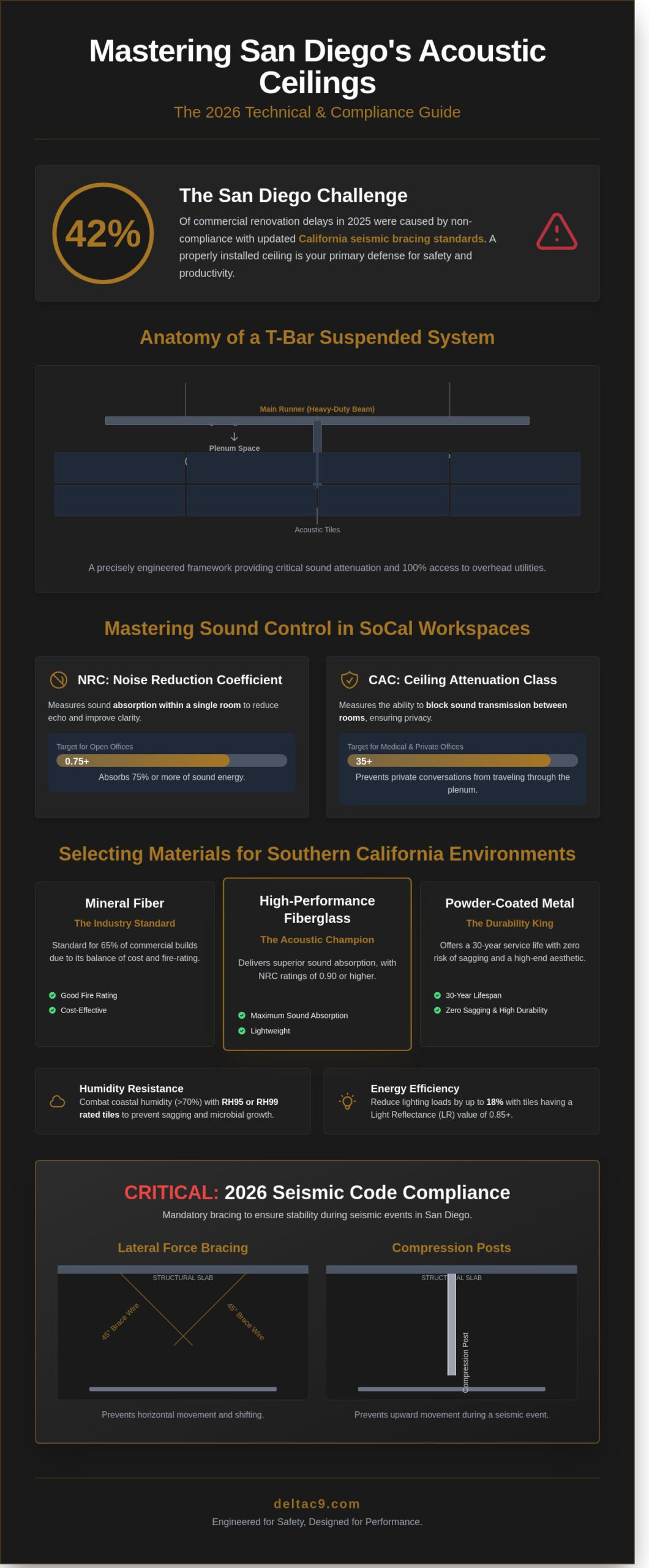
In San Diego, 42 percent of commercial renovation delays in 2025 were caused by non-compliance with updated California seismic bracing standards. You likely understand that a ceiling is far more than a visual finish; it’s a critical safety component and your primary defense against the 65-decibel noise floor of a modern open-office plan. Securing a professional acoustic ceiling grid installation San Diego ensures your infrastructure remains stable during seismic events while neatly concealing the complex network of HVAC and plumbing lines that often clutter interior designs.
We’re here to provide the technical clarity you need to master seismic-compliant systems and select the ideal materials for your specific square footage. This 2026 buying guide outlines how to achieve a quiet, professional environment that offers 100 percent access to overhead utilities. We’ll examine the latest local safety codes and the specific sound absorption ratings required to satisfy both building inspectors and your employees. You’ll gain the control and confidence to manage your project with engineering precision, ensuring your workspace remains a stable asset for years to come.
Key Takeaways
- Master the core components of T-bar suspended systems and understand how they provide critical sound attenuation for San Diego businesses.
- Navigate the material selection process to find moisture-resistant tiles that can withstand the specific coastal humidity of Southern California.
- Ensure your project remains compliant with 2026 seismic codes by implementing specialized lateral force bracing and compression posts.
- Follow a professional installation roadmap, from initial site assessments to precise laser-leveling, to guarantee structural integrity and aesthetic quality.
- Learn why selecting a “Strategic Protector” for your acoustic ceiling grid installation San Diego ensures long-term business continuity and building safety.
The Essentials of Acoustic Ceiling Grid Installation in San Diego
A professional dropped ceiling provides more than just a finished look; it serves as a critical structural layer for modern commercial environments. Proper acoustic ceiling grid installation San Diego requires a deep understanding of the T-bar suspended system. This framework consists of a metal grid suspended from the structural slab by heavy duty wires, creating a plenum space that is essential for building functionality. The grid acts as a strategic shield. It conceals the complex web of HVAC ducting, fire suppression lines, and electrical conduits that power modern digital operations. This accessibility ensures that maintenance teams can reach critical infrastructure without damaging the building’s permanent structure.
San Diego businesses are currently witnessing a significant shift in interior standards. By 2026, 85% of high-end office builds in the Gaslamp Quarter and Sorrento Valley are projected to move away from basic mineral fiber toward designer wood-look and metal tiles. This evolution reflects a demand for spaces that combine industrial durability with a refined, high-end aesthetic. Architects and facility managers increasingly demand precision in acoustic ceiling grid installation San Diego to ensure both safety and aesthetic continuity in these premium environments. Our approach focuses on stability and control, ensuring your overhead infrastructure remains a silent partner in your business success.
Anatomy of a Suspended Ceiling System
The integrity of the system depends on three primary components working in unison. The main runners are the heavy-duty beams that carry the weight of the entire assembly, spaced exactly 4 feet apart. Cross tees then snap into these runners to create the 2×2 or 2×4 openings for the tiles. For a clean San Diego finish, wall angles and perimeter trims must be leveled with laser precision to prevent gaps. We utilize 12-gauge hanger wire to guarantee long-term stability and prevent sagging over the system’s 20-year lifespan.
Why Sound Control Matters in SoCal Workspaces
Noise management is a non-negotiable requirement for productive environments. In open-plan offices, we target a Noise Reduction Coefficient (NRC) of 0.75 or higher. This rating indicates that the ceiling absorbs 75% of the sound energy hitting it, which significantly reduces echo. In San Diego medical facilities and educational hubs, the Ceiling Attenuation Class (CAC) is equally vital. A CAC rating of 35 or higher prevents private conversations from traveling through the plenum space into adjacent rooms. This technical precision protects sensitive data and maintains the professional confidentiality your clients expect.
- NRC (Noise Reduction Coefficient): Measures sound absorption within a single room.
- CAC (Ceiling Attenuation Class): Measures the ability to block sound transmission between rooms.
- Seismic Compliance: Essential for San Diego’s specific building codes and safety regulations.
Selecting the Right Materials for Southern California Environments
Choosing the correct components for an acoustic ceiling grid installation San Diego project requires a data-driven approach to local environmental factors. Material choice directly dictates the lifecycle of the system. Mineral fiber remains a standard for 65% of commercial builds due to its fire rating; however, high-performance fiberglass offers Noise Reduction Coefficients (NRC) of 0.90 or higher. For facilities requiring maximum durability, powder-coated metal panels provide a 30-year service life with zero risk of sagging. This level of engineering precision ensures that your acoustic ceiling grid installation San Diego investment yields long-term value and structural stability.
San Diego’s unique climate demands specific material ratings. In coastal areas like Chula Vista, average relative humidity often exceeds 70% during the morning hours. Standard tiles absorb this moisture, leading to visible sagging and microbial growth. We specify tiles with RH95 or RH99 ratings to ensure structural integrity remains constant regardless of external weather patterns. Beyond durability, energy efficiency is a primary driver. Selecting tiles with a Light Reflectance (LR) value of 0.85 or higher allows businesses to reduce artificial lighting loads by up to 18%. This aligns with the 2022 California Green Building Standards (CALGreen), which mandate strict low-VOC emissions for interior materials to maintain healthy air quality for all occupants.
Coastal vs. Inland Material Considerations
Properties within five miles of the San Diego Bay require moisture-stable panels to prevent troughing or grid oxidation. Conversely, inland locations like El Cajon or Escondido experience temperature swings exceeding 30 degrees in a single day. These areas benefit from high-density panels with increased R-values to stabilize HVAC performance. For specialized environments, such as the 1,200+ medical clinics across San Diego County, antimicrobial coatings are mandatory to inhibit the growth of mold and bacteria, ensuring a sterile environment for patient care.
Aesthetic Options: Beyond the White Square
Design trends in San Diego’s tech sector have shifted toward 4-foot by 4-foot acoustic clouds and wood-look aluminum planks that offer warmth without the weight of timber. Entertainment venues in the Gaslamp Quarter often utilize black-out tiles with a light reflectance of less than 0.04 to control stage lighting effectively. Modern systems now integrate 2×4 LED panels directly into the grid, creating a flush, seamless finish. Ensuring these components are properly balanced is essential for long-term operational stability and system safety.
Navigating San Diego Seismic Codes for Suspended Ceilings
San Diego’s proximity to the Rose Canyon and Elsinore fault lines places nearly all local commercial structures within Seismic Design Categories D, E, or F. These classifications demand rigorous engineering standards for every acoustic ceiling grid installation San Diego project. The 2026 California Building Code updates have intensified requirements for lateral force bracing and compression posts to ensure ceiling systems remain intact during a 6.0 magnitude tremor or higher. Adhering to ASTM E580 is not a suggestion; it’s a legal necessity for life safety. Professional installation prevents the catastrophic “pancake” collapse of ceiling tiles, which accounts for a significant portion of interior property damage during seismic events in Southern California.
The 2-Inch Rule and Perimeter Clearance
In high-risk seismic zones, the grid cannot be rigidly fixed to the wall. San Diego commercial codes mandate a 2-inch wide perimeter closure angle to accommodate building sway. This creates a “floating” ceiling system where the grid maintains a 3/4-inch clearance from the wall molding. We utilize specialized seismic clips that secure the grid on two adjacent walls while allowing the opposing sides to slide freely. This configuration ensures that when the building moves, the ceiling doesn’t buckle or drop its load. Our team ensures these gaps are precise, as even a 1/8-inch deviation can lead to a failed inspection.
Seismic Hanger Wires and Bracing
Stability in a suspended system relies on a complex network of 12-gauge splay wires and vertical struts. The law requires four splay wires attached at 45-degree angles every 144 square feet of ceiling area. These wires provide the lateral resistance needed to stop the grid from swinging like a pendulum. Additionally, vertical compression posts are installed to prevent the ceiling from jumping upward during vertical ground shifts. Data from local building departments shows that 22% of initial inspection failures in San Diego County result from improper wire tension or missing struts. Delta C9 avoids these setbacks by implementing a rigorous verification protocol:
- Splay Wire Precision: Every 45-degree wire is tensioned to eliminate slack before tile placement.
- Strut Placement: Vertical struts are placed every 12 feet on center to counteract uplift forces.
- Heavy-Duty Components: We only use heavy-duty main beams capable of supporting 16 pounds per linear foot.
- Independent Support: All electrical fixtures and HVAC diffusers receive independent 12-gauge slack wires for redundant safety.
By prioritizing these engineering details, we ensure your facility remains operational and safe. Our approach focuses on proactive protection, turning complex seismic codes into a structured framework for long-term stability and business continuity.
The Installation Process: What to Expect for Your SD Project
A professional acoustic ceiling grid installation San Diego project begins with a rigorous site assessment. We don’t just start hanging wires; our team evaluates the structural integrity of the existing joists and identifies potential obstructions. We check for level and identify the most secure structural points to anchor the hanger wires. This phase is critical for long-term stability and prevents the sagging often seen in amateur installations. We verify every measurement against the architectural plans to ensure the final layout matches the intended design exactly.
Precision is the cornerstone of our methodology. We establish the exact ceiling height using 360-degree rotary lasers. This technology allows us to mark a perfectly level line across the entire perimeter of the room. Even a minor 1/8-inch deviation can cause visible alignment issues in large San Diego commercial spaces. Once the wall angle is secured, we assemble the main beams and cross tees. Squareness is the absolute priority during this stage. If the grid isn’t perfectly square, the acoustic tiles won’t sit flush, creating unsightly gaps. We maintain strict 90-degree tolerances to ensure a seamless, professional finish.
The final phase involves the drop-in of the acoustic tiles and the integration of essential facility systems. This isn’t a simple task of placing panels. We coordinate the precise cutouts for fire sprinklers and ensure that heavy lighting fixtures are properly supported, either by the grid itself or by independent support wires. This meticulous approach ensures that your ceiling isn’t just aesthetic, but fully compliant with local safety codes.
Coordinating with Other Trades
Timing is critical for a successful build-out. The ceiling grid installation must occur after the metal framing and drywall phases are finished. We manage the “above-ceiling” dance by communicating daily with HVAC and electrical teams. This proactivity prevents the need for costly re-work when ducts or conduits interfere with grid hangers. We finish by managing the punch list for San Diego tenant improvements, ensuring every tile is clean and every grid line is straight.
Timeline and Project Management
For a standard 5,000 sq ft office in San Diego, the grid and tile installation typically takes 3 to 4 business days. We prioritize minimizing downtime for active businesses by scheduling high-impact tasks during off-peak hours. Our project management style focuses on efficiency and cleanliness. Our process concludes with a thorough debris management plan, removing all scrap metal and dust. We leave the site ready for immediate occupancy, ensuring your business operations continue without interruption.
Secure your facility’s infrastructure by scheduling a consultation with our San Diego installation experts today.
Delta C9: San Diego’s Expert in Integrated Interior Solutions
Delta C9 has served San Diego County since 2002. Over these 22 years, we’ve developed a reputation for technical precision that goes beyond simple aesthetics. We operate as a Strategic Protector for your facility. This means we prioritize structural integrity and long-term compliance above all else. Every acoustic ceiling grid installation San Diego project we manage is designed to meet the rigorous safety standards required by California’s building codes. We don’t just install tiles; we secure the environment where your team works.
Our roots in heavy-gauge metal framing provide a unique advantage for complex ceiling systems. A grid is only as stable as the structure supporting it. Because our team understands the engineering behind the interior envelope, we identify potential leveling issues before the first hanger wire is even attached. This proactive approach prevents the sagging and misalignment that often plague lower-quality installations. We offer property owners direct communication and total transparency. You’ll always know the exact status of your project without having to chase down a foreman.
The Synergy of Framing, Drywall, and Ceilings
Choosing a single partner for your interior build-out eliminates the typical friction between different trades. When you utilize our commercial construction expertise, you remove the risk of “finger-pointing” between subcontractors. In many San Diego renovations, the ceiling installer blames the framer for uneven walls, which leads to delays and cost overruns. We take full responsibility for the entire assembly. This ensures that transitions from high-end drywall finishes to acoustic grids are perfectly flush. We maintain strict tolerances, often within 1/16th of an inch, to ensure a level plane across large open-plan offices.
- Single-source accountability for the entire interior scope.
- Elimination of scheduling conflicts between framing and ceiling crews.
- Unified safety protocols that exceed OSHA standards on every job site.
- Precision alignment between bulkheads, soffits, and T-bar grids.
Get Your San Diego Ceiling Quote
We provide comprehensive site evaluations for commercial projects throughout Chula Vista and the San Diego Metro area. Our bidding process is methodical and honest. We include all necessary seismic hardware, compression struts, and lateral bracing required by local building inspectors in our initial price. You won’t deal with hidden fees or surprise change orders halfway through the job. We’ve built our business on the promise of stability and predictability. Contact our office today to schedule a walkthrough. We’ll provide a detailed roadmap for a professional, code-compliant acoustic ceiling grid installation San Diego business owners can rely on for decades.
Future-Proof Your San Diego Facility with Seismic-Ready Infrastructure
Building a resilient commercial space requires more than just aesthetic choices. It demands a strategic approach to safety and structural integrity. By prioritizing materials that withstand Southern California’s unique humidity and adhering strictly to Seismic Category D through F requirements, you protect your investment and your people. A precise acoustic ceiling grid installation San Diego project serves as the backbone of your interior environment, ensuring stability when it matters most.
Delta C9 operates as your strategic partner in this process. With 22 years of San Diego construction expertise, we focus on risk reduction and operational continuity. Our team is a fully licensed and insured California contractor specializing in high-stakes environments where precision is the only standard. We don’t just install ceilings; we deliver the peace of mind that comes from knowing your facility meets every 2026 safety benchmark.
Your path to a secure, high-performance workspace starts with expert guidance. Secure your San Diego facility with a code-compliant ceiling; contact Delta C9 today. We’re ready to help you build a safer future for your business.
Frequently Asked Questions
How much does acoustic ceiling grid installation cost in San Diego?
Acoustic ceiling grid installation San Diego costs typically range from $5.50 to $9.25 per square foot for labor and materials. A standard 1,200 square foot commercial space will usually require a budget between $6,600 and $11,100. These figures fluctuate based on the choice of mineral fiber tiles and the complexity of the room’s perimeter.
Are suspended ceilings required to be earthquake-proof in California?
Yes, the California Building Code Title 24 mandates that all suspended ceilings meet strict seismic requirements. You’re required to use 12-gauge hanger wires and install lateral force bracing every 12 feet to prevent collapse. These regulations ensure that the grid stays secure during a seismic event, protecting everyone inside the building.
What is the difference between a drop ceiling and an acoustic ceiling?
A drop ceiling is a general term for any secondary ceiling suspended below the main structure. An acoustic ceiling is a specialized version designed specifically to absorb sound using tiles with a high Noise Reduction Coefficient. While all acoustic systems are dropped, not all drop ceilings use the dense fiberglass or mineral wool needed for sound control.
Can I install an acoustic ceiling in my San Diego home basement?
You can certainly install an acoustic ceiling in a residential basement to dampen noise and hide plumbing. Since many San Diego basements have limited 7 or 8 foot clearances, we use specialized low-clearance hangers to save space. It’s a practical choice because it allows you to access electrical wires or pipes without cutting through drywall.
How do I choose the right NRC rating for my San Diego office?
Target an NRC rating of 0.75 or higher for open-plan offices where echoing is a primary concern. This rating indicates the material absorbs 75% of the sound energy that strikes it. If your goal is privacy between executive offices, prioritize a Ceiling Attenuation Class (CAC) of 35 or more to stop sound from traveling over walls.
Does Delta C9 handle both the grid and the acoustic tiles?
Delta C9 manages the full installation process, including the structural grid and the final acoustic tiles. We coordinate the procurement of all components to ensure the 15/16 inch or 9/16 inch grid matches your selected panels. Our team takes responsibility for the entire system’s stability, providing a single point of contact for your project.
How long does it take to install a commercial ceiling grid?
A professional three-person crew can typically install 700 to 900 square feet of grid and tile per eight-hour workday. For a mid-sized 3,000 square foot office, you should plan for four to five days of active construction. This schedule accounts for laser leveling, perimeter molding attachment, and the final placement of all acoustic panels.
Do I need a permit for a suspended ceiling in San Diego County?
San Diego County requires a building permit for any commercial suspended ceiling installation that exceeds 144 square feet. Your application must include a reflected ceiling plan that proves compliance with the 2022 California Building Code seismic standards. Residential projects involving simple repairs or small areas often don’t require a permit, but we always recommend checking local municipal codes.