
Under California Health and Safety Code §17920.3, visible mold is legally classified as a substandard housing condition. This is a critical distinction for San Diego property owners, as mold spores begin colonizing damp surfaces in as little as 24 to 48 hours. You’re likely concerned about hidden growth behind your walls or the difficulty of matching unique Southern California textures once the repairs are finished. It’s understandable to feel overwhelmed by the technical requirements of the 2025 California Building Standards Code, which took effect on January 1, 2026.
Our guide empowers you to master the professional drywall water damage restoration process, ensuring your environment remains structurally sound and aesthetically perfect. We’ll provide the expert clarity you need to handle everything from initial moisture mitigation to insurance documentation. You’ll learn the precise steps for executing strategic “flood cuts” and achieving a flawless Level 5 finish that restores your home’s value and your own peace of mind. We’ll examine the specific techniques required to ensure your restoration meets the latest City of San Diego local amendments adopted in April 2026.
Key Takeaways
- Learn how to navigate the professional drywall water damage restoration process to maintain structural integrity and prevent mold colonization in San Diego’s coastal climate.
- Discover the industrial-grade sequence required to ensure a moisture source is fully mitigated before any reconstruction begins.
- Understand the “12-inch rule” and the engineering criteria used to determine if a wall requires a simple patch or a full structural replacement.
- Master the techniques for matching complex Southern California textures like “Orange Peel” and achieving a seamless Level 5 finish.
- Identify proactive maintenance strategies, such as HVAC condensate line inspections, to protect your property from recurring moisture risks.
Understanding the Drywall Water Damage Restoration Process
The drywall water damage restoration process is a systematic engineering solution designed to stabilize your property’s environment. It’s far more than a simple cosmetic fix. This multi-stage sequence includes professional moisture extraction, antimicrobial treatment, and eventual structural reconstruction. In San Diego, our unique microclimates create specific risks. Coastal homes often face high humidity that prevents natural drying, while inland properties deal with slab leaks that wick moisture upward from the foundation. These slab leaks are particularly common in San Diego’s older residential developments built on concrete foundations.
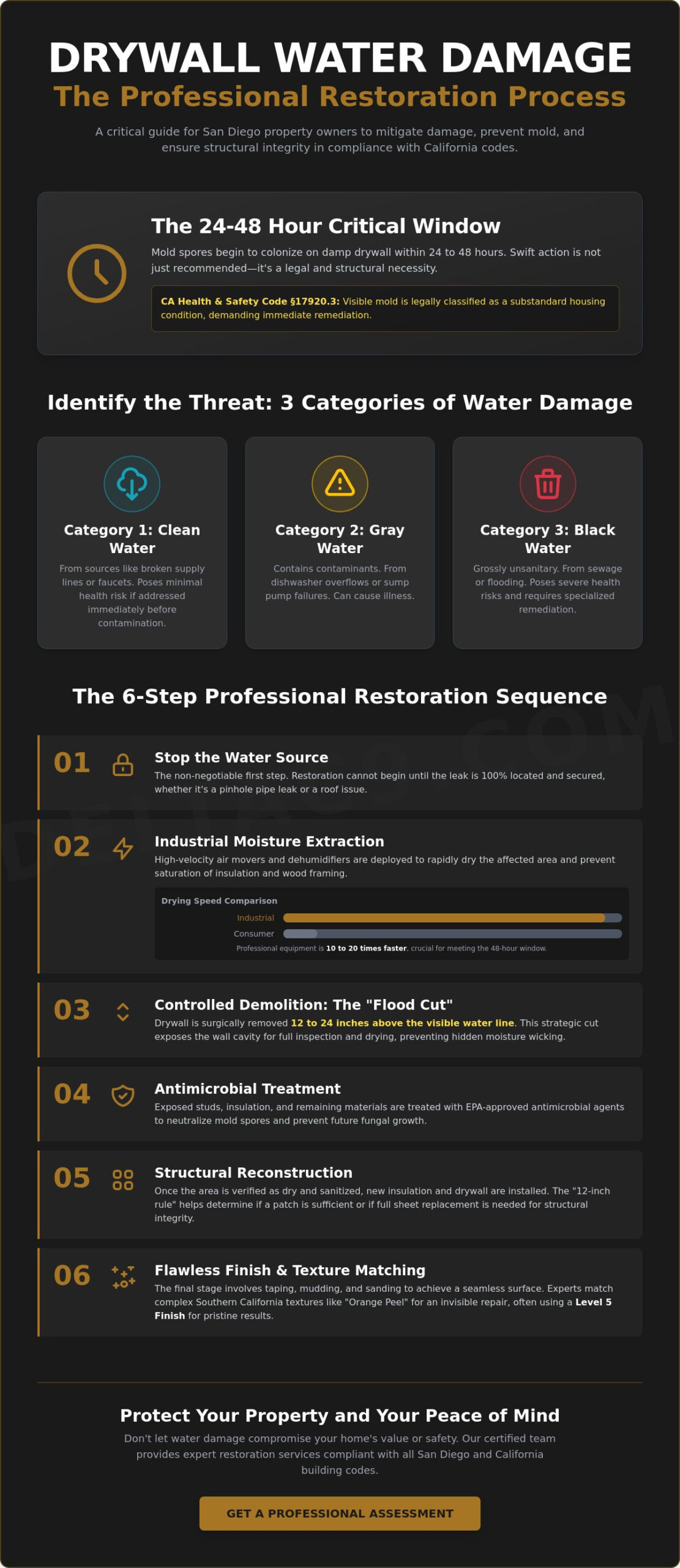
Speed is your most valuable asset when dealing with water intrusion. The “48-hour window” represents a critical biological deadline. Mold spores are opportunistic. Once they find a moisture source and a food supply, colonization begins almost immediately. Under the 2025 California Building Standards Code, which became effective on January 1, 2026, maintaining a mold-free environment isn’t just a preference; it’s a legal requirement for property safety. Visible mold is officially classified as a substandard housing condition under California Health and Safety Code §17920.3, making immediate action a priority for both landlords and homeowners.
Drywall’s primary vulnerability lies in its composition. It consists of a gypsum core encased in heavy paper. These specific properties of drywall make it exceptionally porous. When water enters the core, the material loses its structural integrity and its bond to the wall studs. You must be able to distinguish between surface moisture, which can sometimes be salvaged with industrial dehumidifiers, and a fully saturated core that requires removal to prevent long-term structural failure and hidden mold growth.
The Three Categories of Water Damage in CA
Identifying the type of water involved is the first step in the drywall water damage restoration process. Category 1 is clean water, typically from a broken supply line or a leaking faucet. It poses the least risk but still requires rapid drying to prevent degradation. Category 2 is gray water, which contains chemical or biological contaminants from sources like dishwasher overflows or sump pump failures. Category 3 is black water, involving sewage or groundwater flooding. This category is highly unsanitary and requires specialized remediation to ensure the space is safe for occupancy again.
Identifying Signs of Hidden Damage
Hidden moisture is a silent threat to your home’s stability. Visual cues like bubbling paint, yellow-brown staining, or sagging ceiling sections are clear warnings. You can perform a “Soft Test” by applying firm pressure to the wall. If the drywall feels spongy or yields under your touch, the gypsum core has dissolved and cannot be saved. Musty odors are another primary indicator. If you smell dampness, it’s a sign that mold remediation is needed before any structural repairs can proceed. Detecting these issues early prevents the need for more extensive, costly reconstruction later.
Step-by-Step: The Professional Restoration Sequence
The professional drywall water damage restoration process begins with a non-negotiable step: stopping the water source. Whether it’s a pinhole leak in copper piping or a damaged roof shingle from a rare San Diego rainstorm, restoration cannot proceed until the leak is 100% resolved. Once the source is secured, we utilize industrial-grade dehumidifiers and high-velocity air movers. Professional equipment removes water 10 to 20 times faster than consumer-grade fans. This speed is vital to prevent the saturation of the wall’s insulation and framing, which can lead to long-term structural instability.
Controlled demolition follows the extraction phase. We utilize the “flood cut” technique, which involves removing drywall 12 to 24 inches above the visible water line. This allows for a thorough inspection of the wall cavity and ensures that moisture hasn’t wicked higher than the surface suggests. During this phase, applying antimicrobial agents to the studs and remaining materials is essential to neutralize potential fungal growth. You should consult the EPA mold cleanup guidelines to understand the safety protocols and cleanup techniques required for a healthy environment. If you’re dealing with extensive saturation, our specialized mold remediation services can provide the deep cleaning necessary before reconstruction begins.
Inspection and Moisture Mapping
Moisture mapping is the non-invasive standard for modern restoration. We use thermal imaging cameras and penetrating moisture meters to detect water trapped behind studs that the naked eye cannot see. This data is critical for San Diego insurance adjusters; it provides empirical proof of the damage extent and justifies the scope of work. Accurate mapping prevents costly “re-work” by ensuring every pocket of moisture is identified during the initial assessment.
Drying and Dehumidification Standards
Professional drying is a calculated science. We determine the required air exchange by measuring the cubic footage of the affected room and the specific category of water involved. Monitoring continues daily until the materials reach the “dry standard” for Southern California, which typically accounts for our coastal humidity levels. Simple air drying is insufficient because it fails to address the stagnant air pockets inside wall cavities. These pockets often remain damp long after the surface feels dry. Professional structural drying typically takes 3 to 5 days to reach safe levels.
Structural Repair: Patching vs. Full Replacement
Once the drying phase of the drywall water damage restoration process is complete, we must determine whether to patch the existing surface or execute a full replacement. This decision isn’t subjective; it’s based on the structural bond between the gypsum core and the framing. If the drywall has softened or pulled away from the fasteners, it’s no longer a safe substrate. We adhere to the 12-inch rule, which dictates cutting back to the nearest healthy stud at least one foot beyond the last point of moisture saturation. This ensures we’re anchoring new material to a stable, dry foundation and eliminates the risk of hidden microbial growth behind seemingly dry surfaces.
The framing material also dictates our technical approach. Wood framing requires careful inspection for warping or rot, while metal framing, prevalent in many San Diego structures, must be checked for corrosion or compromised galvanized coatings. During this reconstruction phase, it’s the ideal time to replace compromised insulation. Water-logged fiberglass or cellulose insulation loses its thermal efficiency and becomes a primary site for mold growth if not swapped for fresh material. Ensuring these internal components are secure is the only way to guarantee the long-term stability of the wall.
Commercial vs. Residential Repair Nuances
Commercial projects in San Diego often involve metal framing and drywall assemblies that must meet strict fire-rated standards. These Type X assemblies require specific installation techniques to maintain the building’s safety integrity under the 2025 California Building Standards Code. Residential repairs, however, prioritize aesthetic continuity. Matching the unique ‘Orange Peel’ or ‘Knockdown’ textures common in Southern California homes is a specialized skill that requires professional consistency. This phase also offers a strategic opportunity to integrate soundproofing solutions, such as resilient channels, to improve acoustic privacy between rooms.
Installing the New Material
Precision during installation prevents future maintenance issues. We typically use 1/2-inch drywall for standard residential walls and 5/8-inch for ceilings or fire-rated commercial applications. Proper screw patterns are vital; we place fasteners every 12 inches on wall studs and every 8 to 12 inches on ceiling joists. This density prevents the “nail pops” or sagging that often plague amateur repairs. Ensuring tight, beveled joints allows for a seamless transition during the finishing stage, which is the final step in the professional drywall water damage restoration process.
Achieving a Flawless Finish in San Diego Homes
The aesthetic phase is where the technical success of the drywall water damage restoration process meets visual perfection. In San Diego, where Mediterranean and modern architectural styles dominate, the wall finish must be indistinguishable from the original surface. A common failure in amateur restoration is the “flashing” effect, where the repaired area absorbs paint differently than the surrounding wall. To prevent this, we apply a high-quality primer-sealer that equalizes the porosity of the new gypsum and the old paper. Professional drywall finishing ensures that once the final coat of paint is applied, there are no visible transitions or “halos” around the patch.
Matching the specific “splatter” or “drag” of existing textures is a specialized skill. We analyze the density and height of the surrounding texture before selecting the appropriate equipment. Whether your home features the heavy “Knockdown” style popular in the early 2000s or the subtle “Orange Peel” found in more recent developments, the goal is total continuity. Skim coating plays a vital role here; it allows us to “feather” the new joint compound far beyond the physical patch, creating a gradual transition that the human eye cannot detect.
Texture Matching Mastery
Replicating aged textures requires precise control over hopper gun air pressure and material viscosity. We adjust these variables to match the specific “splatter” pattern of your existing walls, accounting for how previous paint layers may have softened the original profile. We use specialized primer-sealers to block any residual tannin staining from the water damage, preventing ghosting through the final finish. Professional texture matching is the hallmark of a quality restoration because it renders the traumatic event of water damage completely invisible to the eye.
Level 5 Finishing for Modern Interiors
Modern San Diego interiors often feature “smooth wall” finishes that are highly sensitive to critical lighting. When sunlight hits a wall at a sharp angle from a large window, even the smallest imperfection becomes a glaring shadow. In these scenarios, a Level 5 finish is the only acceptable standard. This process involves applying a thin skim coat over the entire wall surface, not just the joints. It creates a uniform surface that is perfectly paint ready, ensuring high-gloss or satin finishes look flawless.
Our team utilizes HEPA-filtered vacuum sanding systems to maintain a dust-free environment during this final phase. This is particularly important for residential remodeling where air quality is a priority for the occupants. If you want to ensure your home is restored to a gallery-quality standard, contact our specialists to schedule a professional assessment of your finishing needs. We’ll handle the complexities of the drywall water damage restoration process so you can return to a beautiful, safe, and functional living space.
Preventing Future Water Damage in San Diego
Proactive property management is the final phase of a truly professional drywall water damage restoration process. While emergency repairs stabilize the immediate environment, long-term security requires identifying systemic vulnerabilities. In Southern California, a primary cause of unexpected ceiling failure is the HVAC condensate line. During peak summer months, these lines can produce several gallons of water daily. If they become clogged with algae or debris, the overflow saturates the surrounding drywall almost instantly. We recommend bi-annual inspections of your primary and secondary drain lines to ensure they remain clear and functional.
The resilience of your interior starts with the initial ceiling and drywall installation. In high-humidity zones like bathrooms, kitchens, and laundry rooms, standard gypsum board is insufficient. We utilize moisture-resistant “Green Board” or cement-based backer boards that inhibit water absorption. These materials provide an essential layer of defense against the steam and splashes common in residential settings. Professional maintenance is always more cost-effective than emergency restoration, as it allows you to address minor leaks before they escalate into structural failures or mold colonies.
Coastal Maintenance Tips
San Diego’s coastal geography introduces specific challenges, particularly regarding indoor humidity and salt-air exposure. To inhibit mold growth, you should maintain indoor relative humidity levels below 50%. Coastal homes are also prone to salt-air corrosion, which can degrade metal framing and fasteners over time, compromising the bond of your drywall. We suggest an annual plumbing audit to check for slab leaks, which are a prevalent issue in local homes built on concrete foundations. Detecting a slab leak early can save you from an extensive drywall water damage restoration process involving the lower three feet of your entire first floor.
When to Call Delta C9
Complex restoration requires a partner who understands the integration of modern building systems. We specialize in handling large-scale commercial construction restoration projects where business continuity is the priority. Our team provides the same level of engineering precision to residential remodels following a major water loss, ensuring your home meets the 2025 California Building Standards Code. We take responsibility for the entire sequence, from the initial moisture audit to the final aesthetic finish. Contact Delta C9 for a professional assessment of your water damage today. We’ll provide the expert guidance needed to restore your peace of mind and the long-term stability of your property.
Restoring Your Property’s Integrity and Value
Successfully managing the drywall water damage restoration process requires a blend of engineering precision and aesthetic mastery. You’ve learned that immediate moisture mapping and industrial-grade drying are the only ways to prevent permanent structural loss and mold colonization. Whether you’re navigating the 2025 California Building Standards Code for a commercial facility or matching custom textures in a coastal home, the quality of the initial response determines the longevity of the repair. A systematic approach ensures that hidden moisture doesn’t compromise your air quality or wall stability in the years to come.
Delta C9 brings over 22 years of San Diego experience to every project. Our team specializes in the technical intersection of metal framing, mold remediation, and flawless drywall finishing. We’ve built an A+ reputation across Southern California by prioritizing the safety and business continuity of our clients. Don’t leave your property’s structural health to chance. Request a Professional Drywall Restoration Quote from Delta C9 to ensure your space is restored to the highest professional standard. We’re here to help you move forward with confidence and a perfectly finished interior.
Frequently Asked Questions
How long does the drywall water damage restoration process usually take?
Professional structural drying typically takes 3 to 5 days to reach a safe moisture standard. The total drywall water damage restoration process, including structural repairs and a Level 5 finish, generally spans 1 to 4 weeks. This timeline depends on the scale of the intrusion and whether specialized mold remediation is required before the reconstruction phase begins.
Is it possible to dry out wet drywall without removing it?
You can only salvage drywall if the water is Category 1 (clean) and the material hasn’t lost its structural integrity. If the gypsum core remains saturated for more than 48 hours, the internal bond usually fails. In these cases, removal is mandatory to comply with the 2025 California Building Standards Code and ensure a mold-free environment.
Does home insurance in San Diego typically cover drywall water damage?
Most San Diego policies cover damage that is sudden and accidental, such as a burst pipe or a failed water heater. They often exclude gradual damage or “seepage” that has occurred over a period exceeding 14 days. You’ll need documented moisture mapping and professional assessments to satisfy the requirements of local adjusters following the April 2026 local code amendments.
What is a “flood cut” and when is it necessary?
A flood cut involves removing the bottom 12 to 24 inches of drywall above the visible water line. This is necessary whenever moisture has reached the wall cavity or insulation. It allows technicians to dry the wooden or metal framing directly and ensures that no hidden fungal colonies remain trapped behind the wall surface after the drywall water damage restoration process is complete.
Can I paint over a water stain if the drywall feels dry?
Painting over a stain without professional verification is a significant risk to your property’s safety. Even if the surface feels dry to the touch, the internal core often retains enough moisture to support mold growth or cause the new paint to bubble. You must use a penetrating moisture meter to confirm the material has returned to the Southern California dry standard before applying any finish.
How can I tell if there is mold behind my water-damaged drywall?
Persistent musty odors are the most reliable indicator of hidden microbial growth. You may also notice dark spotting or “ghosting” where the drywall fasteners are located. We use professional thermal imaging cameras to detect temperature anomalies behind the wall, which often point to pockets of moisture where mold colonies are actively developing.
What is the difference between a patch and a full drywall replacement?
A patch is an aesthetic fix for localized damage where the drywall still maintains a firm bond to the framing. Full replacement is required when the material has sagged, crumbled, or pulled away from the screws. If more than 25% of a wall surface is affected by Category 2 or 3 water, a full replacement is usually the most cost-effective way to ensure long-term structural safety.
Why is professional dehumidification better than using household fans?
Industrial-grade dehumidifiers extract moisture from the air and the building’s infrastructure 10 to 20 times faster than consumer fans. Household fans only circulate air across the surface, which can actually spread mold spores throughout your home. Professional equipment creates a controlled environment that pulls deeply embedded water out of the studs and gypsum, preventing permanent structural degradation.
One Response