
A wall is not merely a partition; it’s a critical engineering component that determines the operational efficiency and long-term stability of your interior environment. In San Diego, where the 2025 California Building Standards Code (Title 24) became effective on January 1, 2026, the technical synergy between drywall and insulation has become the primary defense against rising energy costs and coastal moisture. Treating these systems as separate trades often leads to thermal gaps and acoustic leaks that compromise the functional integrity of your property.
We understand the frustration of escalating utility bills and the lack of privacy caused by poor sound attenuation between rooms. This article demonstrates how the professional integration of these materials creates a durable, soundproof, and energy-efficient space that meets the latest STC ratings and local San Diego amendments. You’ll learn how a unified approach to interior systems ensures your residential or commercial project remains compliant, quiet, and protected against the specific environmental challenges of the Southern California coast.
Key Takeaways
- Understand why integrating drywall and insulation as a unified system is the most effective way to ensure thermal stability and long-term structural protection.
- Identify the specific material grades, including moisture-resistant and fire-rated options, that align with the 2025 California Building Standards Code.
- Learn the technical requirements for a seamless installation process that eliminates thermal bridging and maintains high indoor air quality.
- Explore specialized soundproofing and moisture management strategies designed to address the specific environmental challenges of the San Diego coast.
- Recognize how precision finishing and high-performance insulation serve as a strategic investment in your property’s resale value and operational efficiency.
The Synergy of Drywall and Insulation: Building a High-Performance Envelope
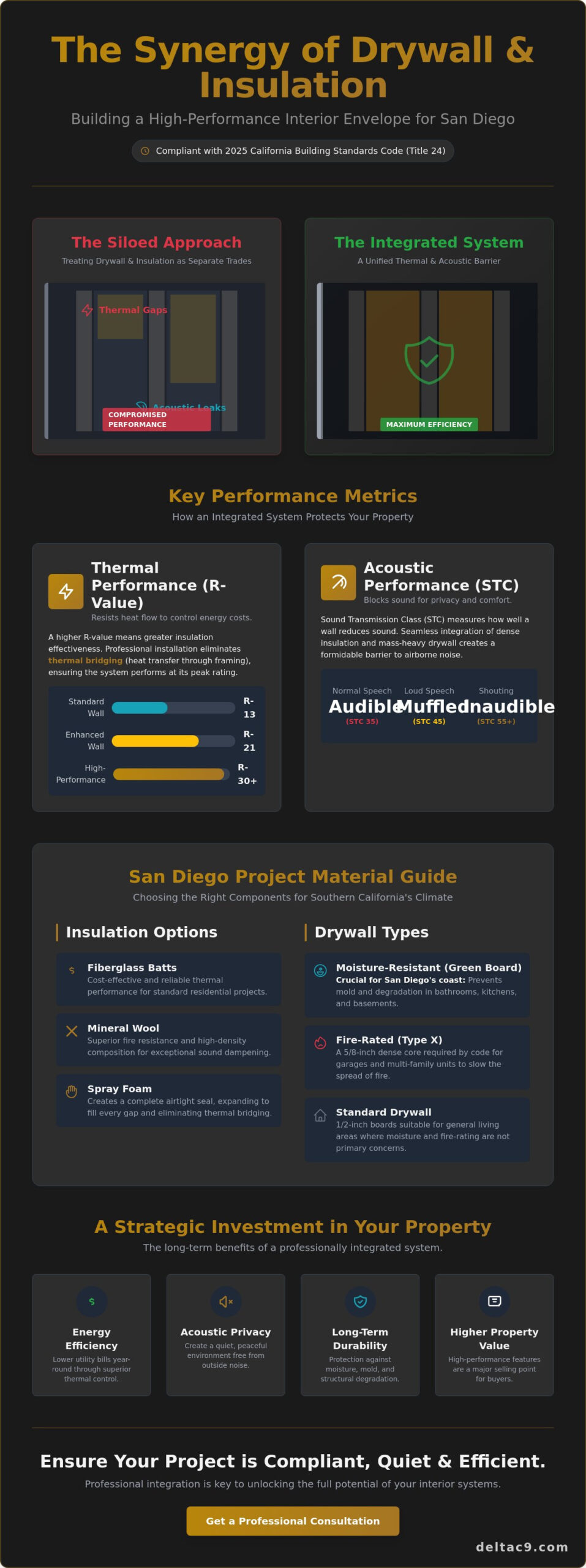
High-performance interiors rely on a robust building envelope. This term refers to the physical separator between the conditioned indoor air and the exterior environment. When we discuss drywall and insulation, we aren’t looking at two separate tasks. We’re looking at a unified thermal and acoustic barrier. Insulation provides the primary resistance to heat flow. The drywall serves as the final airtight seal and protective skin. If these components aren’t perfectly aligned, the entire system’s integrity is compromised.
Understanding what drywall is reveals why it’s a critical part of this envelope. It’s a dense gypsum core that acts as a secondary layer of thermal mass. Professional integration ensures no space exists for air to circulate behind the boards. This prevents the stack effect, where air escapes through small gaps in the wall plates. Without this precision, you’ll experience drafts and cold spots regardless of how much you spend on your HVAC system. A well-sealed thermal barrier also maintains indoor air quality by preventing outdoor pollutants and allergens from seeping through wall cavities.
Thermal Performance and R-Values Explained
In the context of residential energy efficiency, R-value represents the capacity of an insulating material to resist heat flow, where higher values indicate greater effectiveness. For San Diego property owners, maximizing this value is the most reliable way to control cooling costs. While the insulation does the heavy lifting, drywall thickness also plays a role. A 5/8-inch Type X board adds more thermal mass than a standard 1/2-inch panel. Professional installers ensure the insulation is cut to fit the framing exactly. This prevents thermal bridging, where heat bypasses the insulation through the studs or gaps.
The Acoustic Connection: Sound Dampening Basics
Acoustic privacy depends on the synergy between density and absorption. Insulation acts as a muffler, catching sound waves before they can vibrate against the wall’s interior. The drywall then uses its mass to block the remaining energy. This relationship is measured by the Sound Transmission Class (STC) rating. Gaps in the insulation create acoustic leaks that allow noise to travel freely between rooms. Achieving a high STC rating requires a seamless transition from the framing stage to the final finishing. Every utility penetration must be sealed, and every batt must be flush against the drywall to ensure the wall performs as a single, solid unit.
Selecting the Right Materials for Your San Diego Project
Successful interior construction begins with a rigorous material selection process. You must align technical specifications with the unique climate zones and regulatory requirements of San Diego County. The relationship between drywall and insulation is most effective when each component is chosen for its specific environmental resistance. While standard materials suffice for some areas, coastal humidity and urban noise often require specialized solutions that provide a higher level of protection and performance.
Insulation Options for Southern California Climates
Fiberglass batts remain a frequent choice for residential projects due to their predictable performance and cost efficiency. However, property owners seeking superior thermal control often look toward more specialized Types of Insulation. Mineral wool is an excellent alternative for those prioritizing safety and quiet. It offers higher density for sound dampening and exceptional fire resistance. For complex commercial framing where air leakage is a concern, spray foam provides a superior airtight seal. This material expands to fill every void, effectively eliminating the thermal bridging that compromises energy efficiency. If your project focuses on sustainability, recycled cellulose offers a low carbon footprint. It provides a dense, effective barrier that appeals to environmentally conscious developers.
Drywall Types and When to Use Them
Selecting the correct board is just as critical as the insulation behind it. Standard drywall works for general living areas where moisture isn’t a factor. In contrast, coastal properties or high-moisture zones like bathrooms require moisture-resistant “green board” or specialized mold-resistant panels. This proactive choice prevents the structural degradation often caused by San Diego’s marine layer. For multi-family units and commercial buildings, Type X fire-rated drywall is a mandatory requirement to meet California building codes. It’s also vital to verify the standard drywall size and thickness for your specific application. A 5/8-inch thickness is typically preferred for ceilings and firewalls, while 1/2-inch is standard for most residential walls. If you’re designing a high-performance space like a home theater, combining mineral wool with specialized soundproofing layers ensures maximum acoustic isolation. Choosing the right materials today prevents costly remediation in the future.
The Installation Process: Ensuring a Seamless Interior
A wall’s performance is only as good as its installation. Even the highest quality materials fail if the execution is sloppy. In San Diego, high-performance interiors often rely on the precision of metal framing and drywall systems. Metal provides a perfectly straight, fire-resistant skeleton that doesn’t warp like wood. This structural stability is the foundation for a successful drywall and insulation project. Before any material is applied, a rigorous pre-installation inspection must occur. We verify that all electrical, plumbing, and HVAC components are secured and that the framing is square. This proactive step prevents the need for costly repairs once the walls are finished.
Precision matters at every stage. When insulation is cut poorly, it leaves gaps that create thermal bridges. These gaps allow heat to bypass the barrier, leading to the cold spots and drafts mentioned in previous sections. To maintain the integrity of the building envelope, every utility penetration must be sealed. This level of detail ensures that your property remains energy-efficient and compliant with the latest building standards.
Step 1: Preparing the Frame and Installing Insulation
The goal is a snug fit without compression. Compressing fiberglass or mineral wool destroys the air pockets that provide thermal resistance. According to the U.S. Department of Energy’s Guide to Insulation, air sealing is just as important as the insulation itself. We seal outlets and pipes to stop air leakage before it starts. To secure fiberglass batts correctly, they must be friction-fit between studs with the edges pressed firmly against the framing while the material remains at its full manufactured thickness.
Step 2: Drywall Hanging and Finishing Levels
Strategic board placement is the next priority. We hang sheets to minimize the total number of joints. Fewer seams mean a stronger wall and a faster finishing process. The transition from hanging to professional mudding and taping requires a steady hand and technical knowledge of finishing levels. Most residential and commercial spaces utilize a Level 4 finish, which includes three coats of joint compound over all fasteners and tape. For high-end interiors with critical lighting or gloss finishes, we recommend a Level 5 finish. This involves applying a thin skim coat over the entire wall surface to create a perfectly uniform texture and eliminate any visible difference between the paper and the joint compound. It’s the ultimate standard for professional aesthetics.
Addressing Local Challenges: Mold, Moisture, and Sound
San Diego’s geography creates specific demands for interior wall systems. Properties near the coast deal with persistent humidity, while urban developments face constant noise pollution. The 2025 California Building Standards Code (Title 24), effective as of January 1, 2026, has raised the bar for energy efficiency and air sealing. Achieving compliance requires a technical mastery of drywall and insulation to ensure the building envelope remains airtight and durable. We focus on creating a defensive barrier that addresses these environmental stressors before they compromise your interior comfort.
Coastal humidity often bypasses standard barriers. When moisture gets trapped behind the wall, it creates a breeding ground for mold. This is a common issue in older San Diego homes with outdated building envelopes. If you’re renovating a property with existing damage, our mold remediation services provide a clean slate. We remove contaminated materials and treat the underlying structure to ensure your new interior remains healthy and secure.
Mold Prevention in Coastal Properties
Condensation occurs when warm indoor air hits a cold exterior-facing wall surface. High-performance insulation prevents this temperature differential, effectively stopping moisture from forming. In high-moisture zones like bathrooms or basements, we utilize moisture-resistant boards. Watch for musty odors or discolored patches on your walls. These are clear indicators that your current insulation has failed and requires professional attention to restore habitability.
Advanced Soundproofing Techniques
Urban density makes acoustic control a priority for both commercial and residential owners. We use resilient channels to decouple the drywall from the framing, which stops sound vibrations from traveling through the studs. Adding a second layer of drywall with a damping compound further increases the Sound Transmission Class (STC) rating. High-density insulation significantly lowers the noise floor, making rooms feel private and isolated from street traffic. For those seeking maximum privacy, we recommend our specialized soundproofing solutions to meet or exceed the latest California Green Building Code requirements.
Maintaining compliance with local San Diego amendments requires a proactive approach to moisture management and acoustic privacy. By integrating specialized materials with precision installation, we protect your property from the specific challenges of the Southern California environment. This strategic protection ensures long-term stability and a higher standard of living.
Why Professional Drywall and Insulation is a Smart Investment
Viewing interior construction as a long term financial strategy is essential for any San Diego property owner. While it’s tempting to focus on immediate material costs, the true value of a building is found in its operational efficiency and structural durability. A professional investment in drywall and insulation provides a measurable return on investment through energy savings, reduced maintenance, and enhanced market appeal. Precision at this stage ensures the interior remains a high performing asset for decades.
ROI: Energy Efficiency and Property Value
The most immediate benefit of professional installation is the reduction of the building’s HVAC load. High quality insulation with the correct R-value prevents the thermal transfer that forces air conditioning systems to work harder during San Diego’s warmer months. This doesn’t just lower monthly bills; it extends the lifespan of your mechanical systems. Over a 10-year period, the financial return on professional insulation is realized through significantly lower monthly utility expenditures and a measurable increase in the building’s overall market valuation.
Property value is also tied to the quality of the finish. A flawless Level 5 drywall finish creates a uniform, smooth surface that maximizes the impact of interior design and high end lighting. In contrast, DIY mistakes often lead to hidden costs. Improperly taped joints will eventually crack, and incorrect fastener spacing can cause ceiling panels to sag over time. These technical failures create thermal leaks and aesthetic flaws that are far more expensive to remediate than they are to prevent with professional labor.
The Delta C9 Advantage
Delta C9 brings 22 years of specialized San Diego experience to every project. We understand the local climate cycles and the specific requirements of the current California Building Standards. Our integrated approach treats metal framing, drywall and insulation as a single, cohesive system. This ensures that every component supports the other, resulting in a wall that is perfectly straight, thermally efficient, and acoustically private.
- Local Expertise: We navigate San Diego’s specific building amendments to ensure full compliance and safety.
- Integrated Systems: Our team manages everything from the initial framing to the final skim coat for a seamless workflow.
- Operational Reliability: We maintain disciplined project timelines and clean job sites to protect your business continuity or residential comfort.
Protect the integrity of your property with a team that prioritizes technical precision and long term stability. Contact Delta C9 for a professional drywall and insulation consultation to discuss the specific needs of your next high performance interior project.
Strategic Protection for Your Next Interior Project
Building a high-performance interior is a strategic investment in your property’s long-term stability and operational efficiency. We’ve examined how the professional integration of drywall and insulation serves as a critical barrier against San Diego’s coastal humidity and urban noise. Selecting the right materials and ensuring precision during the installation phase does more than satisfy California’s latest building codes. It creates a quiet, energy-efficient environment that maintains its value and structural integrity for decades.
Delta C9 brings over 22 years of San Diego experience to every project. Our specialists handle everything from complex commercial metal framing to detailed residential remodeling with unwavering expertise. We also provide specialized mold remediation and high-performance soundproofing to address the unique challenges of our local environment. Our goal is to provide you with a space that offers total control over your indoor climate and acoustic privacy.
Take the first step toward a more durable and comfortable property today. Get a Professional Drywall and Insulation Quote from Delta C9 to ensure your project is built to the highest technical standards. We look forward to becoming your trusted partner in building a better interior.
Frequently Asked Questions
Can I install new insulation over old insulation in my attic?
You can generally install new insulation over existing material if the original layer is dry and structurally sound. However, if you observe signs of moisture, mold, or compression, a full removal is recommended. Adding a fresh layer increases the R-value, but you must ensure the new batts don’t have a vapor barrier that could trap moisture between the layers. Professional inspection ensures the base layer is safe to build upon.
What is the best type of drywall to use for a garage or utility room?
Type X fire-rated drywall is the standard choice for garages and utility rooms to enhance safety and meet building codes. This 5/8-inch board provides superior fire resistance compared to standard panels. In utility rooms with water heaters or laundry units, moisture-resistant “green board” may also be utilized to prevent structural degradation from high humidity levels. These materials provide the necessary durability for high-traffic or high-risk areas.
How much does it cost to drywall and insulate a standard room in San Diego?
The total investment for drywall and insulation depends on the room’s square footage, ceiling height, and the specific material performance required. Factors such as the choice between fiberglass and mineral wool, or the level of drywall finish requested, will influence the final project scope. We recommend a professional site assessment to determine an accurate technical specification for your San Diego property. This ensures the solution matches your specific environmental and acoustic needs.
Does insulation actually help keep a house cool in the summer?
Insulation is critical for maintaining a cool indoor environment during San Diego’s warmer months. It functions as a thermal barrier that resists the entry of exterior heat into your conditioned space. By reducing the heat load on your HVAC system, high-performance insulation allows your cooling equipment to operate more efficiently. This results in more stable indoor temperatures and lowers monthly energy expenditures for the property owner.
What is the difference between sound-dampening and soundproofing?
Sound-dampening focuses on reducing echoes and vibrations within a single room to improve internal acoustics. Soundproofing is a more comprehensive approach designed to block noise from traveling between separate spaces. This typically involves decoupling the wall structure and using high-density materials to stop sound waves from penetrating the building envelope. Both strategies are often combined in high-end residential and commercial projects to ensure maximum privacy.
How long does the typical drywall and insulation process take for a remodel?
A typical remodel for a standard-sized room generally takes between five to seven business days. This timeline accounts for the precision hanging of boards, the application of multiple coats of joint compound, and the necessary drying times between stages. Complex projects involving high-level finishes or extensive soundproofing may require additional time to ensure technical perfection. We prioritize maintaining a structured schedule to minimize disruption to your daily operations.
Do I need a permit to replace drywall and insulation in California?
Most significant drywall and insulation replacements in California require a building permit, especially when they involve structural changes or fire-rated assemblies. The 2025 California Building Standards Code mandates specific energy efficiency and safety requirements that must be verified through inspection. It’s best to consult with the City of San Diego’s Development Services Department before beginning your project to ensure full compliance with local amendments.
Is spray foam insulation better than fiberglass for soundproofing?
While spray foam is excellent for air sealing, high-density fiberglass or mineral wool often provides superior sound attenuation. These fibrous materials are specifically designed to absorb airborne sound waves. For maximum acoustic isolation, we often recommend a system that combines dense insulation with specialized drywall layers to address both thermal performance and noise control effectively. The choice depends on whether your primary goal is airtightness or acoustic privacy.