
A sagging ceiling tile in a San Diego office is rarely just a cosmetic issue. It’s often the first warning sign of a structural or acoustic system failure that compromises your professional environment. You’ve likely noticed how distracting noise transfer between workstations can become or felt the unease of looking up at a grid that no longer appears level. It’s natural to worry about how these systems will perform during a seismic event, especially with the strict requirements of the 2025 California Building Standards Code now in effect. When managing drop ceiling repair and replacement San Diego property owners must weigh immediate fixes against long-term compliance and safety.
We understand that maintaining business continuity requires a ceiling that is safe, level, and sound-dampening. This guide provides the technical clarity you need to evaluate whether a simple tile restoration or a full grid overhaul is the most responsible path forward for your facility. You’ll learn how to identify the root causes of ceiling failure, understand the impact of local building amendments, and ensure your property meets the latest CALGreen acoustic standards. We’ll outline the exact process for achieving a compliant, high-performance overhead system that protects both your investment and your occupants.
Key Takeaways
- Identify the subtle visual cues of mineral fiber tile failure, such as discoloration and cupping, to prevent minor moisture issues from escalating into structural grid risks.
- Apply the professional “20% Rule” to determine if localized maintenance or a comprehensive drop ceiling repair and replacement San Diego project is the most cost-effective path for your facility.
- Ensure your property remains compliant with the 2025 California Building Standards Code and CALGreen acoustic requirements to guarantee seismic safety and sound privacy.
- Understand the technical importance of laser-leveled perimeters and 12-gauge hanger wires in maintaining a perfectly level, high-performance overhead plane.
Recognizing the Signs: When to Seek Drop Ceiling Repair in San Diego
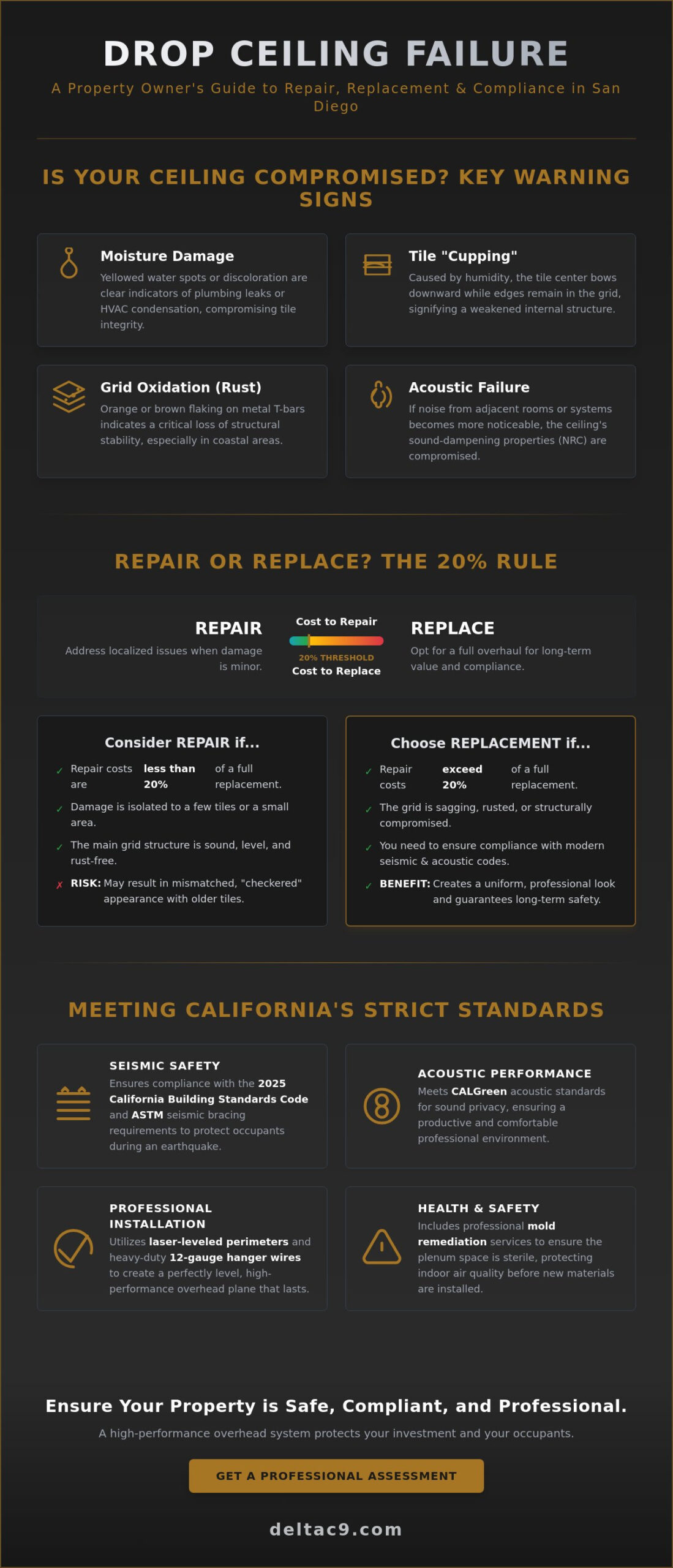
A Dropped ceiling serves as a critical interface between a building’s structure and its operational environment. In Southern California, environmental factors often dictate the lifespan of these systems. Visual cues like discoloration or yellowed water spots are the most common indicators that the system’s integrity is compromised. These marks usually point to active plumbing leaks or HVAC condensation issues that require immediate attention. When mineral fiber tiles are exposed to San Diego’s localized humidity, they often undergo “cupping,” where the edges remain supported by the grid while the center bows downward. This distortion isn’t merely an aesthetic flaw; it signifies that the tile’s internal structure has weakened, making it a primary candidate for drop ceiling repair and replacement San Diego services.
Grid oxidation is another specific concern for coastal properties from Coronado to Del Mar. While the T-bar system is designed for durability, rusted components indicate a significant loss of structural stability. If you notice orange or brown flaking on the metal runners, the grid may no longer be able to support the weight of the tiles and integrated lighting fixtures safely. Additionally, acoustic performance often degrades before physical failure is obvious. If sound from neighboring offices or mechanical rooms becomes increasingly audible, the ceiling’s Noise Reduction Coefficient (NRC) has likely been compromised by age, moisture saturation, or improper previous repairs.
Moisture and Mold Mitigation in Ceilings
Porous ceiling tiles act like sponges, trapping moisture from hidden leaks or malfunctioning insulation above the grid. This environment facilitates rapid mold growth, which can impact indoor air quality long before it’s visible to occupants. Our team integrates professional mold remediation services into the repair process to ensure the plenum space is sterile before new materials are installed. In San Diego’s coastal neighborhoods, airborne salt particles accelerate the electrochemical process of corrosion on standard steel T-bars, compromising the entire grid’s load-bearing capacity.
Structural Sagging and Safety Risks
Structural integrity hinges on the tension and placement of the suspension wires. It’s vital to differentiate between a single loose tile and a failing grid system. A “bowing” grid, where the metal runners themselves appear uneven or wavy, requires immediate professional oversight to prevent a potential collapse. During inspections of older systems, we prioritize checking the attachment points of hanger wires to the overhead structure. Ensuring these connections meet current seismic standards is a fundamental part of maintaining a safe business environment. We follow strict safety protocols during every inspection to identify hidden points of failure without disturbing the stability of the remaining assembly.
Repair vs. Replacement: A Decision Framework for Property Owners
Deciding between localized maintenance and a full system overhaul requires a calculated approach to building lifecycle management. When managing drop ceiling repair and replacement San Diego projects, we recommend applying the 20% Rule. If the cost to repair isolated water damage, sagging tiles, or localized grid issues exceeds 20% of the cost of a complete system replacement, full replacement is almost always the more efficient financial choice. This threshold accounts for the labor inefficiencies of patchwork repairs and the inevitable reality that older components will continue to fail at an accelerating rate.
Aesthetic continuity is a frequent challenge in San Diego’s established commercial districts. Many buildings features tile patterns that are now obsolete. Attempting to match 30 year old mineral fiber tiles usually results in a mismatched, “checkered” appearance that can diminish a property’s professional image and market value. Beyond visuals, the structural health of the grid is paramount. Modern acoustic tiles are often denser and heavier than their predecessors. We must verify that your existing T-bar system meets the seismic bracing standards established by ASTM International before adding new loads. If the grid shows signs of bowing or tension loss in the hanger wires, a full replacement ensures the safety of your occupants.
Evaluating the Existing Grid System
Our technicians perform rigorous tension tests on hanger wires and perimeter wall moldings to determine if the skeleton of your ceiling remains viable. While it’s sometimes possible to keep the grid and replace 100% of the acoustic tiles, this is only advisable if the metal components show no signs of oxidation or mechanical fatigue. We strongly advise against painting old tiles to hide stains. Paint seals the pores of acoustic material, which destroys its sound-dampening properties and may violate local fire codes by altering the material’s flame spread rating.
Upgrading for Energy Efficiency
Full replacement offers a significant opportunity to improve your building’s thermal envelope. Modern high-performance tiles provide superior R-values, which helps stabilize indoor temperatures and reduces the load on your HVAC system during San Diego’s warmer months. This transition is also the ideal time to integrate ultra-efficient LED lighting panels that fit seamlessly into the new grid. By combining these upgrades, you solve underlying insulation gaps while creating a more sustainable, cost-effective workspace. For a deeper look at how integrated systems benefit your facility, explore our ceiling and drywall solutions for local commercial properties.
Beyond Aesthetics: Acoustic Performance and California Standards
A ceiling’s visual appeal is only half of its functional value. In professional environments, the ceiling acts as the primary tool for sound management. When executing a drop ceiling repair and replacement San Diego project, acoustic science is as critical as structural integrity. We focus on the Noise Reduction Coefficient (NRC), which measures how much sound a tile absorbs. For a standard San Diego commercial office, the optimal NRC rating typically falls between 0.70 and 0.85 to effectively minimize ambient echoes. This level of absorption prevents the “hollow” sound often found in large open-plan workspaces.
While NRC focuses on absorption, Ceiling Attenuation Class (CAC) focuses on blocking sound from traveling between rooms. This is vital for private meeting spaces and executive offices where confidentiality is paramount. Our integrated ceiling and drywall solutions address both needs by combining high-CAC tiles with precision drywall finishing. This approach ensures that sound doesn’t simply leak through the plenum space above the grid. Compliance with California Title 24 and ASTM seismic installation standards guarantees that these acoustic upgrades also meet the state’s rigorous safety and energy efficiency mandates.
Soundproofing for Modern Workspaces
Private offices require specialized high-CAC tiles that act as a barrier to overhead sound transmission. Achieving true privacy requires a holistic view of the room’s envelope. We create synergy between metal framing, high-density insulation, and the suspended ceiling to eliminate acoustic weak points. By extending drywall partitions above the grid line to the structural deck, we prevent sound from bypassing the ceiling tiles entirely. This multi-layered strategy is the only way to ensure modern workspaces remain productive and secure. A safe, quiet environment is the hallmark of professional interior construction.
Insulation and Fire Safety
Safety remains our primary value. We exclusively use fire-rated, non-combustible mineral fiber materials that comply with San Diego County fire codes for commercial interiors. These tiles are designed to maintain their structural integrity during high-heat events, providing critical time for building evacuation. Beyond safety, specialized insulation placed above the grid prevents significant thermal loss. This layer of protection keeps conditioned air within the occupied space, which is essential for managing cooling costs in Southern California’s climate. Every drop ceiling repair and replacement San Diego we perform prioritizes these invisible yet essential performance metrics.
The Professional Process: Suspended Ceiling Installation and Maintenance
Precision is the foundation of every high-performance suspended system. Before a single tile is placed, our technicians utilize high-accuracy rotary lasers to establish the perimeter wall molding height. This step ensures a mathematically perfect plane across the entire facility. For drop ceiling repair and replacement San Diego projects, we strictly utilize heavy-duty 12-gauge hanger wires. These wires provide the necessary tensile strength to support the weight of fire-rated acoustic tiles and integrated lighting systems. Unlike lighter residential-grade materials, 12-gauge steel prevents the grid from stretching or shifting over time, maintaining the ceiling’s level profile for years.
Seismic bracing is a non-negotiable requirement in Southern California. The California Building Code mandates specific lateral force resistance to protect occupants during tremors. This involves the installation of splay wires and compression posts. These components work in tandem to prevent the ceiling from swinging or collapsing during a seismic event. We ensure every attachment point is secure and every wire is tensioned to engineering specifications. Properly “dropping” tiles into the finished grid requires a specific technique to avoid edge chipping. This careful handling preserves the visual finish and ensures the system remains easy to navigate for future utility access above the plenum.
Seismic Compliance in San Diego County
DIY ceiling repairs often fail San Diego building inspections because they overlook complex seismic design requirements. Most commercial properties in this region fall into Seismic Design Category D, E, or F. These classifications require specialized hardware, including seismic clips and pop rivets at the grid perimeters. These components provide the necessary “float” or “fix” to the grid, allowing it to move safely without losing structural integrity. Our team understands these technical nuances, ensuring your project meets all local safety codes from the first day of installation.
Ongoing Maintenance Strategies
Proactive care extends the life of your overhead system and prevents costly emergency replacements. Annual inspections are essential to verify suspension wire tension and grid alignment. If you notice a single damaged tile, replacement must be handled carefully to avoid warping the surrounding T-bars. Maintaining the ceiling often involves addressing the adjacent walls to ensure a clean, professional look. Integrating professional drywall repair with your ceiling maintenance plan ensures a seamless transition between vertical and horizontal surfaces. If you are ready to secure your facility’s structural integrity, contact our expert team today for a comprehensive site evaluation.
Delta C9: San Diego’s Trusted Partner for Ceiling and Drywall
Delta C9 represents more than 22 years of specialized expertise in the Southern California interior construction market. We recognize that a ceiling system is only as reliable as the structures supporting it. Our holistic approach integrates metal framing, drywall installation, and suspended systems into a single, coordinated workflow. When managing drop ceiling repair and replacement San Diego projects, property owners receive a solution that addresses the root cause of every failure. If moisture intrusion has led to mold growth, our team provides professional remediation to ensure the plenum space is safe before new components are installed. This commitment to technical excellence ensures move-in ready results for every project we undertake.
We don’t believe in superficial fixes. Our reputation is built on the promise of stability, control, and proactive protection. By overseeing the entire interior envelope, we ensure that your new ceiling system interacts correctly with the building’s insulation and HVAC components. This integrated strategy prevents the recurring issues that often plague properties where multiple subcontractors work in isolation. We act as your strategic protector, identifying potential risks before they manifest as costly structural failures.
Commercial and Industrial Expertise
Large-scale tenant improvements and office remodeling projects require a high degree of logistical precision. We specialize in complex metal framing and drywall assemblies that provide the necessary structural integrity for modern commercial interiors. Our project management protocols focus on minimizing business disruption; we understand that operational continuity is your highest priority. By coordinating every phase of the interior build-out, we eliminate the communication gaps that often occur when hiring multiple subcontractors. This efficiency allows us to deliver high-performance workspaces that meet both your timeline and the latest California building standards.
Residential Refinement
Homeowners seeking superior acoustic control often turn to us for specialized residential projects. Upgrading a home theater or a basement with an acoustic drop ceiling requires a delicate balance of soundproofing science and aesthetic integration. We ensure these systems blend seamlessly with your broader residential remodeling plans, providing a finished look that enhances your home’s value. Being a San Diego-based team means we offer local accountability that national contractors can’t match. We’re your neighbors, and we take personal responsibility for the stability and safety of the systems we install. Whether you’re reinforcing a commercial facility or refining a private residence, our team provides the quiet strength and technical mastery your property deserves.
Securing Your Facility’s Structural and Acoustic Integrity
Maintaining a safe and productive environment requires more than just masking surface imperfections. The decision process for drop ceiling repair and replacement San Diego property owners must follow involves a complex evaluation of seismic compliance, acoustic performance, and long term ROI. A high performance ceiling is a critical system that protects your occupants and ensures business continuity. Precision during the installation phase determines whether your facility remains compliant with the 2025 California Building Standards Code. Every component, from the 12-gauge hanger wires to the seismic clips, plays a role in the stability of your professional space.
Delta C9 brings over 22 years of local experience to every project. We specialize in seismic-compliant commercial grids and maintain full licensing and insurance for both mold remediation and interior construction. Our team ensures your overhead systems are level, secure, and optimized for sound control. We invite you to schedule your professional ceiling inspection and get a quote today. Investing in professional oversight now protects your assets and provides the peace of mind that comes with a stable, well-managed environment. We look forward to securing the future of your professional space.
Frequently Asked Questions
How much does drop ceiling repair cost in San Diego?
Project costs vary based on the extent of the damage and the specific materials required for your facility. While minor tile replacements are less intensive, complex drop ceiling repair and replacement San Diego projects involving grid realignment or seismic upgrades require more specialized labor. Industry data indicates that labor typically accounts for 60% to 75% of the total investment for professional ceiling and drywall work.
Can I replace just one damaged ceiling tile if I can’t find a match?
You can replace a single tile, but finding a perfect visual match for obsolete patterns is often impossible. We suggest “harvesting” a matching tile from a closet or utility room to use in high-visibility areas. If a match isn’t available, replacing all tiles in a single room is the most effective way to ensure aesthetic continuity without rebuilding the entire grid.
What are the seismic bracing requirements for drop ceilings in California?
California Building Code Title 24 mandates specific structural reinforcements to protect occupants during tremors. These requirements include 12-gauge hanger wires, compression posts to resist vertical uplift, and splay wires for lateral stability. Every professional installation in San Diego must adhere to these standards to pass local building inspections and ensure long-term safety.
How long does a professional drop ceiling replacement take for an office?
A full replacement for a standard 1,000-square-foot office usually takes between two and three business days. This timeframe includes the removal of old materials, structural grid adjustments, and the final placement of new acoustic tiles. Larger commercial facilities or industrial projects may require a phased schedule to ensure your business operations continue without significant disruption.
Is an acoustic drop ceiling better than drywall for soundproofing?
Acoustic drop ceilings excel at sound absorption, which effectively eliminates echoes within a workspace. Drywall provides superior sound blocking between rooms due to its density and mass. For the best acoustic performance in a professional environment, we recommend a hybrid approach that uses high-CAC ceiling tiles in conjunction with specialized drywall finishing.
Can a drop ceiling hide mold issues in my San Diego property?
Suspended systems can easily conceal moisture buildup and mold growth within the plenum space above the grid. If you detect persistent odors or see dark spots on your tiles, a professional inspection is necessary. We provide integrated mold remediation services to identify and eliminate these hazards before they impact your building’s air quality or structural integrity.
Does Delta C9 handle both the grid repair and the tile replacement?
We manage the entire scope of work, including grid structural repairs, hanger wire tensioning, and final tile installation. Our expertise also extends to the underlying metal framing and drywall repair if the surrounding walls are compromised. This comprehensive service ensures that the entire overhead assembly is safe, level, and professionally finished.
What is the best type of ceiling for high-humidity coastal areas?
Properties in coastal San Diego neighborhoods should utilize mineral fiber tiles with high humidity resistance ratings or PVC-faced materials. These tiles are specifically engineered to resist the “cupping” and sagging that occurs in humid environments. We also recommend using galvanized or aluminum grid components to prevent the oxidation and flaking caused by airborne salt particles.