
A mold outbreak in a professional facility is never just a surface-level cleaning task; it’s a direct threat to your business continuity and structural integrity. Since the City of San Diego adopted the 2025 California Building Standards Code on April 22, 2026, the regulatory expectations for moisture control and building envelope protection have become more stringent. You shouldn’t have to choose between a healthy workplace and a building that’s actually functional. It’s frustrating when remediation crews tear out contaminated materials but leave your office in a state of disrepair, forcing you to manage separate contractors just to get back to work.
We understand that your primary goal is to maintain a safe environment that meets California Health and Safety Code §17920.3 standards while minimizing revenue loss. This guide explains how to secure professional commercial mold remediation San Diego that transitions seamlessly from cleanup to structural restoration. You’ll discover how to manage the typical $10 to $25 per square foot remediation costs effectively while ensuring your property remains compliant with the 2024 IICRC S520 standards. We will outline a methodical approach to metal framing, drywall installation, and suspended ceiling repair that ensures your facility is move-in ready without unnecessary downtime.
Key Takeaways
- Understand how San Diego’s coastal humidity accelerates mold growth in HVAC systems and why a specialized structural approach is necessary for commercial properties.
- Learn how adherence to IICRC S520 standards and high-grade containment zones protects your staff and prevents cross-contamination during active remediation.
- Discover the efficiency of hiring a single partner for commercial mold remediation San Diego who can simultaneously manage metal framing and drywall installation to reduce downtime.
- Master the documentation requirements for California health and safety regulations, including the importance of Post-Remediation Verification (PRV) for your facility records.
- Identify why a strategic protector mindset ensures a seamless transition from environmental cleanup to a fully restored, move-in ready interior.
Understanding Commercial Mold Challenges in San Diego
Professional mold remediation is far more than a simple cleaning service; it’s a specialized structural and environmental engineering process. In a commercial setting, mold isn’t just a nuisance on the wall. It represents a failure in moisture control that can compromise the stability of metal framing and drywall systems. Effective commercial mold remediation San Diego requires a strategic approach that addresses the root cause of moisture while preparing the building for a full structural build-back. Unlike residential issues, commercial infestations often hide within complex HVAC networks and plenum spaces, where they can spread across thousands of square feet before becoming visible to the naked eye.
San Diego’s unique coastal environment creates a constant battle with humidity. A foundational understanding of Indoor Mold reveals that these organisms require only consistent moisture and organic material to compromise a building’s safety. Our coastal humidity doesn’t just sit in the air; it infiltrates HVAC systems, where it condenses and creates a breeding ground for spores. This is why surface-level “off-the-shelf” cleaning solutions fail in a professional setting. They don’t reach the deep-seated structural infestations that take hold behind industrial-grade finishes or inside wall cavities. When you only treat the surface, you’re leaving the “roots” of the problem intact, ensuring a costly recurrence within months.
San Diego Microclimates: From La Jolla to Chula Vista
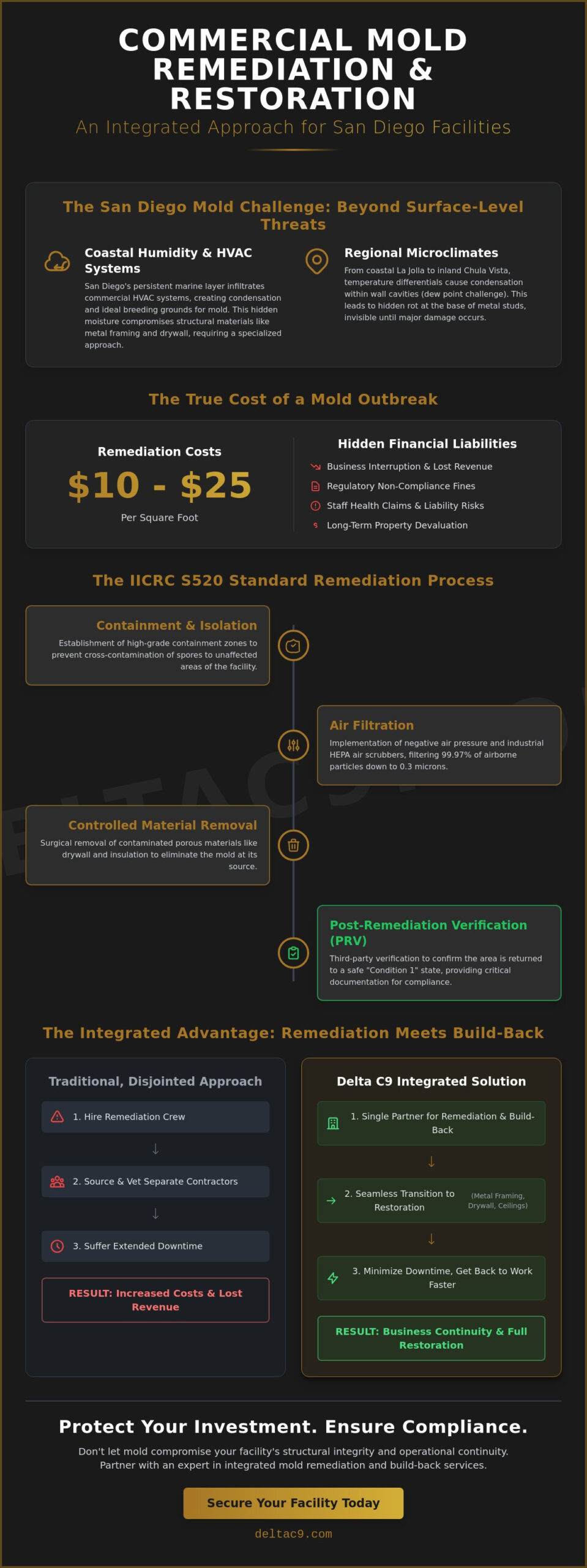
The geography of San Diego creates distinct moisture profiles that facility managers must understand. In coastal areas like La Jolla or Del Mar, the persistent marine layer keeps ambient humidity high, often trapping moisture inside commercial interiors during the night. Conversely, in inland areas like Chula Vista or Escondido, seasonal heat creates a massive temperature differential between the scorching exterior and the air-conditioned interior. In San Diego commercial drywall, the dew point challenge occurs when humid coastal air meets air-conditioned interior surfaces, causing moisture to condense within the wall cavity and trigger rapid mold growth. This hidden moisture eventually rots the base of metal studs and degrades insulation, requiring a complete structural assessment during the remediation phase.
The Economic Impact of Mold on San Diego Businesses
For facility managers, business continuity is the primary objective. The true cost of delayed remediation isn’t just the $10 to $25 per square foot cleanup fee; it’s the hidden liability of health claims and the long-term loss of property value. Since the City of San Diego adopted the 2025 California Building Standards Code on April 22, 2026, compliance has become even more critical for maintaining a “standard” property rating. Leaving mold unaddressed leads to structural rot that can eventually require the replacement of entire metal framing systems. By choosing a partner who understands the transition from environmental cleanup to structural restoration, businesses can ensure their facility meets CA health standards while minimizing the downtime that leads to lost revenue.
The Commercial Mold Remediation Process: Safety and Standards
Effective commercial mold remediation San Diego depends on strict adherence to the IICRC S520 Standard for Professional Mold Remediation, specifically the Fourth Edition published in 2024. This isn’t just a recommendation; it’s the procedural framework that ensures a building is returned to a safe, “Condition 1” state. We utilize high-grade containment zones to isolate affected areas, preventing spores from migrating through open office layouts or shared ductwork. By following EPA Mold Remediation Guidelines, our teams implement negative air pressure and industrial HEPA air scrubbers. These systems filter 99.97% of particles down to 0.3 microns. This level of control is essential when removing porous materials like water-damaged drywall and insulation, which can release millions of spores into the air when disturbed.
The removal process itself must be surgical. We don’t just tear out material; we follow a controlled demolition protocol that minimizes dust and debris. Every piece of contaminated drywall is bagged and sealed within the containment zone before being transported out of the facility. This meticulous handling protects your employees and ensures that the cleanup doesn’t inadvertently cause a larger secondary outbreak. During this phase, we also inspect the underlying metal framing for signs of corrosion or structural compromise, ensuring the foundation is ready for the build-back phase.
Advanced Detection: Beyond What the Eye Can See
Visible mold is often just the tip of the iceberg. Our technicians use calibrated moisture meters and infrared thermal imaging to identify moisture pockets hidden behind commercial metal framing and inside wall cavities. This data-driven approach allows us to pinpoint the exact source of a leak, whether it’s a failing HVAC condensate line or a roof penetration. We conduct rigorous air quality testing both before and after the process. This provides facility managers with empirical proof that the environment has reached post-remediation verification (PRV) status, which is vital for liability protection and tenant safety.
Containment Protocols for Operating Businesses
A mold discovery shouldn’t necessitate a total facility shutdown. We specialize in setting up floor-to-ceiling physical barriers that maintain a professional aesthetic while work continues in adjacent suites. These partitions are more than just plastic sheets; they’re engineered seals that allow for 24/7 remediation work without disrupting your daily commercial operations. Scheduling is often phased to align with off-peak hours, ensuring your business continuity remains the priority. If you’re concerned about how a remediation project might affect your staff, our team can help you plan a seamless restoration strategy that balances safety with productivity.
The Integrated Advantage: Remediation Meets Build-Back
One of the most common frustrations for facility managers is the “siloed” approach to restoration. A traditional remediation crew arrives, tears out the contaminated materials, and leaves you with an exposed skeleton of a building. This creates a gap where your operations remain halted while you vet a separate construction team. By choosing a single partner for commercial mold remediation San Diego, you eliminate this friction. We use our 22+ years of experience to ensure the transition from environmental cleanup to professional drywall finishing is immediate and coordinated. This integrated strategy reduces the administrative burden and often shortens the project timeline by 25% or more.
During the remediation phase, we don’t just clear spores; we perform a detailed audit of your building’s infrastructure. We examine the existing metal studs for signs of structural oxidation or hidden moisture traps. This is the ideal time to verify that your facility’s internal components are sound before any new finishes are applied. If the remediation reveals that the underlying structure is compromised, we can pivot immediately to repairs, ensuring that the final build-back rests on a stable foundation. This continuity is what defines our approach to commercial mold remediation San Diego, as we treat your facility as a single, cohesive system.
Metal Framing vs. Wood: A Mold-Resistant Choice
In San Diego’s commercial sector, metal framing is the superior engineering choice for moisture resilience. Wood is organic and provides a natural food source for mold colonies. Steel studs are inorganic, meaning they won’t support fungal growth even if moisture intrusion occurs again. While wood might seem cost-effective initially, the long-term ROI of steel is undeniable. It provides a stable, rot-proof substrate that maintains its shape and strength for decades, protecting your property value in the competitive California market.
High-Performance Drywall and Insulation
Rebuilding after mold requires more than just standard materials. We prioritize high-performance, moisture-resistant drywall grades specifically designed for commercial environments. When paired with proper insulation, these systems create a barrier against the condensation that often triggers mold outbreaks in San Diego’s coastal climate. We also take this opportunity to address soundproofing. By installing industrial-grade acoustic insulation during the build-back, we improve the privacy and focus of your office environment, turning a restoration necessity into a facility upgrade.
Compliance and Documentation for San Diego Facility Managers
Navigating the regulatory environment in California requires more than just technical skill; it demands meticulous record-keeping. Under the California Health and Safety Code §17920.3, visible mold growth is legally defined as a substandard condition. For facility managers, this means that a failed inspection can lead to mandatory remediation orders and potential fines. Since the City of San Diego implemented the 2025 California Building Standards Code on April 22, 2026, the threshold for moisture control has become even more precise. A professional commercial mold remediation San Diego project must be accompanied by a comprehensive “Scope of Work” that details every containment barrier, air scrubber placement, and material removal step. This documentation serves as your primary defense against future health claims or legal disputes.
Maintaining a clean “chain of custody” for environmental samples is another critical component of the process. When air or surface samples are taken, they must be handled according to strict protocols to ensure their validity in a court of law or for an insurance claim. This rigorous approach to data ensures that when we declare a space “Condition 1” or a normal fungal ecology, the claim is backed by empirical evidence. By keeping these records for the life of the property, you preserve the asset’s market value and provide peace of mind to stakeholders. It’s about more than just cleaning; it’s about establishing a permanent record of structural integrity and environmental safety.
Working with Insurance Adjusters
Commercial insurance claims for mold damage in San Diego County require high-level technical data to move forward. Adjusters often look for specific evidence of sudden and accidental moisture intrusion rather than long-term neglect. We provide the thermal imaging reports and moisture maps needed for accurate assessments. This technical clarity helps expedite the approval process, ensuring that the budget for both remediation and the subsequent structural build-back is secured quickly. When the data is clear, the path to funding the restoration is significantly smoother.
Certified Clearance: Re-Occupying Your Space
Before employees return to their desks, a final clearance report is mandatory. We recommend involving a third-party environmental hygienist to perform post-remediation verification (PRV). This independent oversight ensures there’s no conflict of interest and provides an unbiased all-clear for your facility. Communicating this to your tenants or employees is essential for morale. Presenting a certified report that proves the air quality meets or exceeds outdoor levels is the most effective way to restore trust in the workplace environment. If you’re ready to secure your facility’s future, contact our experts for a professional consultation today.
Delta C9: San Diego’s Partner in Commercial Restoration
Delta C9 operates as a strategic protector of your business’s physical assets and operational continuity. Our approach is built on a foundation of stability and control, ensuring that every project moves forward with engineering precision. Because our expertise is rooted in ceiling and drywall solutions, we’re uniquely positioned to manage the full lifecycle of a restoration event. We don’t just focus on the environmental cleanup; we analyze how moisture has affected your metal framing, insulation, and suspended ceilings. This comprehensive perspective is why our commercial mold remediation San Diego services are trusted by facility managers who prioritize long-term structural health over quick, temporary fixes.
The Delta C9 promise is a commitment to proactive defense. We believe that a successful remediation project should leave your building more resilient than it was before the mold discovery. By integrating metal framing repairs with high-performance drywall installation, we eliminate the vulnerabilities that allow moisture to take hold. You’ll receive a move-in ready interior that’s been restored to professional standards, allowing you to focus on your core business goals while we handle the technical complexities of structural build-back. We take full responsibility for the systems we touch, ensuring your facility remains a safe, productive asset for years to come.
22 Years of San Diego Expertise
For over 22 years, we’ve provided high-level expert consultancy and construction services to commercial and industrial clients across Southern California. This deep history in the region means we’re intimately familiar with the microclimates of San Diego County and the specific moisture challenges they present. We stay ahead of the curve by strictly adhering to local building codes, including the updates effective as of April 22, 2026. Our clients value our transparent communication and our ability to maintain a professional distance while acting as a dedicated business partner. We understand that your business’s reputation depends on a safe environment, and we’ve built our own reputation on delivering exactly that.
Get Your Facility Back to Work
Restoring your facility shouldn’t be a source of stress or uncertainty. We start the process with a methodical, data-driven site assessment that identifies the precise scope of the problem. From there, we develop a customized remediation plan that accounts for your industry’s specific safety requirements and operational schedules. Whether you’re managing a small office or a large industrial complex, our goal is to minimize downtime and provide a seamless transition to a finished interior. We’re here to ensure your transition back to full productivity is as efficient as possible. Schedule your commercial mold assessment with Delta C9 today to secure your facility’s future and ensure the peace of mind that comes with professional commercial mold remediation San Diego.
Securing Your Facility’s Structural Future
Managing a commercial property in San Diego’s coastal environment requires a proactive stance on moisture control and structural maintenance. Effective commercial mold remediation San Diego is most successful when it integrates environmental cleanup with professional build-back services. This unified approach ensures that your facility not only meets the 2025 California Building Standards Code but also remains a safe, productive space for your employees and tenants. By addressing the root causes of moisture within wall cavities and HVAC systems, you protect your business continuity and preserve the long-term value of your real estate asset.
With over 22 years of construction experience in Southern California, Delta C9 provides the stability and control necessary for complex restoration projects. Our mastery of commercial metal framing and drywall systems allows us to transition seamlessly from remediation to a finished, move-in ready interior. We take responsibility for your building’s integrity so you can focus on your professional goals with absolute confidence. Protect your San Diego commercial property with Delta C9’s expert remediation and restoration services. We look forward to helping you maintain a healthy, resilient workplace.
Frequently Asked Questions
How long does commercial mold remediation typically take in San Diego?
Most commercial projects require between 3 and 7 business days to complete the remediation phase. The specific timeline depends on the square footage of the affected area and the complexity of the structural restoration required. We focus on a disciplined, methodical approach to ensure your facility returns to a safe, move-in ready state without unnecessary delays.
Can my San Diego business remain open during the mold remediation process?
Yes, your business can typically remain operational through the use of high-grade containment zones and negative air pressure. These physical barriers isolate the remediation site from the rest of your office, ensuring that spores and dust don’t migrate into occupied spaces. We prioritize business continuity by scheduling more invasive tasks during off-peak hours to minimize disruption to your daily operations.
Does commercial insurance in California cover mold remediation?
Coverage usually depends on whether the mold resulted from a “sudden and accidental” event, such as a localized pipe burst or HVAC failure. Most policies don’t cover mold caused by long-term neglect or lack of maintenance. We provide the technical data and thermal imaging reports needed for insurance adjusters to make accurate assessments, helping to expedite the claims process for your restoration.
What is the difference between mold removal and mold remediation?
Mold removal is the simple act of cleaning surface growth, while commercial mold remediation San Diego is a comprehensive engineering process that addresses the root cause. Remediation includes moisture source identification, high-level containment, and structural build-back to meet the IICRC S520 2024 standards. This strategic approach ensures the problem is solved permanently rather than just hidden behind a fresh coat of paint.
How can I tell if mold is growing behind my commercial drywall?
Persistent musty odors or localized staining on wall surfaces are the most common early warning signs. We use calibrated moisture meters and infrared thermal imaging to detect temperature anomalies that indicate moisture trapped behind your metal framing. If moisture is detected in these hidden cavities, it’s highly probable that fungal growth has already begun on the organic paper backing of the drywall.
Is black mold more common in San Diego coastal areas?
Various mold species, including black mold, thrive in San Diego’s coastal microclimates due to the persistent marine layer and high ambient humidity. While no species is exclusive to the coast, the constant moisture levels in areas like La Jolla increase the risk of rapid proliferation. Managing your building’s envelope and HVAC system is essential for preventing these environmental hazards from taking hold in your facility.
What should I do immediately if I suspect a mold outbreak in my facility?
You should immediately identify and stop the water source while isolating the area to prevent cross-contamination. It’s critical to turn off the HVAC system if you suspect mold is near air intakes to prevent spores from circulating through the building. Contacting a professional for a comprehensive site assessment within 24 to 48 hours is the most effective way to limit structural damage and health liabilities.
Why is metal framing better than wood for preventing mold?
Metal framing is inorganic and does not provide the organic “food source” that mold colonies require to grow. Unlike wood, which absorbs moisture and provides a substrate for fungal life, steel studs remain resilient and structurally sound even in high-humidity environments. This makes metal framing a superior long-term investment for San Diego commercial properties, as it significantly reduces the risk of structural rot and future outbreaks.