
A single seismic compliance oversight in Southern California can delay a commercial certificate of occupancy by 45 days or more. You’re likely aware that navigating the 2025 California Building Code updates requires more than just basic construction knowledge. When you’re investing in commercial metal stud framing San Diego projects, the margin for error is shrinking as material costs have risen by 12% over the last eighteen months. You need a structure that doesn’t just stand but thrives under the pressure of local regulations and environmental demands.
We’ve designed this guide to help you master the technical and regulatory essentials to ensure your San Diego project is built for seismic resilience and long-term durability. Our goal is to provide you with the blueprint for a structurally sound, code-compliant commercial interior that maintains your budget despite market volatility. We’ll examine cost-effective material selection, strategies for securing reliable labor that meets 2026 timelines, and the specific steps needed for a seamless handoff between the framing and drywall phases.
Key Takeaways
- Understand why cold-formed steel is the mandatory standard for fire safety and structural durability in San Diego’s commercial zones.
- Learn to distinguish between structural and non-structural gauges to ensure your building’s framework meets the specific technical requirements of 2026 procurement.
- Navigate the complexities of Seismic Design Categories and California Title 24 to guarantee your project remains compliant and resilient.
- Identify the essential licensure and local experience required to select a qualified partner for commercial metal stud framing San Diego projects.
- Discover how a single-source provider for framing and interior integration reduces project risk and ensures a more predictable construction timeline.
Why Metal Stud Framing is the Standard for San Diego Commercial Construction
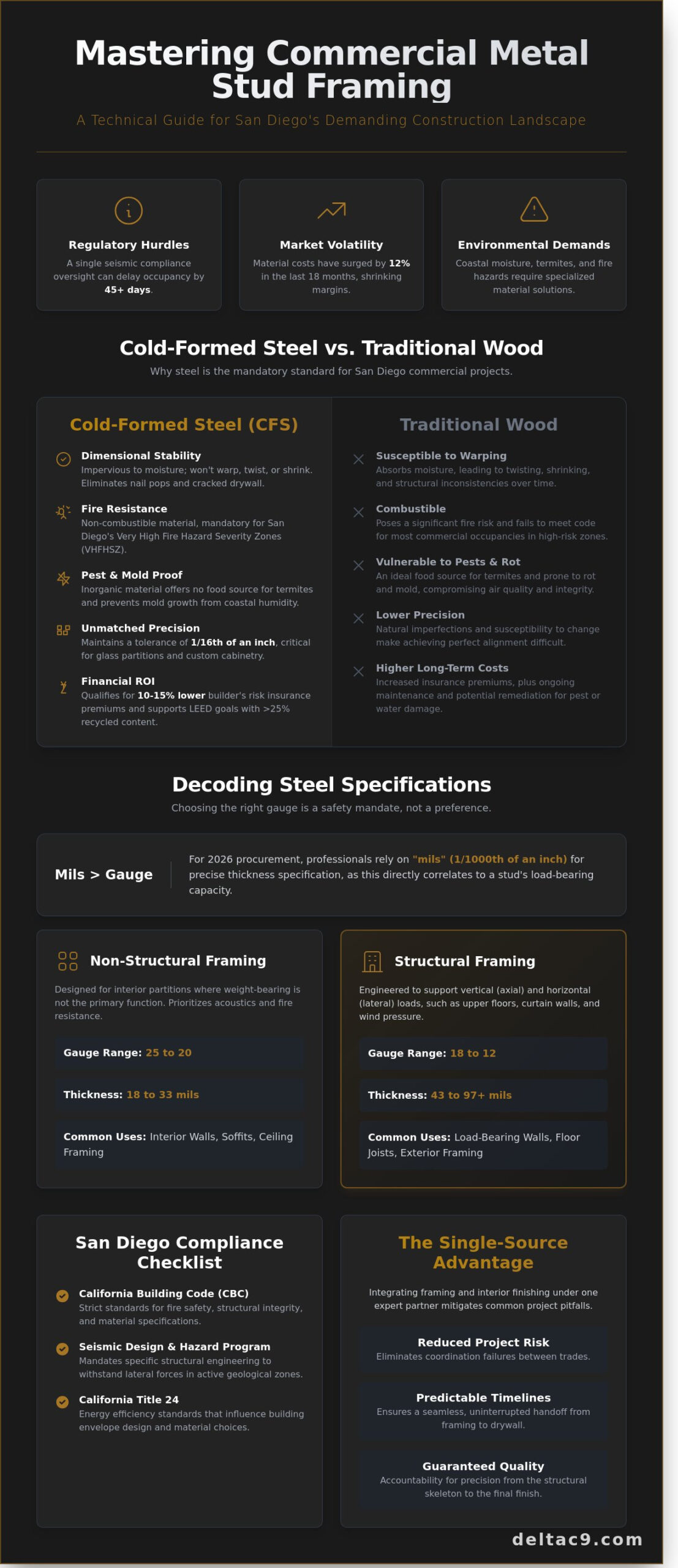
Commercial metal stud framing San Diego projects rely on a sophisticated structural system known as Cold-formed steel (CFS). This method involves shaping thin sheets of steel into C-shaped studs and tracks at room temperature. In San Diego, the choice of material isn’t merely a preference; it’s a strategic necessity. The city’s Very High Fire Hazard Severity Zones (VHFHSZ) dictate strict adherence to non-combustible materials for most commercial occupancies. Steel provides the structural integrity required to meet California Building Code (CBC) standards while ensuring the safety of high-density developments.
Precision remains the primary driver for high-end tenant improvements in downtown San Diego. Modern office layouts and retail spaces require perfectly straight walls for glass partitions and custom cabinetry. Unlike traditional materials, steel studs maintain a tolerance of 1/16th of an inch over long spans. This level of control prevents the aesthetic and functional failures often seen in older, wood-framed structures. It ensures that every door frame and corner meets the exact specifications of the architectural plan.
The Advantages of Cold-Formed Steel (CFS)
Dimensional stability stands as the hallmark of CFS. Steel studs don’t warp, twist, or shrink because they lack the moisture content found in timber. This stability eliminates “nail pops” and cracked drywall in finished spaces. From a financial perspective, the ROI is clear. According to the Steel Recycling Institute, modern steel contains a minimum of 25% recycled content, supporting LEED certification goals. Additionally, non-combustible steel structures often qualify for a 10% to 15% reduction in builder’s risk insurance premiums compared to wood-frame construction. It’s a choice that prioritizes long-term asset protection.
Metal vs. Wood in the San Diego Climate
Coastal moisture poses a constant threat in areas like Chula Vista and Mission Bay. Wood absorbs humidity, leading to rot and mold growth that compromises indoor air quality. Steel is inorganic and naturally resistant to these biological threats. Termites represent another significant risk in Southern California, causing over $5 billion in property damage annually across the United States. Choosing commercial metal stud framing San Diego removes the food source for these pests entirely. This decision ensures long-term property longevity and reduces maintenance overhead for facility managers. By meeting the strict fire safety ratings of the CBC, steel framing protects both the physical asset and the business continuity of the tenants within. It’s the most reliable way to build in a coastal environment.
Evaluating Gauges and Systems: A Buyer’s Technical Framework
Choosing the correct materials for commercial metal stud framing San Diego projects requires a precise understanding of metallurgical specifications. Steel thickness is not a matter of preference; it is a safety mandate governed by structural engineering requirements. In the 2026 steel procurement landscape, professionals rely on “mils” rather than just gauge numbers to ensure accuracy. A mil represents 1/1000th of an inch. For example, a standard 20-gauge stud is typically 30 or 33 mils, while a heavy-duty 12-gauge structural stud reaches 97 mils. This distinction is vital because gauge thickness is the primary factor in axial load capacity, determining how much vertical weight a wall can safely support before failing.
The choice between structural and non-structural steel dictates the building’s longevity. Non-structural members, often referred to as light-gauge steel, are designed for interior partitions where weight-bearing is not a factor. These systems prioritize acoustic performance and fire resistance. Conversely, structural framing must withstand lateral wind loads and the weight of upper floors. Using the wrong specification can lead to wall bowing or catastrophic structural failure. San Diego’s unique geological profile necessitates compliance with the California Seismic Hazard Program, which mandates specific structural integrity for buildings in designated active zones.
Selecting the Right Steel Gauge
- 25 to 20 gauge (18 to 33 mils): These are ideal for interior non-load bearing partitions and soffits. They offer 40% better screw-strip resistance in modern high-strength steel variants.
- 18 to 12 gauge (43 to 97 mils): These are required for exterior walls and load-bearing structural support. They provide the necessary rigidity for buildings exceeding two stories.
Components of a Professional Framing System
A complete assembly involves more than just vertical studs. Top and bottom tracks form the horizontal foundation of the wall, securing the studs in place. In high-rise commercial builds in San Diego, deflection tracks are essential. These specialized tracks allow for 0.5 to 1.5 inches of vertical movement, ensuring that the building’s floor slabs can flex without crushing the interior walls. Bridging and bracing further enhance the system by providing lateral stability against wind and seismic forces. This prevents the studs from twisting under intense pressure. Optimizing commercial metal stud framing San Diego builds involves a strategic approach to these components to ensure long-term system stability.
Acoustic performance also hinges on gauge selection. While thicker steel is stronger, thinner 25-gauge studs often provide better sound dampening in office environments because they are less rigid, reducing the transmission of vibration between rooms. Every component must be verified against the project’s structural stamp to maintain compliance and safety.
Navigating San Diego Building Codes and Seismic Requirements
Building in Southern California requires more than structural integrity; it demands a proactive approach to risk management. For projects involving commercial metal stud framing San Diego contractors must account for the region’s high seismic activity. Most of the San Diego basin is classified under Seismic Design Category (SDC) D or E. This classification forces a shift from standard framing to highly engineered systems that withstand lateral forces. Referencing the San Diego County Steel Building Guidance ensures that all submittals meet AISC 341 and AISI S400 standards. These regulations aren’t suggestions. They’re the foundation of structural stability in a fault-active zone.
California Title 24 standards also dictate how we approach commercial interiors. These energy efficiency requirements often mandate specific framing depths to accommodate higher R-value insulation. If you’re developing a healthcare facility, Department of Health Care Access and Information (HCAI/OSHPD) compliance is mandatory. These projects require rigorous documentation and specialized anchoring systems that differ significantly from standard retail builds. For educational spaces, Division of the State Architect (DSA) oversight ensures that commercial metal stud framing San Diego schools can support life safety during a 6.7 magnitude event or higher. We also prioritize Sound Transmission Class (STC) ratings. High-performance offices target an STC of 50 or higher, which we achieve through precise stud spacing and resilient channels.
Earthquake Resilience in Framing
Structural flexibility prevents catastrophic failure during ground movement. We utilize deep-leg slip tracks to allow for vertical deflection without crushing the vertical studs. In Southern California, suspended ceilings require heavy-duty compression struts and splay wires per ASCE 7-16 standards. Every connection point relies on ICC-ES certified fasteners and connectors. These components are laboratory-tested to ensure they don’t shear under the intense vibrations typical of the Rose Canyon Fault zone.
Fire-Rated Assembly Requirements
Safety remains our primary metric for success. Most commercial partitions require a 1-hour or 2-hour fire-rating to protect occupants. A standard 1-hour wall uses 3-5/8 inch metal studs with a single layer of 5/8 inch Type X fire-rated drywall on each side. For 2-hour assemblies, double-layering is the industry standard. The San Diego Fire Department (SDFD) conducts thorough inspections before any wall is closed. They verify that fire-stopping materials and hourly-rated assemblies match the approved architectural plans exactly. This level of precision ensures your facility remains compliant and, more importantly, safe.
How to Vet a Commercial Framing Contractor in Southern California
Selecting the right partner for commercial metal stud framing San Diego projects requires more than a cursory glance at a portfolio. You need a contractor who understands the technical demands of the 2022 California Building Code. Start by verifying their licensure through the Contractors State License Board (CSLB). A C-9 Drywall or a Class B General Building license is mandatory. This protects your investment and ensures the firm operates under state-mandated bonds and insurance protocols. A legitimate license is the first line of defense against liability issues that can stall a project for months.
Safety metrics provide a transparent window into a company’s operational stability. You should request the contractor’s Experience Modification Rate (EMR) from the last three years. An EMR below 1.0 indicates a safety record superior to the industry average. In San Diego’s competitive market, firms with low EMRs often secure lower insurance premiums. This efficiency can translate to a 5% to 9% reduction in total project costs for the developer. It’s a clear indicator that the team prioritizes risk mitigation and professional conduct on the job site.
Integrated services streamline the project lifecycle. When a single subcontractor handles the framing, drywall, and finishing, you eliminate the technical friction that often occurs during trade handoffs. This cohesive approach typically reduces the construction schedule by 12 to 15 days on a standard 25,000 square foot commercial build-out. It ensures that the structural integrity of the commercial metal stud framing San Diego aligns perfectly with the final aesthetic requirements of the interior space.
Critical Questions for Your Subcontractor
Don’t settle for vague promises about timelines. Ask if they use BIM coordination at LOD 300 or higher to identify clashes before the first stud is installed. In the 2024 market, heavy gauge steel lead times fluctuate by 4 to 6 weeks. Your contractor must demonstrate a proactive procurement strategy. Request three references from San Diego County projects completed within the last 24 months to verify their standing with local building inspectors.
Reviewing the Bid and Scope of Work
Bids must include seismic bracing and specialty hardware mandated by San Diego municipal codes. Verify the scope includes insulation and soundproofing with specific STC ratings. If your project requires high-end aesthetics, ensure the bid specifies a Level 5 finish. This prevents unexpected change orders that often inflate costs by $2.00 to $4.50 per square foot during the final phases of construction.
The Delta C9 Advantage: Precision Framing and Interior Integration
Delta C9 brings 22 years of specialized experience to every job site in San Diego County. We operate as a strategic protector for your commercial investment. This means we don’t just assemble components; we ensure the structural stability and total code compliance of your interior envelope. By acting as a single-source contractor for framing, drywall, and remediation, we eliminate the communication gaps that typically lead to a 15% increase in project delays. Our Chula Vista-based team maintains a 98% on-time completion rate by managing every phase with engineering precision. When you choose Delta C9 for commercial metal stud framing San Diego, you’re securing a partner that prioritizes your business continuity through proactive risk reduction and meticulous planning.
Our approach centers on the idea that stability is the foundation of every successful commercial space. We’ve spent over two decades refining a workflow that handles the heavy lifting of technical coordination. This allows business owners and facility managers to focus on their operations while we manage the structural integrity of the build. We don’t rely on guesswork. Every measurement and stud placement follows a logical, documented process designed to exceed California’s rigorous building standards. It’s about providing a sense of control and predictability in a construction environment that’s often chaotic.
Integrated Interior Solutions
Our workflow ensures a seamless transition from commercial metal stud framing San Diego to professional drywall finishing. We integrate expert mold remediation and high-performance soundproofing directly into the initial build phase. This prevents the need for costly retrofitting later. For modern San Diego office spaces, we design and install custom suspended ceiling solutions that meet specific acoustic requirements. By handling these interconnected services under one roof, we guarantee that the finishing stages match the precision of the underlying metal structure.
Get Started with Delta C9
We simplify the complexities of Chula Vista and San Diego permitting by leveraging our local expertise. Our team understands the specific municipal codes that govern commercial remodeling and new construction in Southern California. We guide you through a structured consultation process to define your project’s technical requirements and timeline constraints. This methodical planning ensures budget precision from the first day of work. You can Request a Professional Framing Quote from Delta C9 to begin your project with a team that values your peace of mind and long-term operational success.
Build for Longevity in the San Diego Commercial Landscape
Success in Southern California’s 2026 construction market requires a balance of engineering precision and strict adherence to evolving seismic codes. Selecting high-quality 18-gauge or 20-gauge steel systems ensures your structure meets the rigorous demands of California Title 24 regulations. When you prioritize commercial metal stud framing San Diego, you’re investing in a system designed for fire resistance and structural stability that lasts for decades. Choosing a partner who understands the intersection of building science and local industrial requirements is the final step in securing your project’s timeline.
Delta C9 delivers 22 years of San Diego County construction experience to every job site. We’ve built a reputation on technical mastery; specializing in both precision framing and integrated mold remediation to protect your investment from day one. Our team stays fully licensed and insured to handle large-scale industrial projects that require absolute compliance and proactive risk management. Partner with San Diego’s framing experts at Delta C9 for your next project to gain the peace of mind that comes with professional, local expertise. We’re ready to help you turn your architectural plans into a durable reality.
Frequently Asked Questions
Is metal stud framing more expensive than wood in San Diego?
Metal studs generally cost 10% to 15% more than wood at the point of purchase. However, the lack of waste and faster installation times reduce overall labor costs by approximately 12%. You won’t deal with warping or mold issues, which ensures the long-term stability of your commercial facility.
What is the standard spacing for metal studs in commercial projects?
Standard spacing for commercial metal studs is 16 inches or 24 inches on center. We use 16-inch spacing for walls that require extra rigidity or support heavy finishes. For non-load-bearing interior partitions, 24-inch spacing is the industry standard that optimizes material usage without compromising structural integrity.
Do I need a special permit for metal framing in a San Diego tenant improvement?
You must obtain a building permit from the City of San Diego Development Services Department for any tenant improvement project involving structural changes. This process ensures your framing meets the 2022 California Building Code requirements. Our team manages the technical details to ensure your project remains compliant and passes every inspection phase.
Can metal studs be used for load-bearing walls in multi-story buildings?
Cold-formed steel studs are fully capable of supporting load-bearing walls in buildings up to 10 stories tall. We utilize heavy-duty 12-gauge or 14-gauge steel for these structural applications. This method provides a high strength-to-weight ratio, which is vital for seismic safety in Southern California’s active geological environment.
How does metal framing improve fire safety ratings in California?
Metal framing improves safety because steel is a non-combustible material that doesn’t contribute fuel to a fire. Using these studs allows us to build assemblies that meet 1-hour or 2-hour fire-resistance ratings under ASTM E119 standards. It’s a critical component for protecting your assets and ensuring occupant safety in high-density commercial zones.
What is the difference between light-gauge and heavy-gauge steel studs?
Thickness is the defining factor between light-gauge and heavy-gauge studs. Light-gauge steel, typically 25 to 20 gauge, works best for non-structural interior walls. Heavy-gauge steel, ranging from 18 to 12 gauge, provides the necessary strength for exterior curtains and load-bearing structures. We select the specific gauge based on the precise engineering requirements of your blueprint.
Does Delta C9 handle both framing and drywall installation?
Delta C9 delivers an integrated service model that includes both commercial metal stud framing San Diego and professional drywall installation. By handling both phases, we eliminate communication gaps between separate trades. This streamlined process increases efficiency and guarantees that the finished surfaces meet our rigorous quality control standards.
How long does a typical commercial framing project take in San Diego?
A typical 5,000 square foot commercial framing project in San Diego takes between 10 and 15 business days to complete. Larger or more complex structures will require a longer timeline based on the specific engineering plans. We provide a detailed schedule before work begins so you can maintain full control over your business operations.
One Response