
With a greater than 99% probability of a major earthquake striking California, your structural choices aren’t just about aesthetics; they’re about long-term survival and business continuity. Many developers focus solely on fluctuating steel prices, but in Southern California, the primary driver of your commercial metal framing cost per square foot is often the complexity of seismic bracing and local building codes. It’s common to feel overwhelmed by the technical divide between structural gauges and interior mil thicknesses, especially when San Diego’s specific requirements for major renovations come into play.
We recognize that you need stability and a clear path to project completion without unexpected financial hurdles or regulatory delays. This guide provides the professional clarity you need to master these complexities and build a reliable budget. You’ll learn how material thickness, assembly height, and regional labor trends influence your bottom line. By the end of this article, you’ll have a comprehensive understanding of how to balance high-level structural safety with cost-effective construction strategies, ensuring your next commercial project stands on a foundation of engineering precision and fiscal control.
Key Takeaways
- Gain a clear understanding of 2026 steel market trends to ensure your Southern California project bids remain both competitive and accurate.
- Identify the critical cost differences between structural exterior gauges and non-load-bearing 25-gauge studs to optimize your budget allocation.
- Master the calculation of your commercial metal framing cost per square foot by accounting for specific San Diego seismic bracing and lateral anchor requirements.
- Analyze the long-term fiscal advantages of metal framing, including its impact on fire insurance premiums and overall structural durability.
- Learn how a unified strategy for framing and drywall finishing can streamline your project timeline and reduce total labor expenditures.
Commercial Metal Framing Cost per Square Foot in 2026
The 2026 construction landscape in Southern California has transitioned into a period of relative predictability. After years of steel price volatility, current bidding processes for Cold-formed steel (CFS) now focus more on labor efficiency and engineering precision rather than raw material speculation. When calculating the commercial metal framing cost per square foot, stakeholders must distinguish between interior partition work and structural exterior assemblies. The former focuses on volume and speed, while the latter requires heavier gauges and complex lateral bracing to meet California’s rigorous safety standards.
Project budgets generally split into hard and soft costs. Hard costs encompass the physical materials, such as studs, tracks, and fasteners, alongside the direct labor required for installation. Soft costs include the necessary engineering stamps and permit fees that ensure the structure complies with local ordinances. Total project size also plays a decisive role in your financial planning. Large-scale industrial developments often benefit from economies of scale; the fixed costs of mobilization and logistics are spread across a greater volume of material, which effectively lowers the unit price compared to smaller, more intricate office renovations.
Average Price Ranges for Standard Commercial Projects
Industry standards for interior office build-outs focus on non-load-bearing partitions. These projects typically utilize lighter-gauge steel, which allows for faster installation and lower material expenses. In contrast, structural metal framing for new commercial builds requires significantly more investment. This tier involves load-bearing walls that must support floor and roof loads. Premium cost tiers are often triggered by high-ceiling requirements, specialized soundproofing needs, or complex architectural curves that demand custom fabrication and extended labor hours.
Labor vs. Material Cost Breakdown
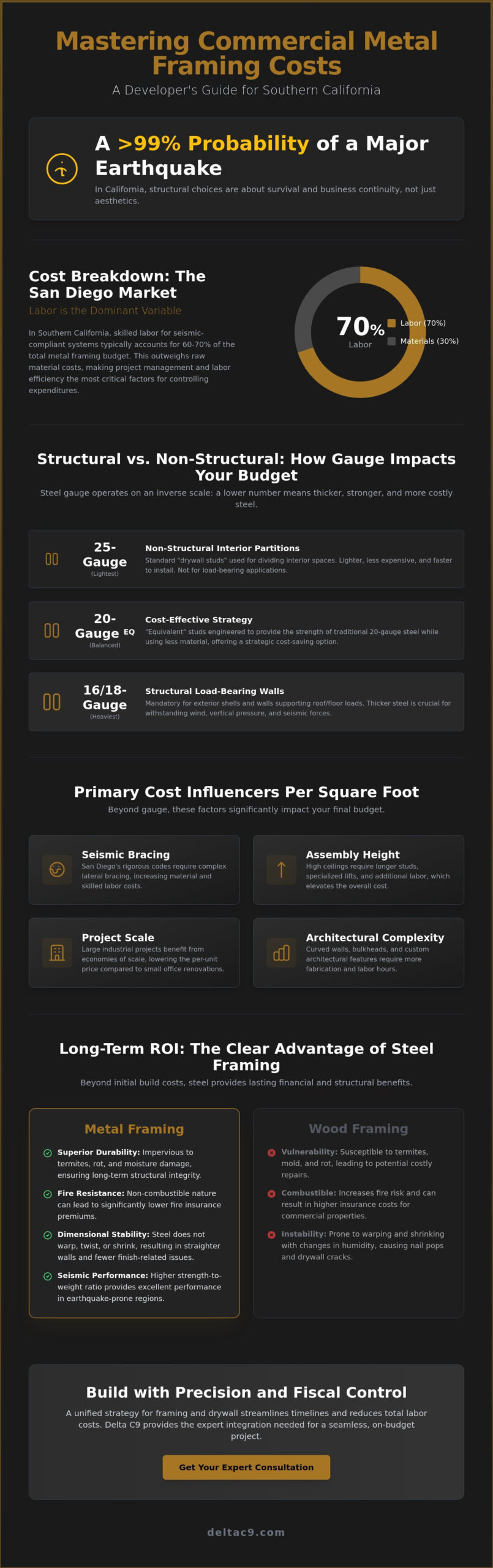
In the San Diego market, labor remains the dominant variable in your commercial metal framing cost per square foot. It’s common for labor to account for 60% to 70% of the total expenditure. This high ratio is driven by the specialized skill set required to install seismic-compliant systems. Hourly rates for experienced crews reflect the high cost of living and the rigorous safety training required for Southern California job sites. Beyond the hourly rate, site logistics like material delivery windows and crane access can significantly influence the final rate. Efficient project management that integrates framing with subsequent phases, such as drywall installation, remains the most effective way to control these labor-heavy costs.
Structural vs. Non-Structural: How Gauge Impacts Your Budget
The thickness of the steel, measured in gauges, is the most significant technical factor determining your project’s financial trajectory. In the construction industry, gauge numbers operate on an inverse scale; a lower number represents a thicker, more robust piece of steel. This physical reality dictates that a 16-gauge structural stud contains significantly more raw material than a 25-gauge interior stud. Consequently, your commercial metal framing cost per square foot will fluctuate based on whether the wall is designed to support the building’s weight or simply divide an office floor. Selecting the correct gauge is a balancing act between engineering safety and fiscal responsibility.
For interior partitions that don’t support structural loads, 25-gauge “drywall studs” are the standard, budget-friendly choice. These lighter components are easier to handle and cut, which reduces labor hours. However, when a project moves to the exterior shell or requires load-bearing capabilities, the transition to 16-gauge or 18-gauge steel becomes mandatory. These thicker materials are necessary to withstand wind loads and vertical pressures. Investing in the right thickness ensures the long-term return on investment for steel framing by preventing structural fatigue and maintaining the integrity of the building envelope over decades of use.
Understanding Steel Gauges and Mils
Modern manufacturing has introduced 20-gauge “equivalent” (EQ) studs, which offer a strategic way to save on material costs. These studs are engineered to provide the strength of traditional 20-gauge steel while using less actual metal. It’s also vital to consider the web width. A standard 3-5/8″ stud is sufficient for most interior walls, but moving to a 6″ web for higher structural demands will naturally increase the price per square foot. Our specialists at Delta C9 can help you determine if an integrated approach to ceiling and drywall solutions can further optimize these material choices.
The Cost of Height and Spacing
Wall height and stud spacing are the “hidden” variables in any framing quote. While 24-inch on-center spacing is the most economical, it’s often insufficient for walls exceeding 12 feet or for areas with high wind-load requirements. Tall walls require a “premium” because they demand thicker gauges and specialized lateral bracing to prevent deflection. As the spacing tightens to 16 inches or 12 inches on-center to meet strict California codes, the commercial metal framing cost per square foot rises because more individual studs are required for the same linear run. Engineering these spans correctly from the start prevents costly revisions during the inspection phase.
Evaluating the ROI: Metal vs. Wood Framing for Commercial Use
While timber often presents a lower initial price point, the commercial metal framing cost per square foot offers a superior long-term return on investment. In professional environments, durability and risk mitigation are the primary drivers of value. Steel components do not shrink, split, or warp. This dimensional stability ensures that the building’s structural integrity remains constant over time. Additionally, the speed of installation with metal studs is a significant factor in project efficiency. Pre-punched holes in the studs allow for faster integration of mechanical, electrical, and plumbing systems. This streamlined process reduces the overall project timeline and helps control labor expenditures.
Sustainability and insurance benefits also contribute to the financial logic of steel. When evaluating the total commercial metal framing cost per square foot, you must account for these ongoing operational savings. As one of the most recycled materials globally, steel helps commercial projects achieve LEED certification and meet corporate sustainability goals. From a fiscal perspective, the most immediate saving often comes from insurance providers. Many companies offer lower premiums for buildings framed with non-combustible materials. By choosing steel, you are proactively protecting the asset against fire risks. This strategy translates into lower operating costs throughout the building’s lifecycle.
Durability and Maintenance Savings
San Diego’s coastal humidity can be punishing for traditional timber structures. Steel is naturally resistant to rot, termites, and moisture damage, which is a critical advantage in our local climate. Unlike wood, which expands and contracts with environmental changes, straight steel studs prevent the common issue of “screw pops” in finished drywall. By eliminating these structural shifts, you significantly reduce the long-term maintenance budget required for cosmetic repairs. This stability ensures that the interior remains pristine for years after the initial construction is complete.
Compliance with California Fire Codes
Strict adherence to the California Building Code often dictates the choice of materials. For Type I and Type II commercial structures, non-combustible framing is a legal requirement. While wood can be chemically treated to resist fire, these treatments are expensive and can lose effectiveness over time. Metal framing provides a permanent, inherent fire resistance that simplifies the fire marshal inspection process. This clarity in compliance reduces the risk of project delays. It ensures that your facility meets the highest safety standards for all occupants, providing peace of mind for both owners and tenants.
San Diego Specifics: Seismic Bracing and Local Compliance
Building in Southern California requires a deep understanding of the California Building Code (CBC), which is significantly more stringent than national standards. In San Diego, your commercial metal framing cost per square foot is heavily influenced by seismic zone requirements. These aren’t merely suggestions; they are structural mandates designed to ensure business continuity after a major event. While basic vertical studs are the most visible part of the assembly, the “hidden” costs often lie in the lateral bracing, specialized anchors, and seismic clips required to manage horizontal forces. These components ensure that the framing system can flex without failing, a critical requirement given the 99% probability of a significant earthquake striking the region.
The local labor market also plays a decisive role in project budgeting. San Diego consistently sees higher labor rates compared to Inland Empire locations like Riverside. This discrepancy is due to both the higher cost of living and the specialized training required for local seismic compliance. When you receive a quote, it’s vital to ensure that the labor component accounts for the precision needed to install deflection tracks and complex bracing systems. A mistake in these technical details can lead to failed inspections and costly delays that far outweigh any initial savings on a lower-priced, less-experienced crew.
Seismic Engineering and Inspection Costs
Seismic-rated fasteners and heavy-duty deflection tracks are standard requirements for commercial projects in San Diego County. Engineering stamps are mandatory for structural framing, ensuring that every connection point meets the calculated load requirements. You should also budget for third-party inspections, which are often required for structural steel connections and seismic anchors. These inspections provide an extra layer of security, confirming that the installation matches the engineered plans exactly. This rigorous process is what allows modern steel structures to remain stable under extreme conditions.
Navigating San Diego Permitting
Permit approval timelines in the City of San Diego can vary, but having a well-coordinated set of plans is the best way to avoid bottlenecks. Proper metal framing and drywall coordination is essential during this phase. When the framing and finishing stages are planned as a single, cohesive unit, municipal inspectors can move through the site more efficiently. Hiring a contractor with 22+ years of local experience ensures familiarity with specific municipal preferences, which often speeds up the final sign-off. If you are planning a project in the San Diego area, contact Delta C9 to discuss how we can streamline your seismic compliance and permitting process.
Selecting a Contractor: Why Delta C9 is the Logical Conclusion
Choosing a partner for your San Diego development requires a shift from analyzing technical data to evaluating field execution. With 22+ years of experience in the regional commercial construction sector, Delta C9 provides the stability and technical expertise necessary for high-stakes environments. We understand that your commercial metal framing cost per square foot represents more than just a budget line; it’s the foundation of your project’s operational success. Our commitment to engineering precision ensures that both structural shells and ornamental interior details meet the highest standards, preventing the cascading delays often caused by trade misalignment.
One of the most frequent errors in commercial budgeting is the separation of framing and drywall contracts. This fragmentation often leads to accountability gaps and increased overhead. We advocate for a unified strategy. By adopting an integrated approach to ceiling and drywall services, our clients typically realize a 10-15% saving on total labor expenditures. This efficiency stems from a single management team overseeing the transition from metal studs to finished surfaces, ensuring that every stud is perfectly aligned for the drywall phase. This foresight eliminates the need for costly “change order” corrections during the final stages of the build.
The Integrated Service Advantage
Delta C9 streamlines the entire interior envelope process. We provide a clear, methodical path from the initial metal frame, insulation, drywall, and paint to a move-in ready state. This single-source model reduces project management overhead and ensures that critical performance metrics, such as acoustic integrity, are maintained. Our specialists ensure that high-performance soundproofing is integrated correctly within the framing assembly, protecting the privacy and functionality of your commercial space.
Requesting Your San Diego Framing Quote
To provide an accurate commercial metal framing cost per square foot estimate, we require a comprehensive set of architectural plans and structural notes. Our process is rooted in transparency and technical accuracy. We perform detailed site walks and technical feasibility assessments to identify potential challenges before they impact your timeline. This rigorous pre-construction phase ensures that the bid you receive is final and inclusive of all seismic requirements. Contact Delta C9 today for a professional commercial framing estimate. We are ready to serve as your strategic partner in building a secure, compliant, and cost-effective commercial facility.
Securing Your Structural Integrity and Budget
Mastering your commercial metal framing cost per square foot requires a strategic view of both materials and local regulations. You’ve seen how steel gauge selection and wall height requirements directly influence your financial planning. You also understand that San Diego’s seismic codes aren’t just technical hurdles; they are essential safeguards for your long-term investment. By prioritizing engineering precision and structural compliance, you ensure that your facility remains safe, durable, and operational for decades to come.
Partnering with a specialist who understands the nuances of the Southern California market is the most effective way to eliminate financial uncertainty. Delta C9 brings 22+ years of San Diego experience to every project. We are specialized in seismic compliance and operate as a fully licensed and insured California contractor. Our integrated approach to framing and interior finishing provides the stability and control your project deserves. We focus on the technical details so you can focus on your business goals.
Get a Precision Quote for Your San Diego Commercial Project
We look forward to helping you build a resilient and cost-effective future for your commercial assets.
Frequently Asked Questions
Is metal framing more expensive than wood in 2026?
Metal framing typically involves a higher initial cost than wood, but it offers better long-term value for commercial assets. Steel’s durability prevents issues like warping and rot, which are common in coastal climates like San Diego. In 2026, the non-combustible nature of metal also contributes to lower fire insurance rates. Property owners often find that these operational savings and reduced maintenance costs outweigh the initial price difference.
What is the standard labor cost for commercial metal framing in San Diego?
Labor costs for commercial framing in San Diego typically account for 55% to 60% of the total project budget. This percentage is higher than the national average due to California’s specialized seismic requirements and local labor market rates. Hiring skilled crews ensures that your project complies with all municipal safety standards. This investment in professional labor prevents expensive structural failures or inspection delays during the build process.
How does the gauge of the steel affect the cost per square foot?
The gauge of the steel significantly influences the commercial metal framing cost per square foot because it determines the amount of raw material used. Lower gauge numbers represent thicker steel, which is more expensive to manufacture and requires more labor to install. While 25-gauge studs are suitable for interior partitions, structural walls require 16 or 18-gauge steel. Balancing these material choices is essential for maintaining your budget without compromising structural safety.
Does commercial metal framing require special permits in California?
Yes, all commercial metal framing projects in California must comply with strict permitting and engineering standards. San Diego County requires specific engineering stamps and seismic bracing documentation for structural work. These regulations ensure the building can withstand horizontal forces during seismic events. Working with an experienced contractor simplifies this process, as they understand the documentation required for a smooth municipal approval and final sign-off.
Can metal framing be used for residential remodeling in San Diego?
Metal framing is a popular and effective choice for residential remodeling projects in San Diego. It provides exceptional fire resistance and dimensional stability, which prevents drywall cracks over time. Homeowners often choose steel for room additions or basement build-outs where moisture resistance is a priority. It’s an ideal solution for creating perfectly straight walls that support high-end interior finishes and modern architectural designs.
How long does it take to frame a 5,000-square-foot commercial space?
Framing a 5,000-square-foot commercial space usually takes between two and three weeks for an experienced crew. The exact timeline depends on factors like ceiling height, the number of interior partitions, and the complexity of the architectural layout. Projects with specialized soundproofing or structural reinforcements may require additional time. Coordinating the framing phase with insulation and drywall installation is the best way to ensure project efficiency and maintain your schedule.
What is the difference between structural and non-structural metal studs?
Structural metal studs are designed to bear the weight of the building, while non-structural studs are used only for interior partitions. Structural studs utilize a thicker gauge of steel and wider webs to support vertical and lateral loads. Non-structural studs, often called drywall studs, are lighter and easier to install. Identifying the correct application for each stud type is critical for both engineering compliance and effective cost management.
Why should I hire a specialized framing contractor instead of a general handyman?
Hiring a specialized contractor is essential because commercial framing requires a deep understanding of seismic codes and structural engineering. A general handyman lacks the specialized tools and technical expertise to install load-bearing assemblies safely. Professional contractors also carry the necessary insurance and licensing to protect you from liability. Ensuring your project is built to code from the start prevents costly structural repairs and legal issues in the future.