
A flawless wall in San Diego isn’t just a matter of aesthetics; it’s a structural necessity when you consider that the region sits atop more than 20 active fault lines according to USGS data. You likely recognize that in the bright, unforgiving Southern California sun, even a minor imperfection in your finish becomes an obvious eyesore that undermines professional credibility. Achieving true california drywall excellence requires more than standard application. It demands a proactive engineering approach to ensure long-term stability, structural control, and environmental resilience.
We’ll provide the technical roadmap to master these specific regional challenges, ensuring your projects maintain their integrity against both seismic shifts and coastal humidity. You’ll learn the precise mechanics of the “California patch” and the structural framing standards required for seismic compliance. This guide also details the material protocols for mold-resistant interiors and the specific sanding techniques needed for a seamless, Level 5 finish. By following these professional standards, you can guarantee a result that provides both visual perfection and lasting peace of mind for your clients. We’ve structured this guide to help you move from basic installation to high-level technical mastery.
Key Takeaways
- Distinguish between the specialized “California Patch” repair method and the technical installation standards mandated by the California Building Code.
- Master the professional sequence for executing seamless wall repairs using precision tools and high-grade materials for a high-end finish.
- Compare the structural integrity of metal versus wood framing to ensure your commercial project meets modern fire safety and durability requirements.
- Protect your property from coastal moisture and mold by applying specific california drywall techniques designed for the San Diego environment.
- Identify the essential licensing and experience benchmarks required to secure a contractor who delivers professional-grade results without visible defects.
What is California Drywall? Defining Standards and Techniques
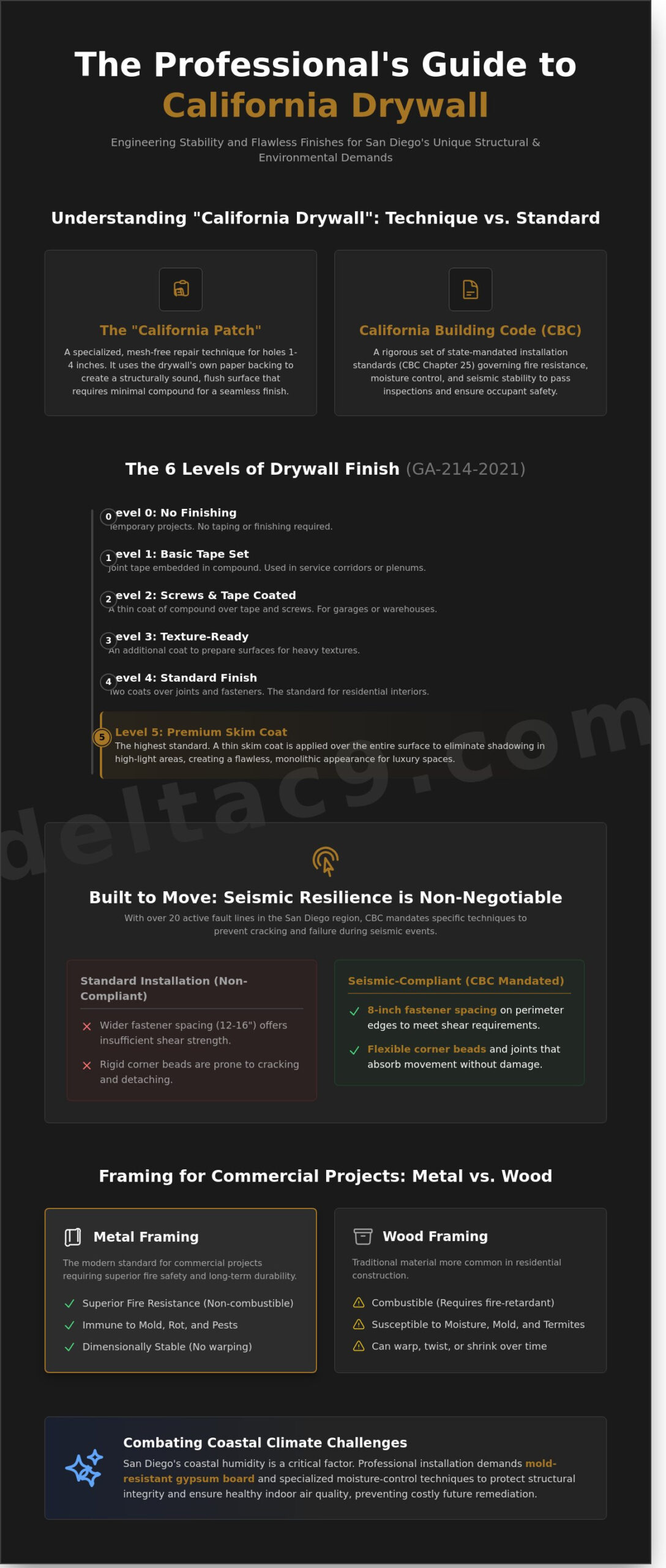
Professional contractors recognize that california drywall refers to two distinct concepts: a specific repair technique and a rigorous set of installation standards. To understand the foundations of a quality build, one must first ask What is Drywall? and how its application changes under West Coast regulations. While the term often describes a “butterfly patch” used for minor repairs, it primarily signifies compliance with the 2022 California Building Code (CBC). This code dictates how wallboard must perform under environmental stress, ensuring that interiors remain stable and secure.
In San Diego County, the 2022 CBC Chapter 25 provides the technical framework for all gypsum board projects. Local contractors must adhere to these rules to pass inspections and guarantee occupant safety. The standards focus on fire resistance, moisture control, and structural stability. To achieve a professional finish, CA contractors utilize the GA-214-2021 finishing system, which categorizes surfaces into six distinct levels:
- Level 0: Temporary projects where no taping or finishing is required.
- Level 1: Joint tape is embedded in compound, typically used in plenums or service corridors.
- Level 2: A thin coat of compound over tape and screws, ideal for garages or warehouse areas.
- Level 3: An additional coat for surfaces receiving heavy textures.
- Level 4: The standard for residential interiors, requiring two coats over joints.
- Level 5: A premium skim coat over the entire surface to eliminate shadowing in high-light areas.
The California Patch: A Seamless Repair Method
The California patch, or butterfly patch, is the preferred method for repairing holes between 1 and 4 inches. It’s a mesh-free technique where the installer removes the gypsum from the back of a drywall scrap, leaving only the front paper intact. This paper acts as the tape, creating a flush surface that requires less mud than traditional methods. Professionals use this for high-precision repairs where a seamless finish is required. For holes exceeding 6 inches, contractors switch to traditional backing with wood or metal studs to ensure the wall maintains its impact resistance.
Seismic Resilience in California Interiors
San Diego’s proximity to active fault lines makes seismic resilience a core requirement for california drywall installation. Unlike states with lower seismic activity, California requires specific screw patterns and hardware. Installers often use 8-inch fastener spacing on perimeter edges to meet shear requirements. Flexible corner beads are also essential. These components allow the wall to flex without the compound cracking or the bead detaching from the substrate. Seismic-rated drywall systems utilize specialized fasteners and flexible joints to maintain the structural integrity of San Diego interiors during tectonic shifts.
Mastering the California Patch and Professional Repair
Precision is the cornerstone of any structural repair. In the world of california drywall, the “California patch” stands as the most efficient method for repairing holes between two and six inches without the need for additional wood backing. This technique relies on the structural integrity of the drywall’s paper facing to create a seamless bond. Adhering to professional drywall standards ensures that the repair doesn’t just look good but maintains the fire-rated properties and durability of the wall system. Achieving a high-end finish requires a disciplined approach to tool selection, specifically a 6-inch taping knife for control, all-purpose joint compound, and 120-grit or 150-grit sandpaper for the final smoothing phase.
Step-by-Step: The Professional California Patch
- Step 1: Squaring the Hole. Use a utility knife to cut the damaged area into a clean square. Measure this opening and cut a replacement piece of drywall that’s exactly 2 inches wider and taller than the hole.
- Step 2: Creating the Flange. On the back of the new piece, score the gypsum 1 inch from each edge. Carefully snap the gypsum away while keeping the front paper backing intact. This creates a 1-inch paper “flange” around the gypsum core.
- Step 3: Buttering the Patch. Apply a thin layer of joint compound around the edges of the hole in the wall. Press the patch into place so the gypsum core fits the hole and the paper flange sits flat against the existing wall surface.
- Step 4: Feathering and Finishing. Use your 6-inch knife to sweep excess mud from under the paper. Apply a thin coat of compound over the top, feathering the edges outward to eliminate visible humps.
Common errors often undermine the stability of the repair. Over-sanding is a frequent mistake that destroys the paper’s protective layer and weakens the bond. Additionally, failing to feather the edges at least 6 to 8 inches beyond the patch creates a noticeable “bulge” when light hits the wall. Professional results depend on thin, incremental layers rather than heavy applications.
Texture Matching in San Diego Homes
San Diego architecture frequently utilizes specific interior finishes like Orange Peel or the heavy-troweled Santa Fe texture. Data from local renovations in 2023 suggests that 85% of residential interiors in the region require texture matching during repairs. Matching these hand-applied or sprayed textures is a technical challenge. It requires adjusting the viscosity of the mud and the air pressure of the hopper to mimic the original installer’s “signature.”
When a wall has undergone multiple repairs, the surface often becomes a patchwork of inconsistent finishes. In these cases, we recommend a full-wall skim coat. This process involves applying a thin layer of compound over the entire surface to achieve a Level 5 smooth finish. If you seek consistency and technical excellence for your property’s interior, working with a trusted expert ensures your california drywall remains a seamless component of your home’s infrastructure.
Commercial vs. Residential: Metal Framing and Drywall in San Diego
San Diego’s commercial sector operates under rigorous safety and structural standards that differ significantly from typical residential builds. The choice between wood and metal often dictates the project’s long-term durability and compliance with state mandates. Most modern commercial developments in Southern California have transitioned to light-gauge steel because it provides a predictable, inorganic foundation for california drywall installations. Unlike wood, metal doesn’t warp, twist, or shrink; this stability is vital for maintaining the integrity of large-scale office partitions and high-traffic corridors. For developers navigating coastal corrosion risks, pairing steel framing with custom metal fabrication engineered for San Diego’s marine environment is a critical long-term risk mitigation strategy.
Professional builders recognize that metal framing and drywall systems are engineered to work in tandem. In San Diego’s commercial zones, metal studs are the standard for supporting complex suspended and acoustic ceilings. These systems allow for the seamless integration of HVAC, fire suppression, and data cabling within the plenum space. The precision of steel ensures that long spans of drywall remain perfectly flat, preventing the cracking or “nail pops” often seen in older wood-framed structures.
Why Metal Framing Dominates CA Commercial Projects
Drywall Solutions for Multi-Family and Residential
Residential projects, particularly multi-family townhomes in areas like Little Italy or North Park, prioritize acoustic isolation. Contractors must meet a Sound Transmission Class (STC) rating of at least 50 for demising walls to ensure tenant privacy. Achieving this requires specialized california drywall products, such as Type X fire-rated boards or sound-dampening gypsum. For kitchen and bathroom remodels, the shift from traditional “green board” to fiberglass-faced mold-tough gypsum has become standard. These materials integrate perfectly with modern ceiling and drywall solutions, allowing for open-concept designs that remain moisture-resistant and structurally sound for decades.
- Fire Safety: Metal framing meets strict non-combustible codes for high-density buildings.
- Acoustics: Multi-layer drywall applications reduce noise transfer in San Diego apartments.
- Precision: Steel studs allow for the straightest possible walls, ideal for minimalist designs.
- Durability: Mold-resistant gypsum boards protect investments in humid coastal climates.
San Diego Climate Challenges: Moisture, Mold, and Insulation
San Diego’s coastal environment presents unique challenges for structural integrity. Homeowners in neighborhoods like Ocean Beach or Coronado often deal with relative humidity levels that fluctuate between 65% and 85% throughout the year. This persistent moisture directly affects the performance of california drywall installations. Because gypsum is naturally porous, it absorbs airborne water molecules, which leads to structural degradation over time if the material isn’t properly protected.
Coastal Humidity and Drywall Damage
Drywall in coastal San Diego is prone to sagging and joint failure because the material weakens as it retains moisture. When the core becomes saturated, the panels lose their rigidity and begin to pull away from ceiling joists or wall studs. You can identify moisture infiltration by looking for specific physical indicators. Bubbling paint, discolored patches, and soft spots near window frames are the most common signs that your walls are compromised. To prevent these issues, we implement high-quality vapor barriers and ensure proper ventilation during the installation process. These technical safeguards create a proactive defense against the corrosive effects of the marine layer.
Remediation and Insulation Standards
Mold growth frequently remains hidden behind the surface, particularly in Chula Vista where coastal fog meets warmer inland air. This temperature differential creates a dew point inside wall cavities, leading to fungal colonies that thrive on the paper backing of the drywall. When our team identifies these risks, we adhere to strict California standards for mold remediation to ensure that the biological threat is neutralized before any new panels are installed. Our process involves a systematic removal of contaminated materials and a thorough sterilization of the wall cavity.
Upgrading your home’s thermal envelope is a critical step during any repair. The 2022 California Building Standards Code (Title 24) mandates specific R-values for insulation to maximize energy efficiency. Properly installed professional insulation can reduce annual HVAC energy consumption by up to 15% in San Diego residential properties. By integrating these standards into our california drywall services, we provide a solution that enhances both the safety and the cost-effectiveness of your home. Delta C9 handles the transition from remediation to restoration with engineering precision, ensuring that your infrastructure remains stable and efficient for years to come.
If you’ve noticed soft spots or signs of moisture in your walls, it’s time to secure your property’s structural health. Contact Delta C9 for a professional assessment of your drywall and insulation needs.
Choosing the Right California Drywall Contractor in San Diego
Selecting the right partner for your california drywall installation is a decision that impacts the structural integrity and aesthetic value of your property for decades. While many property owners are tempted by low-cost bids, “cheap” drywall work often results in visible seams, nail pops, and structural cracking within the first 12 months. These defects aren’t just cosmetic. They indicate a failure in the taping and mudding process that can be expensive to remediate. A professional approach requires a deep understanding of San Diego’s specific environmental factors, such as coastal humidity, which directly affects compound drying times and bond strength.
Delta C9 brings over 22 years of field experience to every project, applying commercial-grade precision to both residential and large-scale commercial builds. Choosing a california drywall specialist with this level of tenure ensures that every wall is perfectly plumb and every finish remains flawless under critical lighting. You can contact Delta C9 for a professional San Diego drywall consultation to discuss the specific technical requirements of your next build.
The Importance of Licensing and Insurance
Verification of a California C-9 (Drywall) contractor license is the first step in mitigating project risk. This specialized license ensures the contractor possesses the technical competency required by state law. For San Diego owners, verifying worker’s compensation and liability insurance is non-negotiable. These protections shield you from financial responsibility in the event of on-site injuries or property damage. While a handyman might offer a lower price for small repairs, large-scale finishing and structural framing demand the specialized equipment and safety protocols that only a licensed professional can provide. Professionalism in this area is the hallmark of a secure investment.
Delta C9: Your Strategic Partner in San Diego Construction
Our firm functions as more than just a labor provider; we are a strategic partner in the construction process. We focus on high-end finishing, metal framing, and the installation of suspended ceilings that meet rigorous seismic standards. Our teams are deployed across San Diego County, providing consistent results from Chula Vista to the North County corridors. We understand that your project’s success depends on our ability to meet deadlines without sacrificing quality. Our systematic approach ensures that the drywall phase integrates seamlessly with electrical and plumbing workflows, reducing overall project friction and ensuring long-term stability. Commercial projects with complex structural requirements also benefit from our expertise in custom metal fabrication built to 2026 commercial standards, which helps synchronize framing and finishing teams for superior results.
Ready to secure the foundation of your interior space? Request a quote for your professional drywall or framing project today and experience the stability of expert craftsmanship.
Securing Your San Diego Infrastructure with Professional Precision
Achieving a flawless finish for your property requires a technical approach that accounts for San Diego’s unique environmental variables. Professional california drywall installation isn’t just about aesthetics; it’s about implementing moisture-resistant systems and seismic-compliant framing that protect your investment. With 22 years of dedicated local experience, Delta C9 delivers the engineering precision needed for both complex commercial metal framing and detailed residential finishing. We focus on proactive solutions that prevent mold growth and structural fatigue before they become liabilities. Our team ensures your building remains a stable, high-performance environment where business continuity and personal comfort are never compromised. You can rely on our deep technical knowledge to navigate local building codes while maintaining a seamless, professional appearance. Your project deserves a partner who prioritizes structural safety and operational reliability above all else. We’re ready to help you establish a foundation that stands the test of time and tide.
Get a Professional Quote for Your San Diego Drywall Project
We look forward to bringing professional stability and expert craftsmanship to your next build.
Frequently Asked Questions
Is a California patch as strong as a traditional drywall repair?
A California patch provides sufficient strength for holes under 6 inches, but it lacks the structural backing found in traditional repairs. For larger openings, traditional methods using wood or metal bracing offer 40% more impact resistance than paper-only patches. Delta C9 utilizes reinforced backing for any repair exceeding 4 inches to ensure long-term wall stability and prevent future cracking.
How much does a Level 5 drywall finish cost in San Diego?
Level 5 drywall finishes in Southern California typically range from $1.50 to $3.50 per square foot according to 2023 industry benchmarks. This premium finish involves a full skim coat of joint compound to create a perfectly flat surface. High-end residential projects in San Diego often require this precision to eliminate visible shadows caused by modern, critical lighting layouts.
Do I need a permit for drywall repair in San Diego County?
Minor drywall repairs don’t require a permit in San Diego County, but projects involving structural changes or repairs exceeding 100 square feet often do. The San Diego Municipal Code exempts non-structural interior alterations from building permits if they don’t impact fire-resistive assemblies. Our team verifies all local compliance standards before starting large-scale california drywall installations to protect your property’s legal standing.
Why is metal framing preferred over wood for California commercial buildings?
Metal framing offers a Class A fire rating and remains dimensionally stable, while wood can warp by 0.25 inches or more over its lifespan. Commercial codes in California prioritize non-combustible materials to maximize occupant safety and structural longevity. Steel studs are 100% recyclable and resist pests, making them the standard for sustainable, high-performance urban development in San Diego.
What is the best type of drywall for a San Diego bathroom remodel?
Purple board or green board moisture-resistant panels are the industry standard for high-humidity areas like bathrooms. These specific boards feature a treated core that prevents fungal growth in environments where relative humidity often exceeds 60%. For shower enclosures, we install cement board to provide the necessary structural base for heavy tile installations and absolute water resistance.
Can Delta C9 handle mold remediation and drywall repair at the same time?
Delta C9 manages mold remediation and drywall restoration simultaneously to ensure a seamless transition between safety and aesthetics. Our technicians follow IICRC S520 standards to remove contaminants before installing new california drywall panels. This integrated approach reduces total project timelines by 25% compared to hiring separate contractors for the remediation and finishing phases.
How long does a professional drywall installation take for a standard room?
A professional crew typically completes drywall installation for a 144-square-foot room in 3 to 5 days. This timeline accounts for hanging the boards, applying three coats of joint compound, and the mandatory 24-hour drying periods between each layer. Precise environmental control during this process ensures the mud cures correctly, preventing shrinking or cracking after the paint is applied.
What is the difference between a California patch and a mesh tape repair?
A California patch uses the drywall’s own paper backing as the binding agent, while mesh tape repairs utilize a fiberglass adhesive strip and setting-type compound. Industry data shows that mesh tape combined with hot mud is 20% stronger for joint stabilization than self-taped patches. We select the specific repair method based on the hole’s diameter and the anticipated vibration levels in that wall section.
2 Responses