
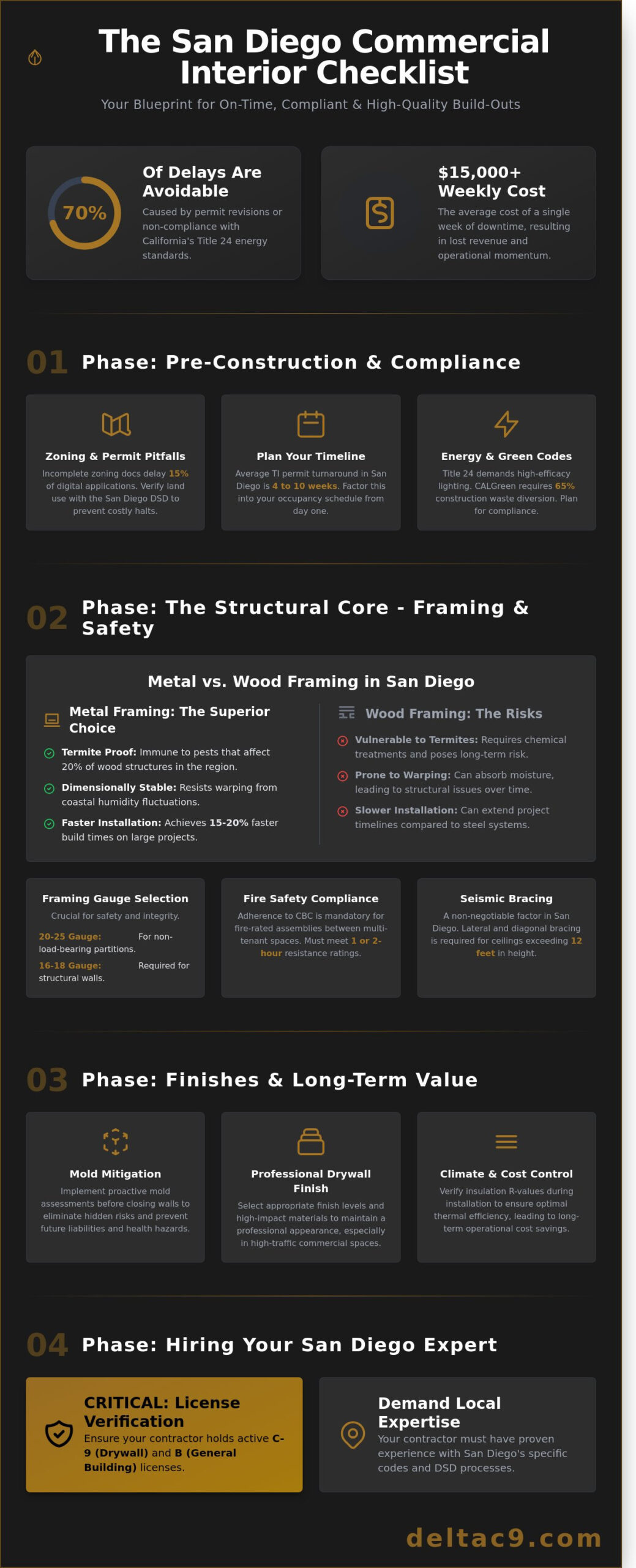
Did you know that 70% of commercial construction delays in San Diego stem from avoidable permit revisions or non-compliance with California’s Title 24 energy standards? You likely understand that a single week of project downtime can cost a mid-sized local firm upwards of $15,000 in lost revenue and operational momentum. Maintaining precise control over these variables is the only way to ensure your business continuity remains uninterrupted during a renovation or build-out.
We’ve developed this comprehensive interior project checklist to serve as your strategic defense against project creep and regulatory failures. It provides the technical clarity you need to oversee framing, drywall, and local compliance with absolute confidence. By following this structured approach, you’ll secure a facility that’s both durable and fully optimized for your specific operational needs. Our guide previews the essential milestones for seamless phase coordination, helping you deliver a project that’s on time and within code without compromising on quality or safety. You’ll gain the oversight necessary to eliminate hidden mold risks and structural vulnerabilities before they become permanent liabilities.
Key Takeaways
- Navigate the complexities of local zoning and California Title 24 standards to ensure your interior project remains compliant and energy-efficient from the start.
- Identify the specific metal framing and seismic bracing requirements essential for structural integrity in high-ceiling commercial construction environments.
- Learn to select the appropriate drywall finish levels and high-impact materials to maintain a professional appearance in high-traffic commercial spaces.
- Mitigate long-term risks by implementing proactive mold assessments and verifying insulation R-values for optimal climate control and safety.
- Streamline your selection process by verifying essential C-9 and B licenses to ensure your contractor possesses the local expertise required for San Diego projects.
San Diego Pre-Construction Checklist: Planning and Compliance
Successful tenant improvements begin long before the first wall is demolished. In the San Diego market, the commercial construction landscape requires a methodical approach to regulatory alignment. You must first verify zoning and land use with the San Diego Development Services Department (DSD). Since 2022, the DSD has shifted toward a fully digital permit process, yet approximately 15% of applications still face delays due to incomplete zoning documentation. Ensuring your project aligns with the local General Plan prevents costly mid-project halts and protects your business continuity.
This phase is a critical component of the overall construction process, where planning meets compliance. For structures built before 1990 in San Diego County, seismic retrofitting is a priority. These requirements ensure your business remains operational after a seismic event, focusing on the stability of the building’s core and the safety of its occupants. Identifying these needs early allows for a more predictable budget and a more secure infrastructure.
Navigating San Diego Building Permits
Submitting plans to the DSD or the Chula Vista Building Division follows a strict protocol. You’ll need to upload professional architectural drawings via the Accela portal and pay plan check fees based on the project’s square footage. A common pitfall is confusing minor interior remodels with structural commercial construction permits. If your design involves moving load-bearing elements or altering fire suppression systems, the permit requirements become significantly more complex. In 2023, the average turnaround for TI permits in San Diego ranged from 4 to 10 weeks; it’s vital to factor this into your occupancy schedule.
Energy and Environmental Standards
Compliance with California Title 24 Energy Standards is mandatory for all San Diego interior build-outs. Your checklist should focus on high-efficacy lighting controls, occupancy sensors, and specific R-values for insulation to ensure thermal efficiency. Under CALGreen regulations, 65% of construction waste must be diverted from landfills, a requirement that demands a structured waste management plan. Additionally, the San Diego 2022 Water Use Efficiency Ordinance mandates low-flow fixtures for all commercial spaces. These standards aren’t just hurdles; they’re benchmarks for long-term operational cost reduction and environmental responsibility. Whether you’re planning commercial improvements or considering residential remodeling projects in San Diego, understanding these energy efficiency requirements is crucial for any construction project in the region.
The Structural Interior: Commercial Metal Framing Standards
Metal framing serves as the backbone of modern commercial construction. Selecting the right gauge is a technical decision that impacts both safety and cost. For non-load-bearing partitions, 25-gauge or 20-gauge studs often suffice; however, structural walls or those supporting heavy equipment require 16-gauge or 18-gauge steel. Precision in these choices prevents wall bowing and ensures the interior can withstand daily operational stresses.
Proper coordination of Mechanical, Electrical, and Plumbing (MEP) rough-ins must occur before the framing is closed. This prevents costly rework and project delays. In San Diego, projects must strictly adhere to the California Building Standards Code to ensure fire-rated assemblies between multi-tenant spaces meet the 1-hour or 2-hour resistance requirements. Seismic bracing is another non-negotiable factor. For ceilings exceeding 12 feet, installers must implement lateral support and diagonal bracing to maintain stability during a seismic event.
Why Metal Framing Wins in San Diego Commercial Projects
Steel offers superior performance compared to wood in Southern California’s coastal environment. It’s immune to termite damage, which affects approximately 20% of wood-frame structures in the region over time. Unlike timber, steel remains dimensionally stable despite the humidity fluctuations found in coastal San Diego properties. In large-scale Chula Vista industrial projects, metal framing allows for 15% to 20% faster installation times, helping teams meet tight occupancy deadlines while maintaining commercial construction quality.
Metal Framing Quality Control Checklist
Maintaining high standards during the framing phase ensures a smooth transition to finishing trades. Every project should follow a rigorous inspection protocol:
- Plumb and Square: Verify all corners and openings are perfectly vertical before hanging drywall to avoid finish issues.
- Stud Spacing: Use 16-inch on-center spacing for walls exceeding 10 feet to prevent lateral deflection.
- Deflection Tracks: Install head-of-wall deflection tracks to allow the building’s primary structure to move without cracking interior partitions.
- MEP Pathing: Check that pre-punched holes in studs align for efficient conduit and pipe runs.
Achieving this level of precision requires a partner who understands the nuances of high-stakes infrastructure. You can maintain better control over your project’s timeline and safety by working with a strategic technical consultant who prioritizes structural integrity from day one.
Commercial Drywall and Finishing: Achieving the Professional Look
The quality of interior walls defines the longevity and aesthetic value of a business space. In commercial construction, the selection of drywall materials and the precision of the finish aren’t merely cosmetic choices. They are technical requirements that ensure safety, acoustic privacy, and structural durability. Proper installation begins with a clear understanding of the project’s specific environmental demands and the intended use of each room.
Understanding Drywall Finish Levels (0-5)
San Diego office environments often feature expansive windows that invite intense, direct sunlight. This critical lighting reveals every minor imperfection in a wall surface. While a Level 4 finish is standard for most commercial spaces, a Level 5 finish is necessary for surfaces receiving gloss paint or heavy side-lighting. This top-tier finish requires a thin skim coat of joint compound over the entire surface to create a perfectly uniform texture. It eliminates the “joint telegraphing” that occurs when light hits the wall at an angle.
Contractors must account for Southern California’s coastal climate. With average humidity levels near 69% in coastal San Diego, drying times for joint compounds can increase by 18% compared to inland desert projects. Rushing this process leads to joint cracking or “photographing” where seams become visible after painting. Use this checklist during your final inspection to ensure a professional result:
- Inspect joints under high-output LED lights held parallel to the wall surface.
- Verify that all fasteners are completely concealed and sanded perfectly flush.
- Ensure seamless transitions where drywall meets suspended ceiling grids; gaps in these areas should not exceed 1/8 of an inch.
Specialized Boards for Commercial Use
Standard drywall won’t suffice for every zone within a modern facility. For high-traffic retail areas or corridors in San Diego schools, abuse-resistant boards provide up to 40% more resistance to surface indentations than standard panels. In commercial kitchens or high-moisture restrooms, California building codes require mold-resistant “Green Board” or fiberglass-faced panels to prevent microbial growth and maintain air quality standards.
Fire safety is a non-negotiable priority for any commercial construction project. You must install 5/8-inch “Type X” fire-rated drywall in elevator shafts and exit corridors to provide a certified 60-minute fire resistance rating. For executive suites and conference rooms, sound-dampening drywall with a Sound Transmission Class (STC) rating of 50 or higher ensures private conversations remain confidential. Following the standards set by the Associated General Contractors of America ensures that your project meets both local safety regulations and national quality benchmarks. This methodical approach protects your investment and ensures the long-term stability of your business infrastructure.
Remediation and Safety: Protecting the Commercial Environment
Safety isn’t a secondary concern in commercial construction; it’s the foundation of business continuity. Managing a tenant improvement project requires a proactive stance against environmental hazards that compromise both structural integrity and employee health. Our approach prioritizes stability and control, ensuring your facility remains a secure asset rather than a liability. By identifying risks before the first wall is opened, we protect your investment from the unpredictable costs of late-stage remediation.
Mold Remediation During Commercial Remodeling
Buildings located within five miles of the San Diego coastline face unique humidity challenges that often lead to hidden microbial growth. Water damage typically manifests as subtle discoloration on 5/8 inch Type X drywall or a persistent musty odor in storage areas. We utilize professional moisture meters to identify surfaces exceeding a 15% moisture threshold before demolition begins. Delta C9’s protocol focuses on high-level protection through strict containment and HEPA-aire scrubbing. We don’t just remove the visible growth. We address the root cause by installing high-performance vapor barriers and ensuring insulation R-values meet the 2022 Title 24 standards. This methodical process prevents future outbreaks and protects the air quality for all occupants. These same moisture control principles apply to strategic residential remodeling in San Diego, where coastal humidity poses similar challenges for homeowners seeking to protect their investment.
Acoustic and Suspended Ceiling Checklist
Open-office layouts in modern commercial construction require sophisticated sound management to maintain productivity. Effective noise control relies on selecting the right materials and adhering to strict regional codes. San Diego County falls under Seismic Design Category D, which dictates specific bracing and attachment requirements for all suspended ceiling grids. Use this checklist to evaluate your ceiling system:
- NRC Ratings: Select ceiling tiles with a Noise Reduction Coefficient (NRC) of 0.75 or higher for high-traffic zones to absorb 75% of sound energy.
- Seismic Compliance: Verify that the grid system meets ASCE 7-16 standards for lateral force resistance to ensure safety during a seismic event.
- System Integration: Coordinate the placement of HVAC diffusers and LED lighting fixtures within the 2×2 or 2×4 grid to avoid structural interference.
- Soundproofing: Install plenum barriers or sound masking systems in sensitive areas like executive boardrooms to prevent voice carryover.
In the Chula Vista climate, thermal performance is equally vital for operational efficiency. We recommend a minimum of R-15 wall insulation and R-30 ceiling insulation to stabilize indoor temperatures and reduce monthly energy costs. This engineering precision ensures your environment is quiet, safe, and efficient. Ensure your facility meets the highest safety standards by partnering with Delta C9 for your commercial construction and remediation needs.
Hiring a San Diego Commercial Contractor: Selection Checklist
Selecting the right partner for your tenant improvement project determines the long-term stability of your facility. A mistake in the selection process can lead to structural delays or compliance failures that cost thousands in daily operational losses. You must verify that your contractor holds both an active California B (General Building) license and a C-9 (Drywall) specialty license. This dual qualification ensures the team understands the overarching structural requirements of commercial construction while possessing the technical precision needed for interior finishes.
Beyond licensing, scrutinize the Experience Modification Rate (EMR). A rating below 1.0 indicates a safety record superior to the industry average. Ensure the firm carries a minimum of $2 million in general liability insurance and comprehensive workers’ compensation coverage. Local expertise matters because San Diego County building codes often involve specific seismic and fire-rated assembly requirements that out-of-state firms might overlook. For a cal corporation establishing or expanding a presence in San Diego, verifying these credentials is especially critical to avoid costly compliance failures during the build-out phase. Use this checklist to vet your candidates:
- Verify active CSLB status for B and C-9 classifications.
- Request a list of three San Diego County projects completed within the last 24 months.
- Confirm the contractor employs dedicated remediation specialists for mold or moisture issues.
- Review safety logs and current EMR documentation.
- Ask for specific examples of industrial projects in San Diego exceeding 10,000 square feet to assess their capacity for large-scale structural interior work.
The Specialist vs. The Generalist
Delta C9 brings 22 years of specialized experience to the Southern California market, focusing on the intersection of structural integrity and interior aesthetics. While a generalist might oversee a broad range of tasks, an interior specialist ensures that metal framing is executed with millimeter precision. When you compare bids, look for line-item transparency rather than just the bottom line. A bid that accounts for high-grade remediation services and specific acoustic ratings provides more value than a lower quote that ignores these technical necessities.
Project Management and Communication
Effective commercial construction relies on a single point of contact to eliminate communication silos. This structure prevents the common 15% delay caused by misaligned scheduling between framing and drywall teams. Demand a clear milestone report that includes weekly updates on material lead times and labor allocation. Your contractor should provide a documented timeline that accounts for every phase from initial remediation to the final coat of finish. This methodical approach ensures your business continuity remains the priority throughout the build.
Schedule a consultation for your San Diego commercial project with Delta C9 to ensure your facility meets the highest standards of safety and efficiency.
Secure Your San Diego Project’s Success Today
Navigating the complex landscape of commercial construction in San Diego requires a partner who understands the intersection of strict building codes and high-end interior finishes. You’ve seen how essential it is to align your pre-construction planning with local compliance standards and maintain rigorous metal framing protocols for structural durability. Quality drywall finishing and proactive remediation aren’t just aesthetic choices; they’re critical safeguards for your facility’s long-term value and safety.
Delta C9 brings over 22 years of San Diego construction experience to your project. We’re a locally owned and operated team based in Chula Vista, providing specialized expertise in metal framing, drywall systems, and environmental remediation. We take pride in our engineering precision and our commitment to business continuity for every client we serve. You won’t have to worry about the technical details when you have a strategic protector managing your interior build-out.
Take the next step toward a stable and professional business environment. Get a Professional Quote for Your San Diego Commercial Project and ensure your interior project meets the highest standards of excellence. We look forward to building a secure future for your business.
Frequently Asked Questions
What is the average cost per square foot for commercial construction in San Diego?
The average cost for commercial construction in San Diego typically ranges between $85 and $145 per square foot for standard tenant improvements. These figures fluctuate based on specific material choices and mechanical requirements. A high-end medical suite might exceed $200 per square foot, whereas basic office shells remain on the lower end of the spectrum. We recommend budgeting an additional 10% for unforeseen structural adjustments during the bidding phase.
How long does the permitting process take for a tenant improvement in Chula Vista?
Permit processing for a tenant improvement in Chula Vista currently takes between 6 and 10 weeks for the initial review cycle. You’ll need to submit plans through the Chula Vista Accela Citizen Access portal for digital processing. Timelines often depend on the volume of applications at the Development Services Department; however, professional expediting can reduce delays by 15%. This structured approach ensures your project remains compliant with local zoning laws.
Do I need a separate permit for metal framing and drywall in San Diego?
You don’t need a separate permit for metal framing and drywall since these are included under your primary tenant improvement building permit. The City of San Diego Development Services Department reviews these structural elements as a single project scope. You must schedule distinct inspections for the framing and the screw pattern before the drywall is finished. This process ensures that the internal components meet safety codes before they’re permanently enclosed.
What are the seismic requirements for commercial interior walls in Southern California?
Southern California commercial interior walls must comply with ASCE 7-22 standards for seismic bracing to ensure occupant safety. Walls taller than 9 feet or those supporting heavy equipment require 45-degree kickers attached to the structure above every 12 feet. These measures prevent wall collapse during a 6.0 magnitude or greater earthquake. Our team implements these engineering requirements to maintain the structural integrity of your facility during seismic events.
Can Delta C9 handle both mold remediation and the subsequent reconstruction?
Delta C9 provides a seamless transition from mold remediation to full reconstruction services for your facility. We manage the entire lifecycle of the recovery process, which reduces your downtime by 25% compared to hiring separate contractors. Our team ensures that every square inch of the affected area meets safety standards before we begin the structural rebuilding phase. This integrated approach protects your business continuity and ensures a safe working environment.
What is the difference between a Level 4 and Level 5 drywall finish?
A Level 4 finish involves three coats of joint compound over fasteners and seams, while a Level 5 finish adds a thin skim coat across the entire wall surface. Level 5 is necessary for areas with high-gloss paint or critical lighting to eliminate shadows and imperfections. This extra step increases labor costs by approximately 20% but guarantees a perfectly smooth appearance. It’s the standard choice for executive boardrooms and high-end retail spaces.
How does Title 24 affect my commercial interior remodeling project?
Title 24 mandates that your commercial interior remodeling project meets strict California Energy Commission standards for lighting and HVAC efficiency. You’ll likely need to install occupancy sensors and LED fixtures that consume 50% less energy than older systems. Compliance is mandatory for obtaining a certificate of occupancy, as it directly impacts the long-term operational costs of your facility. Our experts ensure every design choice aligns with the 2022 building energy efficiency standards.
Why is metal framing preferred over wood in San Diego commercial buildings?
Metal framing is preferred in San Diego commercial construction because it provides a non-combustible structure that meets Class A fire ratings. Unlike wood, steel studs won’t warp, rot, or attract termites, which are common issues in Southern California’s coastal climate. It offers a higher strength-to-weight ratio, allowing for taller spans in warehouse or high-ceiling office environments. This durability ensures your interior infrastructure remains stable for decades without requiring significant maintenance.
3 Responses