
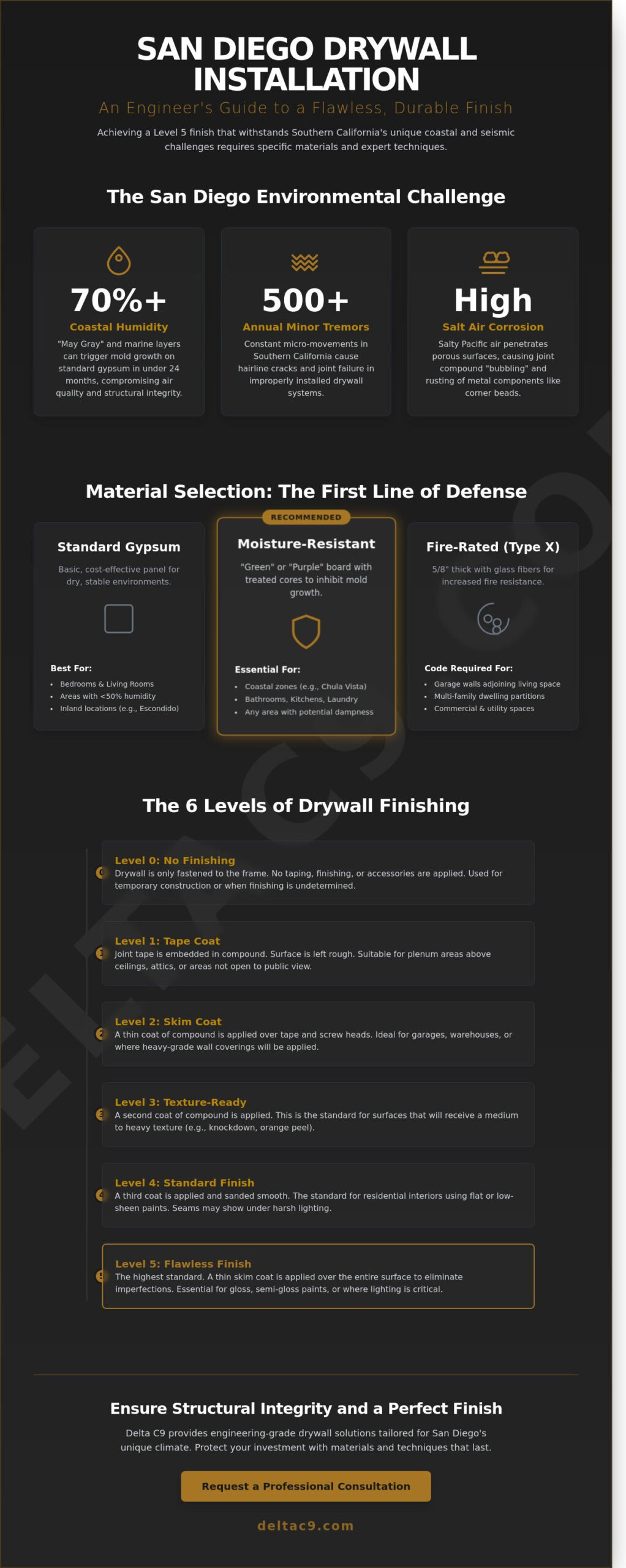
Did you know that coastal humidity levels in San Diego can exceed 70% during the seasonal “May Gray” period, potentially triggering mold growth on standard gypsum boards in less than 24 months? You’ve likely noticed that local environmental factors, from the salty Pacific air to the 500 minor seismic tremors recorded across Southern California each year, place immense stress on your interior surfaces. It’s frustrating to invest in a renovation only to see hairline cracks or damp spots appear shortly after a professional drywall installation is completed.
This 2026 guide empowers you to master the technical requirements of professional construction, ensuring your project meets the rigorous California Title 24 energy codes. We’ll provide the engineering-grade insights needed to achieve a durable, Level 5 finish that stands up to San Diego’s unique climate. You’ll learn how to select the right moisture-rated materials for coastal zones and implement the specific structural reinforcements required for long-term stability in seismic regions. Our objective is to move beyond mere aesthetics, focusing on the structural integrity and proactive protection your property deserves.
Key Takeaways
- Learn how to select moisture-resistant materials like “green board” to protect your project from San Diego’s coastal humidity.
- Discover why integrating metal framing ensures superior structural integrity and mold resistance for long-term stability.
- Master the technical requirements of professional drywall installation to ensure your project meets strict California building codes and regional fire safety standards.
- Identify the specific drywall finishing levels needed to achieve either a functional utility space or a flawless residential surface.
- Gain the criteria for selecting a qualified contractor who understands San Diego’s unique permitting landscape and environmental challenges.
Understanding Professional Drywall Installation in San Diego’s Coastal Climate
Professional drywall installation is a precisely engineered process that involves mounting gypsum panels to a structural frame. This system creates surfaces that provide fire-rated protection, acoustic insulation, and essential aesthetic finishes. To understand the complexity of these materials, one can look at the technical definition of What is Drywall? which highlights its evolution from heavy plaster to modern, lightweight gypsum boards. In the specific context of Chula Vista, this process must account for the high salt content and humidity levels typical of a coastal environment.
Standard gypsum boards often fail in San Diego’s coastal zones because they lack the necessary moisture barriers. Professionals prioritize “green board” or “purple board” for these properties. These specialized panels contain treated cores and fiberglass facings that resist mold growth and structural softening. Additionally, all interior partitions must adhere to the California Building Standards Code (Title 24). This code dictates specific fire-resistance ratings and energy efficiency standards that ensure the safety and longevity of the building’s interior envelope.
Seismic safety is another critical factor for any Southern California property. Professional drywall installation acts as a sacrificial layer that absorbs energy during minor tremors. By following strict fastening patterns and using high-quality materials, installers prevent the spiderweb cracking that often occurs in DIY projects after a 3.0 magnitude earthquake. This proactive approach ensures the stability of the home remains intact even as the ground shifts.
The Impact of Ocean Air on Drywall Longevity
Salt air and humidity levels frequently exceeding 65% in Chula Vista can quickly degrade traditional joint compounds. When salt particles penetrate the surface, they attract moisture, leading to “bubbling” or “efflorescence” behind the paint. Professional-grade, high-solids primers are non-negotiable for these properties because they seal the gypsum pores against corrosive elements. Hygroscopic properties in 2026 building materials mean drywall panels continuously exchange moisture with the coastal air, causing microscopic expansion and contraction that can devastate poorly taped seams.
Seismic Considerations for SoCal Interiors
Protecting a home against tectonic movement requires more than just screws and tape. Professionals utilize flexible, polymer-modified joint compounds and specific fastening patterns, such as 12-inch spacing on wall studs, to allow for slight structural movement. For those planning a comprehensive renovation, a san diego remodeling strategy that prioritizes structural integrity is the only way to achieve lasting results. Installers also use code-compliant, zinc-coated or plastic corner beads. These materials provide maximum impact resistance and won’t rust when exposed to the damp Pacific breeze, ensuring the corners stay sharp and crack-free for decades.
Selecting the Right Materials: Drywall Types for Southern California Homes
Choosing the correct substrate determines the long-term stability and safety of your interior surfaces. In Southern California, environmental factors like coastal humidity and seismic activity dictate specific material choices. Standard whiteboard remains the primary choice for dry, inland areas such as Escondido. It provides a cost-effective, smooth finish for bedrooms and living areas where moisture levels remain below 50 percent.
Coastal regions like Chula Vista require a more proactive approach to moisture management. For these environments, moisture-resistant panels, often called green or purple board, are essential. These products feature chemically treated cores and water-repellent paper to prevent mold growth in bathrooms and kitchens. Safety protocols also demand the use of Fire-Rated (Type X) drywall. These 5/8-inch panels contain non-combustible glass fibers that provide a 1-hour fire rating. Following California Building Code requirements is mandatory when constructing walls between garages and living spaces or within multi-family units.
Modern residential trends in 2026 show a 25 percent increase in the use of sound-dampening drywall. High-density panels, layered with viscoelastic polymers, effectively isolate noise in home offices and urban condos. This specialized drywall installation ensures a quiet environment even in densely populated San Diego neighborhoods.
Thickness and Size Standards in 2026
Precision in material selection extends to panel dimensions. While 1/2-inch panels are the standard for most walls, 5/8-inch panels offer superior rigidity and acoustic insulation. For curved architectural features, 1/4-inch flexible drywall allows for tight radii without cracking. Contractors now favor 12-foot panels over traditional 8-foot sheets. This shift reduces the number of horizontal seams by 33 percent, which minimizes labor costs and creates a more seamless finish.
Eco-Friendly and VOC-Free Options
Sustainability is now a core component of California construction. Modern gypsum products often incorporate 90 percent recycled content, reducing the environmental footprint of your project. For occupied remodeling, low-dust joint compounds are critical. These formulas cause dust particles to clump and fall directly to the floor, protecting indoor air quality. Selecting materials that meet Greenguard Gold standards contributes to LEED certification in commercial San Diego builds. If you are planning a renovation, you can consult with our specialists to identify the most durable materials for your specific microclimate.
A professional drywall installation relies on these technical specifications to ensure business continuity and home safety. By matching the material to the specific room environment, you prevent premature degradation and maintain the structural integrity of your property.
Structural Integrity: Why Metal Framing and Drywall Integration Matters
Structural integrity begins long before the first sheet of gypsum touches the wall. For property owners in Chula Vista dealing with water damage, the choice of framing material determines the longevity of the repair. While wood remains traditional, metal framing and drywall integration offers superior stability. Metal studs don’t warp, twist, or shrink over time. This prevents the structural shifts that cause unsightly cracks in the finished surface.
In San Diego, approximately 90% of commercial interior builds utilize metal framing due to its Class A fire rating and moisture resistance. A common misconception suggests metal is strictly for industrial warehouses. In reality, it’s a premium choice for residential basements and moisture-prone areas. Metal doesn’t provide a food source for mold; this is a critical advantage after a flood event. By choosing steel over timber, you’re investing in a rot-proof skeleton that maintains its shape regardless of humidity levels. Property owners looking to expand their living space should also understand how to drywall a basement using moisture-resistant techniques specifically designed for San Diego’s coastal climate.
Precision Framing for Level 5 Finishes
Achieving a flawless Level 5 finish requires a substrate that’s perfectly plumb. We use laser-leveling technology to align every stud within a 1/16-inch tolerance. This precision follows the industry standards outlined in the GA-216 Application and Finishing of Gypsum Panel Products, ensuring the drywall installation remains stable for decades. Because metal doesn’t dry out and contract like lumber, it effectively eliminates the nail pops that often plague wood-framed homes after the first year of climate cycles.
Remediation and Structural Prep
Delta C9 prioritizes the “bones” of a room. We don’t just cover up damage. Our team integrates mold remediation with the framing process to ensure the wall cavity is sterile and dry. We verify that all electrical and plumbing systems meet current codes before the drywall installation begins. High-performance rockwool insulation is often added during this phase to improve thermal efficiency and sound dampening. This methodical approach ensures your property isn’t just repaired; it’s fortified against future issues. We believe that a wall is only as good as what’s behind it, so we never compromise on the structural preparation phase.
The Levels of Drywall Finishing: A San Diego Buyer’s Framework
Choosing the right finish ensures the structural integrity and aesthetic value of your property. The Gypsum Association defines six distinct levels of finish, ranging from basic utility to high-end architectural perfection. For a successful drywall installation, you must match the finish level to the final decorative treatment and the specific lighting conditions of the room.
- Levels 0-2: These represent the initial stages of taping and joint compound application. They are typically reserved for temporary structures, garages, or warehouses where appearance is secondary to fire-rating requirements.
- Levels 3-4: This is the standard for most Chula Vista residential projects. Level 3 is ideal for heavy-grade wallcoverings, while Level 4 is the baseline for walls receiving flat or low-sheen paints.
- Level 5: This is the “Gold Standard” for luxury interiors. It provides the highest degree of smoothness, eliminating the risk of “joint photographing” or shadowing under intense light.
What is a Level 5 Finish?
A Level 5 finish involves applying a thin, uniform skim coat of joint compound over the entire surface of the wall and ceiling. This step conceals the difference in porosity between the paper face of the board and the joint compound used during drywall installation. According to the Gypsum Association (GA-214), this level is mandatory in areas with critical lighting, such as rooms with large floor-to-ceiling windows or integrated LED recessed lighting. You can find more technical details in our guide on drywall finishing.
Texture Trends in Southern California
Modern San Diego design has moved away from the heavy “popcorn” ceilings of the 1970s and the aggressive “orange peel” textures common in the 1990s. Homeowners now prefer smooth, monolithic surfaces that reflect light evenly. When a full smooth finish isn’t required, “Knockdown” or “Skip Trowel” textures offer a more subtle, hand-crafted aesthetic. Professional finishers achieve invisible seams in large, open-concept spaces by meticulously feathering joints over 12 to 18 inches, ensuring the transitions remain undetectable even in high-traffic areas.
Investing in a higher level of finish directly impacts your property’s market value. Data from the National Association of Realtors suggests that high-quality interior finishes contribute significantly to a home’s overall appeal and resale speed. While Level 5 requires more labor, it provides a flawless canvas that prevents future maintenance issues related to surface imperfections and ensures long-term stability.
Ready to upgrade your home’s interior with a professional finish? Contact our experts for a consultation today.
Hiring a Drywall Contractor in San Diego: The Delta C9 Difference
Selecting a contractor for your drywall installation requires more than a quick internet search. You must verify California State License Board (CSLB) credentials and active workers’ compensation insurance. Ask potential hires about their familiarity with San Diego’s specific seismic bracing requirements and Title 24 energy standards. Delta C9 brings 22 years of localized field experience to every project. This longevity allows us to anticipate how Chula Vista’s coastal humidity affects joint compound drying times and material selection. We don’t just hang boards; we provide strategic protection for your property. Our crews implement heavy-duty dust containment systems and multi-layer floor shielding to ensure your home remains a functional space. We’ve refined our process over two decades to ensure that “clean” isn’t just a goal, but a standard operating procedure.
Getting an accurate quote involves more than calculating a price per square foot. Low-ball estimates often ignore the cost of specialized textures, high-quality corner beads, or the removal of mold-damaged debris. We provide comprehensive value assessments that account for structural integrity and long-term durability. Our estimates reflect a commitment to stability and proactive problem-solving, ensuring you don’t face unexpected change orders halfway through the job.
The Importance of Local Expertise
Navigating San Diego County building inspectors requires technical precision and established rapport. We manage the project sign-offs to prevent administrative bottlenecks that can stall a remodel for weeks. By specializing in both framing and drywall installation, Delta C9 eliminates the coordination gaps that usually occur between different trades. This integrated approach has served the San Diego residential and commercial sectors since 2002. We understand the structural demands of regional architecture, ensuring every wall meets local safety standards and aesthetic expectations.
Next Steps for Your Remodel
Preparing for a professional crew involves clearing a six-foot perimeter around the work area and relocating fragile items. A standard room repair usually takes 2 to 4 days from hanging to the final sanding phase. For a full commercial floor, expect a 10 to 15 day window depending on the complexity of the finish levels. We recommend a site visit to assess moisture levels and structural framing before work begins. This ensures the substrate is ready for a flawless finish. Contact Delta C9 for a professional drywall installation consultation in San Diego to secure your property’s structural future and ensure a seamless renovation experience.
Secure the Structural Integrity of Your San Diego Property
Successful property development in San Diego depends on managing local environmental factors like the high humidity levels found in coastal zones. You’ve seen how high-end finishing levels and integrated metal framing provide the structural foundation necessary for long-term stability. Selecting moisture-resistant materials isn’t just a preference. It’s a requirement for maintaining air quality and preventing mold growth in Southern California’s unique climate.
Delta C9 brings 22+ years of San Diego construction experience to every site. We specialize in the precise execution of metal framing and high-end finishing, ensuring your drywall installation meets the highest industry standards. Our team applies specialized expertise in mold remediation to protect your investment against the specific challenges of 2026 building codes. We prioritize your project’s continuity and long-term durability through methodical planning and engineering precision. We’re ready to bring this level of control and stability to your next build.
Get a Professional Drywall Installation Quote for Your San Diego Project
Your vision for a perfect interior starts with a foundation built to last for decades.
Frequently Asked Questions
How much does professional drywall installation cost in San Diego?
Professional drywall installation in San Diego typically ranges between $1.50 and $3.50 per square foot of wall surface according to local industry averages. This figure accounts for labor, materials, and finishing. Large scale projects often benefit from economies of scale. Smaller repairs usually involve a flat minimum service fee to cover mobilization and setup costs.
How long does it take to drywall a 1,500 square foot home?
A standard 1,500 square foot home requires approximately 5 to 7 business days for a complete drywall installation. This timeline includes hanging the panels, applying three coats of joint compound, and final sanding. Each layer of compound needs 24 hours to dry properly before the next application. Humidity levels in Chula Vista can occasionally extend these drying cycles by 12 hours.
Do I need a permit for drywall repair or installation in San Diego County?
You don’t need a permit for minor drywall repairs under 100 square feet in San Diego County. However, the San Diego Development Services Department requires a building permit if you’re installing new walls or altering the structural layout. Always verify with local building codes before starting major renovations. Compliance ensures your property remains insurable and meets safety standards during future inspections.
What is the difference between sheetrock and drywall?
Sheetrock is a specific brand of drywall manufactured by the US Gypsum Company, while drywall is the generic term for the building material. They’re functionally identical in most residential applications. Both consist of gypsum plaster pressed between thick sheets of paper. Professionals use these terms interchangeably on job sites throughout Southern California without any technical distinction in performance or quality.
Can I install drywall over existing plaster walls in an older San Diego home?
You can install 1/4 inch or 3/8 inch drywall over existing plaster walls to create a smooth surface without a full demolition. This method saves time and reduces dust in older San Diego homes built before 1950. You’ll need to use longer screws to reach the underlying wood lath or studs. It’s also necessary to install electrical box extensions to account for the increased wall thickness.
How do I prevent mold from growing behind my new drywall?
Preventing mold behind drywall requires maintaining indoor humidity levels below 50 percent and addressing all leaks immediately. Using mold resistant gypsum board, often called “purple board,” provides an extra layer of protection in moisture prone areas like bathrooms. We recommend applying an antimicrobial primer to the wall cavity before closing it up. Proper ventilation through high CFM exhaust fans is critical for long term structural integrity.
What is a Level 5 drywall finish and do I really need it?
A Level 5 finish involves applying a thin skim coat of joint compound over the entire surface to hide all imperfections and texture. You need this premium finish if you plan to use high gloss paint or if the wall faces intense, direct sunlight. According to the Gypsum Association (GA-214), this is the highest standard of finish available. It eliminates the slight texture difference between the paper and the joint compound.
Why is metal framing better than wood for my San Diego commercial project?
Metal framing offers superior fire resistance and structural stability compared to wood for San Diego commercial projects. Steel studs don’t warp, rot, or attract termites, which are common issues in Southern California’s climate. The precision of metal components allows for perfectly straight walls in large office spaces. This material also provides better acoustic performance when paired with specific insulation and high quality drywall installation techniques for below-grade and moisture-prone spaces.
One Response