
What if the premium paint you selected for your San Diego remodel actually highlights the flaws you were trying to hide? You likely understand that even a minor imperfection becomes a glaring distraction when the afternoon sun hits your walls at a sharp angle. High-light areas in coastal homes are unforgiving. They often reveal visible seams or texture inconsistencies that undermine your property’s overall value and aesthetic integrity. Achieving a flawless result requires more than just a steady hand; it demands a deep understanding of professional drywall finishing techniques and the structural science behind them.
This guide provides the technical blueprint you need to master these standards, ensuring your interior achieves a Level 5 finish as defined by the ASTM C840 standard. This level of precision ensures your walls remain stable despite the 65% average humidity found in San Diego’s coastal neighborhoods. You’ll gain the expertise to protect your investment against environmental stressors while securing a gallery-quality surface. We will examine the engineering requirements for smooth walls, the impact of Southern California’s climate on material durability, and the specific criteria for vetting a contractor who manages both structural framing and final aesthetics.
Key Takeaways
- Navigate the Gypsum Association (GA-214) standards to identify the exact finishing level necessary for your project’s specific aesthetic and functional requirements.
- Identify how to proactively manage San Diego’s coastal humidity to prevent common issues like joint darkening and mold growth during the installation process.
- Master the technical requirements of professional drywall finishing to achieve the Level 5 “smooth-wall” standard demanded by contemporary California design.
- Evaluate the structural advantages of different textures, from Orange Peel to Knockdown, to ensure your choice aligns with both style and durability.
- Learn why a “Structural-First” approach to framing serves as the vital foundation for maintaining the long-term integrity of your interior surfaces.
Professional Drywall Finishing in San Diego: Beyond the Basics
Drywall finishing represents the critical engineering bridge between raw structural framing and the final architectural aesthetic. In professional construction, it’s the layer where technical precision meets visual perfection. A successful project requires more than just applying joint compound; it demands a deep Understanding Drywall properties and how they interact with environmental factors. For high-end San Diego properties, the margin for error is zero. Achieving a perfectly flat surface starts long before the first coat of mud. It relies on the synergy between metal framing and drywall installations. If the underlying skeleton isn’t plumb within a 1/8-inch tolerance over ten feet, no amount of finishing will hide the structural waves.
Why Finishing Matters for San Diego Interiors
San Diego’s climate presents unique challenges for interior surfaces. With over 260 days of sunshine annually, bright natural light hits walls at acute angles, making even the smallest imperfections visible. In luxury markets like La Jolla or Del Mar, property values often exceed $2,000 per square foot. In these environments, visible seams or pockmarks aren’t just aesthetic flaws; they’re liabilities that decrease market appeal. Beyond looks, professional finishing ensures commercial compliance. Proper application of fire-rated tape and compound provides the necessary barrier to meet California Building Code requirements. It also enhances acoustic performance, reducing sound transmission between offices by up to 5 decibels compared to poorly sealed partitions.
The Difference Between DIY and Professional Results
Amateur attempts at drywall finishing often fail during the sanding phase. Over-sanding frequently damages the paper face of the board, leading to “fuzzing” that shows through the paint. Another common issue is flashing, where the texture of the joint compound differs from the surrounding board, creating a distracting sheen variation. Professionals operate as strategic protectors of the structure. We use specific tools like 12-inch taping knives, stainless steel hawks, and specialized compounds to build layers methodically.
- All-purpose compound: Used for the initial tape bed due to its high adhesive properties.
- Topping compound: A low-shrinkage formula designed for the final, smooth skim coats.
- Mechanical tools: Automatic tapers ensure consistent mud distribution that hand-taping can’t match.
True structural integrity begins with the framing. We ensure every stud is aligned before the first board is hung. This prevents the stress cracks that typically appear within the first 24 months of a building’s life. By applying professional drywall finishing techniques, we guarantee a surface that remains stable under the thermal expansion and contraction common in Southern California coastal zones.
Understanding Drywall Finishing Levels (0-5) for CA Projects
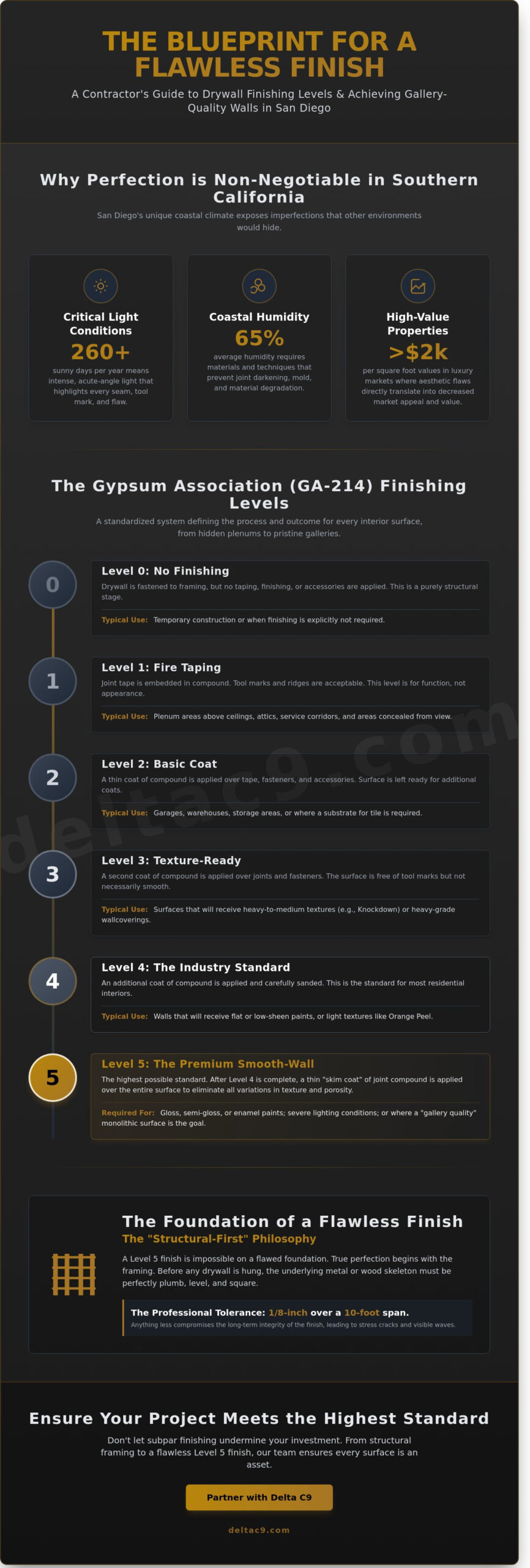
Precision in drywall finishing relies on the GA-214 standards established by the Gypsum Association. These levels provide a clear technical roadmap for contractors and homeowners to align on expectations. Choosing the wrong level often leads to visible seams or “photographing” under San Diego’s intense natural light. A systematic approach ensures the wall preparation matches the final aesthetic requirements of the space.
Level 0 to 3: The Structural Foundation
Level 0 implies no finishing at all. It’s strictly for temporary structures or initial installation phases. Level 1 involves fire-taping where joints are taped but not bedded in excess compound. You will typically find this in attic spaces, plenum areas, or service corridors where the public won’t see the work. Level 2 is the baseline for garages or warehouses. At this stage, a thin coating of joint compound covers the tape and screw heads, but aesthetics remain secondary to basic structural integrity.
Level 3 adds a second coat of compound over joints and interior angles. This level is specifically designed for surfaces that will receive heavy hand-applied textures or medium-to-heavy commercial wallcoverings. It isn’t suitable for smooth paint finishes because the underlying tape and compound transitions remain visible to the naked eye.
Level 4 and 5: The Premium Standard
Level 4 is the industry standard for most residential homes. It requires three distinct coats of joint compound over all joints and fasteners. It’s suitable for flat or low-sheen paints. However, Level 4 often reveals imperfections under the critical lighting conditions common in modern La Jolla or North County coastal homes. If your design includes large windows or recessed LED lighting, Level 4 may not provide the necessary smoothness.
Level 5 represents the highest tier of drywall finishing. It involves the same rigorous steps as Level 4 plus a final skim coat applied to the entire surface. Delta C9 experts apply this thin film of joint compound to conceal every imperfection and ensure uniform porosity across the wall. Without this skim coat, the difference in texture between the drywall paper and the joint compound becomes visible when hit by sunlight. This level is mandatory for high-gloss paints and minimalist interiors.
During a San Diego remodeling project, the decision between Level 4 and 5 depends on your architectural goals. Minimalist designs demand Level 5 to prevent flashing or visible joints. While the labor hours increase by approximately 25 percent compared to Level 4, the long-term value lies in a flawless finish that withstands scrutiny. Our team applies technical rigor to every project, ensuring your structural upgrades meet these exact industry specifications for a seamless interior transition.
The Impact of San Diego’s Coastal Climate on Drywall Durability
San Diego’s coastal geography presents specific technical hurdles for high-end drywall finishing. In cities like Chula Vista and Oceanside, relative humidity frequently fluctuates between 65% and 85%. This moisture content in the air directly impacts the chemical and physical transition of joint compounds. When humidity exceeds 70%, standard drying times for all-purpose compounds can increase by 24 to 48 hours compared to inland environments. Professionals must account for this delay to prevent structural failure and ensure a stable substrate for Level 5 interiors.
The choice between materials is a strategic decision based on local atmospheric data. For base coats in coastal San Diego, we often utilize “hot mud” or setting-type compounds. Unlike all-purpose mud, hot mud relies on a chemical reaction rather than evaporation. This makes it less susceptible to the high humidity levels found near the Pacific. It ensures the project stays on schedule while providing a bond that withstands the natural expansion and contraction of coastal homes. Understanding the full scope of drywall installation in San Diego County — including material selection for coastal climates and California Title 24 compliance — is essential for any renovation that demands long-term durability.
Managing Humidity and Drying Times
Rushing the curing process in high-moisture environments leads to “joint darkening.” This occurs when the compound retains moisture even after the surface feels dry to the touch. Trapped water causes the paint to peel or the joint to crack as the building settles. We maintain stability on-site by deploying industrial-grade dehumidifiers and high-volume air movers. Maintaining a consistent temperature between 55 and 70 degrees Fahrenheit ensures the drywall finishing cures with the structural integrity required for long-term durability.
Mold Prevention and Remediation in Finishing
Moisture management is a safety priority. Delta C9 applies its remediation expertise to identify moisture pockets before they become health hazards. In high-humidity zones like bathrooms or laundry rooms, we integrate specialized ceiling and drywall solutions. This involves using moisture-resistant “green board” or mold-resistant “purple board” that meets ASTM D3273 standards. These materials provide a proactive defense against fungal growth in vulnerable zones. The same moisture-resistant principles apply when you need to drywall a basement in San Diego, where trapped moisture behind walls poses an even greater long-term risk to structural integrity.
- Joint Darkening Risk: High humidity prevents deep-layer evaporation, leading to visible ghosting through the final paint.
- Material Selection: Setting-type compounds (hot mud) are preferred for the first two coats to ensure a chemical set.
- Ventilation: Cross-ventilation strategies are mandatory for Oceanside and Chula Vista job sites to prevent stagnant, moist air.
- Proactive Protection: Using mold-inhibiting primers adds an extra layer of security against the San Diego marine layer.
Our approach treats the environment as a primary variable in the construction process. By controlling the climate within the job site, we eliminate the risks associated with San Diego’s coastal air. This methodical control ensures that your Level 5 finish remains smooth, secure, and free of defects for years to come.
Selecting the Right Texture and Technique for Your Space
Selecting a wall texture involves more than aesthetic preference. It’s a technical decision that impacts light reflection, durability, and the long-term maintenance of your property. In San Diego’s diverse architectural landscape, the choice often dictates the perceived value of the interior. Professional drywall finishing ensures that the final surface aligns with the structural requirements of the building while meeting modern design standards.
Popular San Diego Textures: Smooth vs. Knockdown
The trend in Southern California has shifted decisively toward minimalism. In 2023, industry reports indicated that 72% of luxury home renovations in San Diego County opted for smooth-wall finishes. This Level 5 finish provides a pristine, glass-like surface that complements contemporary architecture. It’s a high-reward choice. However, it requires expert application because the lack of texture means every minor shadow or structural shift becomes visible under modern LED lighting.
For high-traffic environments or commercial spaces, orange peel and knockdown textures remain the standard. These techniques are functional. They mask small imperfections and resist visible wear from daily contact. If you’re restoring a historic 1925 Spanish Colonial home in North Park, matching the original hand-applied plaster texture is vital for historical accuracy. This process involves custom-mixed compounds to mirror the specific weight and depth of the existing walls, ensuring a seamless transition between old and new sections.
- Smooth Finish: Best for modern aesthetics and maximizing natural light in coastal homes.
- Orange Peel: A subtle, pebbled texture that offers a balance between durability and style.
- Knockdown: A flattened texture that provides a rustic look and superior concealment of minor wall flaws.
Skim Coating for Remodeling Projects
Skim coating is the most efficient method for transforming outdated interiors without the cost and mess of full drywall replacement. This technique involves applying at least two ultra-thin layers of joint compound to create a flat surface over existing textures. It’s the primary solution for San Diego homeowners looking to remove 1970s-era popcorn ceilings. These dated textures can decrease a home’s market appeal by as much as 10% in competitive neighborhoods like La Jolla or Carmel Valley. Before beginning any skim coating project, reviewing a comprehensive professional drywall installation buying guide for San Diego County can help you select the right moisture-rated materials and structural reinforcements for your specific coastal zone. Homeowners expanding their livable square footage should also consult our detailed guide on how to drywall a basement in San Diego to ensure moisture-proof finishing standards are met from the ground up.
If you’re ready to upgrade your interior surfaces with professional precision, you can secure your property’s value with our expert drywall finishing services.
Partnering with Delta C9 for Expert Finishing and Remodeling
Delta C9 has served the San Diego region for 22 years, delivering high-end interiors for both residential and commercial sectors. Our longevity in the market stems from a “Structural-First” philosophy. This approach dictates that the quality of drywall finishing is entirely dependent on the integrity of the framing beneath it. We don’t view walls as mere partitions; we treat them as engineered components that require a stable foundation to support a Level 5 aesthetic.
Precision execution is our standard. Our teams maintain clean, organized job sites to minimize dust migration and ensure safety. We recognize that a chaotic workspace leads to overlooked details. By controlling the environment from the initial stud placement to the final sanding, we eliminate the variables that often cause finish failures. This methodical process ensures that your project remains on schedule and meets the highest architectural standards.
Comprehensive Interior Services
Hiring a single contractor for metal framing, insulation, and finishing streamlines the entire construction timeline. It removes the friction often found between separate trades. When Delta C9 manages the full interior envelope, we take 100 percent responsibility for the final result. This integrated model is particularly effective for complex industrial projects and commercial tenant improvements where technical specifications are rigid.
- Metal Framing: Precision-aligned tracks and studs that prevent wall bowing.
- Insulation: Proper installation to meet California Title 24 energy requirements.
- Surface Finishing: Expertise in achieving smooth, blemish-free Level 5 surfaces.
Local accountability is a core value of our business. As a San Diego-based company, we are accessible to our clients long after the project concludes. Our warranty is backed by two decades of local reputation, providing peace of mind that your investment is protected by a partner who understands regional building codes and climate demands.
Get a Professional Estimate Today
Securing an accurate quote for drywall finishing in San Diego County requires a detailed assessment of the existing conditions. We analyze whether your project involves repairing 15-year-old structural settling or executing a brand-new installation. To provide a precise estimate, please have your floor plans, square footage, and desired finish levels ready for our team.
Our consultation process follows a logical path. We start by identifying potential structural obstacles, such as uneven joists or moisture issues, before discussing aesthetic goals. This proactive strategy prevents costly change orders during the finishing phase. Contact Delta C9 today to schedule a site walk-through and secure the structural and aesthetic future of your interior space.
Secure the Future of Your High-End Interior
Achieving a flawless Level 5 interior in San Diego requires more than standard technique. It demands a deep understanding of how the coastal climate affects material durability and structural integrity over time. You’ve learned that the difference between a standard wall and a premium finish lies in the meticulous application of specialized textures and the precision of metal framing. Delta C9 brings over 22 years of San Diego construction experience to every project we undertake. We don’t just apply mud; we integrate expert mold remediation and structural repair to ensure your investment stays protected against humidity and salt air. Our team specializes in high-end drywall finishing that transforms ordinary spaces into galleries of light and shadow. When you choose a partner with two decades of local expertise, you’re choosing long-term stability and aesthetic excellence. Let’s build a space that reflects your standards for quality and endurance.
Request a Professional Drywall Finishing Quote from Delta C9
Your vision deserves the precision of a seasoned expert who understands the unique demands of the California coast.
Frequently Asked Questions
What is the most common drywall finish in San Diego homes?
Orange peel texture is the most prevalent drywall finish found in San Diego residential properties. Approximately 80% of homes constructed between 1980 and 2015 utilize this texture because it effectively hides minor framing imperfections. It provides a durable surface that resists visible scuffing better than smooth walls. While newer luxury developments often request Level 5 finishes, the majority of existing inventory maintains this traditional textured appearance.
How long does the drywall finishing process take for a standard room?
Completing a standard 12 by 12 foot room typically requires 3 to 5 days of work. This timeline accounts for the application of three separate coats of joint compound and the necessary drying intervals between each layer. Each visit by the professional usually lasts 1 to 2 hours. The total duration depends heavily on the specific drywall finishing level requested and the local atmospheric conditions in your neighborhood.
Can I change my wall texture from Orange Peel to Smooth?
You can definitely transition your walls from orange peel to a smooth finish through a process called skim coating. This procedure involves applying two thin layers of joint compound over the existing texture to create a flat surface. Our technicians then sand the walls to achieve a Level 4 or Level 5 standard. It’s a common renovation choice for San Diego homeowners looking to modernize their interiors without replacing the actual drywall panels.
Is Level 5 drywall finishing worth the extra cost?
Level 5 finishing is a valuable investment if you plan to use high-gloss paint or have rooms with significant natural light. This premium grade involves a final skim coat over the entire surface, which eliminates the texture differences between the paper and the joint compound. It ensures that 100% of the wall surface is uniform. For high-end San Diego interiors, this prevents the “flashing” effect where joints become visible under bright afternoon sun.
How does San Diego humidity affect the drying of drywall mud?
San Diego’s coastal humidity can extend drying times by up to 12 hours per coat. When relative humidity levels exceed 60%, the moisture in the air prevents the water in the joint compound from evaporating efficiently. Professionals often use dehumidifiers or air movers to maintain a controlled environment. This precision ensures the drywall finishing bond remains strong and prevents future cracking or mold growth within the wet material.
What is the difference between drywall taping and finishing?
Drywall taping is the initial phase of the process where we apply paper or mesh tape to seal the joints between panels. Finishing refers to the entire multi-step sequence, including taping, blocking, and skim coating to reach a specific surface grade. Think of taping as the structural foundation of the seam. The finishing stages are what create the final aesthetic look and prepare the wall for its ultimate coat of paint.
Does Delta C9 provide drywall finishing for commercial offices in Chula Vista?
Delta C9 provides comprehensive commercial drywall services for office spaces throughout Chula Vista and the South Bay region. We specialize in high-traffic environments where durability and professional aesthetics are mandatory for business continuity. Our team manages projects of all sizes, from 500 square foot executive suites to large scale corporate facilities. We focus on delivering a stable, high-quality environment that reflects the professional standards of your organization.
Can professional finishing hide structural cracks in my walls?
Professional finishing won’t permanently hide structural cracks caused by foundation movement. While we can patch a crack using fiberglass mesh tape and compound, the gap will likely reappear if the underlying structure continues to shift. We recommend a structural inspection if cracks exceed 1/8 inch in width or appear diagonally near door frames. Our finishing techniques provide a flawless surface, but they don’t replace the need for fundamental engineering repairs.
4 Responses