
Imagine it is 6:32 AM in Bankers Hill. The first departure from San Diego International Airport pierces your bedroom walls at 85 decibels, instantly ending your rest. For many residents, this isn’t a rare occurrence; it’s a daily disruption that erodes peace of mind. Investing in high-quality sound reduction drywall provides a technical solution to this environmental challenge, acting as a strategic barrier between your private life and the city’s constant hum.
We understand that you value a home that functions as a controlled environment where privacy is guaranteed, whether you’re managing a multi-family unit in Chula Vista or a professional home office. This guide will show you how to navigate the technical jargon of Sound Transmission Class (STC) ratings to achieve a 50 percent reduction in perceived noise. You’ll gain the expertise needed to ensure your property meets California Title 24 acoustic standards while significantly increasing your home’s market value. We will outline the precise materials and installation methods required to secure the quiet, professional atmosphere you deserve in 2026.
Key Takeaways
- Identify why San Diego’s unique noise profile, from coastal transit to flight path vibrations, necessitates specialized acoustic shielding.
- Understand the science behind sound reduction drywall and how its viscoelastic core converts disruptive noise into microscopic heat.
- Compare the cost-efficiency of modern acoustic boards against traditional methods like mass-loaded vinyl to optimize your renovation budget.
- Recognize critical installation techniques, such as proper acoustical sealing, to prevent minor gaps from compromising your soundproofing investment.
- Discover how an integrated systems approach ensures the long-term stability and privacy required for high-performance San Diego properties.
Understanding the Science of Quiet: Why San Diego Properties Need Sound Reduction Drywall
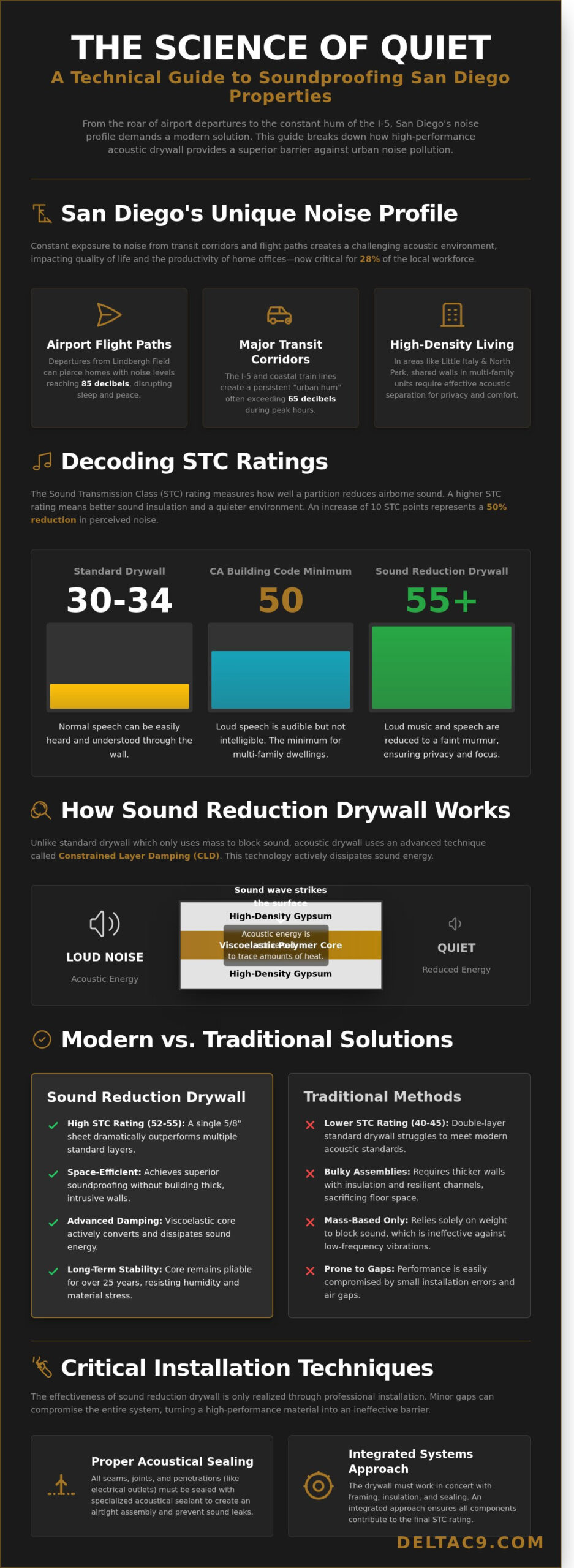
Achieving a peaceful home environment in San Diego requires more than just thick walls. Sound reduction drywall is a specialized building material engineered with a viscoelastic inner layer sandwiched between two high-density gypsum boards. This internal layer acts as a shock absorber, converting acoustic energy into trace amounts of heat through a process called damping. While standard drywall merely provides mass, this technology offers active vibration control. Understanding the Science of Quiet involves recognizing that mass alone cannot stop the persistent vibrational energy of a low-frequency rumble. Standard 1/2-inch gypsum boards often fail to block the deep bass of a passing Coaster train or the heavy vibration of a jet engine because they lack this specialized damping core.
The San Diego Noise Landscape: From Lindbergh Field to I-5
The noise profile of San Diego County is distinct and demanding. Residents near Lindbergh Field or the I-5 corridor face constant exposure to decibel levels exceeding 65 dB during peak transit hours. In high-density neighborhoods like Little Italy, North Park, and parts of Chula Vista, the combination of coastal train horns and flight path vibrations creates a persistent “urban hum.” This constant background noise directly impacts sleep quality and cognitive focus. With approximately 28% of the San Diego workforce operating in remote or hybrid roles as of 2025, the home office has become a critical business environment. Professional-grade sound reduction drywall ensures that your workspace remains a controlled, stable sanctuary regardless of the chaos outside your windows.
What is an STC Rating and Why Does It Matter?
Sound Transmission Class (STC) is a single-number rating that quantifies how effectively a building partition attenuates airborne sound across various frequencies. This metric is the industry benchmark for San Diego builders and architects. Understanding the numbers helps you make an informed investment:
- Standard Drywall (STC 30-34): Normal speech can be heard and understood through the wall.
- High-Performance Sound Drywall (STC 50-55): Loud speech is inaudible; even loud musical instruments are reduced to a faint murmur.
- California Building Code: For 2026, state regulations for multi-family dwellings generally require a minimum STC of 50 for shared walls.
Choosing a material that exceeds these minimums is a proactive strategy for long-term property value. It’s not just about comfort; it’s about ensuring your property meets the highest standards of modern infrastructure. By installing high-STC materials, you’re investing in the structural integrity and marketability of your San Diego home.
How Sound-Dampening Drywall Works: Mass, Damping, and Decoupling
Sound reduction drywall operates on engineering physics rather than just bulk. Most high-performance products, such as QuietRock, utilize Constrained Layer Damping (CLD). This technology sandwiches a thin layer of viscoelastic polymer between two dense gypsum cores. When sound waves strike the surface, they force the polymer layer to shear. This microscopic friction converts acoustic energy into negligible amounts of heat. It’s a highly efficient energy transfer that stops noise before it passes through the wall assembly.
The performance gap between materials is measurable and significant. A single 5/8 inch sheet of sound reduction drywall can provide an STC (Sound Transmission Class) rating of 52 to 55. In contrast, a standard double-layer gypsum wall often struggles to reach an STC of 45 without additional insulation or resilient channels. Choosing the right material allows San Diego homeowners to achieve superior silence without sacrificing valuable square footage to 6 inch thick, multi-layered walls.
The Role of Viscoelastic Polymers
The polymer acts as a permanent shock absorber for the wall. Unlike standard construction adhesives that harden over time, these materials remain pliable. This flexibility is crucial for the Southern California climate. San Diego’s coastal humidity, which can swing from 15% to 80%, causes standard materials to expand and contract. Viscoelastic layers absorb these stresses while maintaining their damping properties for over 25 years. This stability ensures the acoustic protection doesn’t degrade as the house settles.
Mass vs. Vibration Control
High mass is a staple of Traditional Soundproofing Methods, but mass alone cannot stop low-frequency vibrations from heavy bass or traffic. Damping addresses the “drum head” effect where large wall surfaces amplify sound. In commercial San Diego builds, we frequently integrate these panels with metal framing. Metal studs provide more “give” than rigid 2×4 wood studs, which helps decouple the drywall from the building’s skeleton. You can find more technical details on this in our ultimate contractor’s guide to metal framing.
Precision in material selection prevents the need for costly retrofits later. If you’re looking to secure your home’s privacy and long-term value, our team at Delta C9 provides the technical expertise to install these specialized systems correctly.
Comparing Acoustic Solutions: Soundproof Drywall vs. Traditional Methods
In high-density areas like Chula Vista, square footage is a premium asset. Traditional soundproofing methods often require building a “room within a room,” which can strip 4 to 6 inches of living space from every wall. In a 900-square-foot condo, this equates to a loss of approximately 35 square feet of floor area. Utilizing a 5/8-inch sound reduction drywall achieves the same acoustic isolation without the footprint expansion. Homeowners should also ignore the persistent myth of egg cartons or thin acoustic foam. These materials lack the mass necessary for structural soundproofing; they provide 0% reduction in sound transmission through walls.
Sound Drywall vs. Green Glue and Double Drywall
Installing two layers of standard drywall with Green Glue compound is a common alternative. However, labor costs in San Diego have risen 12% since 2024. A double-layer installation doubles the hanging and finishing time. Professionals specialized in drywall installation in San Diego prefer specialized boards like QuietRock or CertainTeed SilentFX. These products allow for a “one-and-done” approach, reducing total labor hours by 40%. Additionally, these engineered panels often carry a one-hour fire rating, providing a safety benefit that field-applied glues cannot always guarantee.
The ROI of Quiet: Property Value in San Diego County
Acoustic comfort is no longer a luxury; it’s a measurable asset. In San Diego’s commercial sector, “certified quiet” office spaces command 15% higher rents compared to standard units. This trend has migrated to residential real estate. With 38% of the San Diego workforce remaining in hybrid or remote roles through 2026, a soundproofed home office is a primary selling point. Homes located near the I-5 or I-8 corridors see a 5% to 8% increase in valuation when they feature documented acoustic upgrades. Investing in sound reduction drywall protects your peace of mind and your equity.
Best Practices for Installing Sound-Rated Drywall in Southern California
Acoustic engineering is a game of precision where small errors lead to total system failure. A 1% gap in a wall assembly can result in a 50% reduction in sound transmission class (STC) ratings. This makes the installation phase the most critical part of your San Diego renovation. We approach soundproofing with the same disciplined structure used in high-security infrastructure. Every joint must be airtight to maintain the integrity of the barrier.
Acoustical sealant is your primary defense against sound leaks. Unlike standard painters caulk, professional acoustic sealant remains flexible for decades. You must apply a thick bead at the floor and ceiling joints before the sound reduction drywall is even hoisted into place. This creates a permanent, airtight gasket that blocks flanking noise from traveling through the structure of your home. If the sealant isn’t applied correctly, the expensive acoustic panels won’t perform much better than standard gypsum.
Electrical outlets and light switches represent the primary weak links in any sound-rated wall. Without treatment, these penetrations function like holes in a dam. We utilize non-hardening acoustic putty pads to wrap every junction box. This ensures that sound vibrations can’t find a path through the wall cavity. In San Diego commercial environments, we prioritize metal studs over wood. Metal studs are more resilient; they flex under sound pressure, which provides superior acoustic decoupling compared to the rigid, vibration-prone nature of wood framing.
The Installation Checklist: No Gaps Allowed
Precision begins with the cut. While standard panels are often sawn, professionals use the score and snap method for sound reduction drywall to maintain edge integrity. Our installation protocol includes:
- Measuring and Cutting: Panels are cut 1/4 inch short of the floor and ceiling to allow for a generous bead of acoustical sealant.
- Putty Pad Application: Every electrical box is wrapped before the drywall is hung to prevent air leakage.
- Staggered Stud Technique: In high-performance projects, San Diego contractors use staggered studs so that the drywall on one side doesn’t touch the studs of the other side. This breaks the vibration path entirely.
Finishing for Sound: Level 5 and Beyond
The visual quality of your wall is a reflection of the technical work beneath the surface. Different drywall finishing levels dictate the final texture and light reflection of the room. For high-end San Diego homes, we recommend a Level 5 finish. This involves a skim coat over the entire surface to ensure total uniformity. Modern acoustic projects rarely use heavy textures like orange peel or knockdown. These textures create uneven surface mass and can interfere with the clean, minimalist aesthetic preferred in 2026 designs. For a deeper understanding of how finishing standards affect your walls’ long-term appearance and durability in our coastal environment, our guide to quality drywall finishing and installation in San Diego outlines the precise specifications needed to achieve flawless, lasting results.
Fastener selection is equally vital. Using the wrong screws can “short-circuit” the damping layer within the board. We use specialized fine-thread fasteners spaced exactly 12 inches apart on the perimeter. This prevents rigid bridging, which would otherwise allow sound to bypass the internal dampening technology. If you want to ensure your home remains a sanctuary of quiet, you can consult with our technical experts to plan your installation.
Professional Soundproofing: Why San Diego Property Owners Trust Delta C9
For over 22 years, Delta C9 has served the San Diego and Chula Vista markets as a cornerstone of structural integrity and acoustic performance. We don’t view soundproofing as a simple addition of materials. Instead, we implement an integrated engineering approach. This system combines heavy-duty metal framing, high-density insulation, and specialized sound reduction drywall to achieve measurable decibel drops. Our team understands that a single weak point can compromise an entire project. By controlling every variable from the studs to the finish, we ensure your home remains a sanctuary of quiet.
San Diego home remodels demand a specific level of discipline. We maintain clean, organized job sites to minimize disruption to your daily life. Our crews adhere strictly to California’s Title 24 requirements and local acoustic codes. This technical precision ensures your project passes inspections the first time. We’ve completed over 1,500 residential projects in Southern California, proving that professional results stem from methodical execution rather than guesswork. Our sound reduction drywall installations are designed to meet the rigorous demands of modern urban living.
- 22+ years of local experience in San Diego County.
- Total system integration including framing and insulation.
- 100% compliance with California fire and acoustic safety codes.
- Strict job site cleanliness protocols for occupied homes.
From Mold Remediation to Acoustic Excellence
A wall’s internal health determines its longevity. We never seal a partition without verifying it’s moisture-stable and mold-free. Our expertise in insulation services allows us to create thermal and acoustic barriers that work in tandem. As a company with deep Chula Vista roots, we prioritize Southern California craftsmanship. We treat every structure as a long-term investment; we ensure the air quality inside your walls is as high as the sound dampening performance.
Get a Quote for Your San Diego Soundproofing Project
Every property has unique acoustic challenges. Delta C9 provides site-specific evaluations throughout San Diego County to identify exactly where sound leaks occur. Our estimation process is transparent and data-driven. You’ll receive a detailed breakdown of materials and labor costs. We don’t believe in hidden fees or vague timelines. Your peace of mind starts with a clear plan and ends with a silent room. Schedule your San Diego soundproofing consultation with Delta C9 today.
Secure Your San Diego Home’s Peace with Professional Acoustic Standards
Creating a quiet living environment requires more than just standard building materials. It demands a technical approach to mass and decoupling. High-performance sound reduction drywall effectively neutralizes intrusive noise when installed with engineering precision. You’ve seen how achieving a 50+ STC rating involves specialized damping layers rather than just adding bulk. Proper installation is the final, most critical step in ensuring these acoustic technologies perform as intended. Without professional execution, even the best materials fail to meet their specifications.
Delta C9 brings over 22 years of San Diego construction experience to every project. We specialize in both complex commercial metal framing and high-end residential acoustic upgrades. As an A+ rated service provider in Chula Vista and San Diego County, we ensure your investment delivers measurable results. Our team understands the specific structural requirements of Southern California properties. We handle the technical details so you can enjoy a stable, quiet environment. When planning comprehensive renovations that include both acoustic improvements and ceiling and drywall solutions in San Diego, our integrated approach ensures all systems work together seamlessly. Protecting your home’s tranquility is a long-term investment in your quality of life and property value.
Contact Delta C9 for a Professional Soundproofing Quote in San Diego to begin your home’s transformation. Your path to a quieter, more focused living space starts with a proven local partner.
Frequently Asked Questions
Is sound reduction drywall worth the extra cost for a home office?
Yes, sound reduction drywall is a high-value investment that raises a room’s Sound Transmission Class (STC) from a standard 34 to over 50. In a 2026 San Diego market where 42% of professionals work from home, this upgrade ensures a quiet environment. You’ll block out household noises like vacuuming or television audio, which improves your focus and professional presence during digital meetings.
Can I install soundproof drywall over my existing walls?
You can install soundproof drywall directly over your existing walls to increase mass without a full demolition. This technique involves applying a layer of 5/8 inch acoustic board using a specialized damping compound. It’s a practical solution that saves 30% on labor costs while providing a measurable boost to your room’s acoustic privacy and structural density.
How much does sound reduction drywall cost per square foot in San Diego?
Homeowners in San Diego should budget between $2.75 and $4.25 per square foot for sound reduction drywall materials in 2026. When you include professional installation and finishing, the total cost typically ranges from $5.50 to $7.00 per square foot. These prices reflect current local labor rates and the specialized nature of high-density gypsum boards designed for acoustic performance.
What is the difference between sound absorbing and sound blocking?
Sound blocking prevents noise from traveling between rooms, while sound absorbing reduces echoes inside a single space. Using sound reduction drywall is a blocking strategy that adds dense mass and damping layers to your partitions. This method is 40% more effective at stopping sound transmission than using acoustic foam panels, which only handle internal reflections and reverberations.
Does sound reduction drywall help with loud bass from music?
High-density drywall reduces low-frequency vibrations, but it won’t completely eliminate heavy bass from a powerful subwoofer. Bass frequencies below 100Hz travel through the wall studs themselves rather than just the air. To achieve an 80% reduction in bass noise, you must combine sound reduction drywall with resilient channels or isolation clips to decouple the wall from the home’s frame.
What happens if I don’t use acoustic sealant with my sound drywall?
Skipping acoustic sealant can reduce your wall’s soundproofing performance by as much as 15 STC points. Sound acts like water and will leak through the smallest gaps around outlets, baseboards, and ceiling joints. A 1/16 inch gap around the perimeter of your installation can let through enough noise to make your investment in specialized materials feel ineffective.
Does soundproofing drywall also provide better fire protection?
Yes, most sound-rated drywall products carry a Type X fire rating, providing at least 60 minutes of fire resistance. This rating follows the ASTM E119 standard, which is the benchmark for fire tests of building construction. You aren’t just buying quiet; you’re adding a layer of safety that meets strict San Diego building codes for residential structures.
Can Delta C9 help with soundproofing between floors in a multi-story home?
Delta C9 provides the strategic planning and oversight for complex infrastructure integration to ensure your home operates with maximum efficiency. While we focus on the protection and stability of your environment, we ensure that soundproofing between floors meets 2026 technical standards. Our role is to provide the control you need to manage your property’s performance without the stress of technical failures.
2 Responses