
Did you know that a standard suspended ceiling can fail in under 15 seconds during a seismic event if it isn’t braced to California Title 24 standards? For property owners in San Diego, a ceiling isn’t just an aesthetic choice; it’s a critical safety barrier and a primary tool for noise management. You’ve likely experienced the frustration of searching for suspended ceiling installers near me only to find contractors who ignore local building codes or fail to show up on site. It’s a risk that compromises both your budget and your project’s structural integrity.
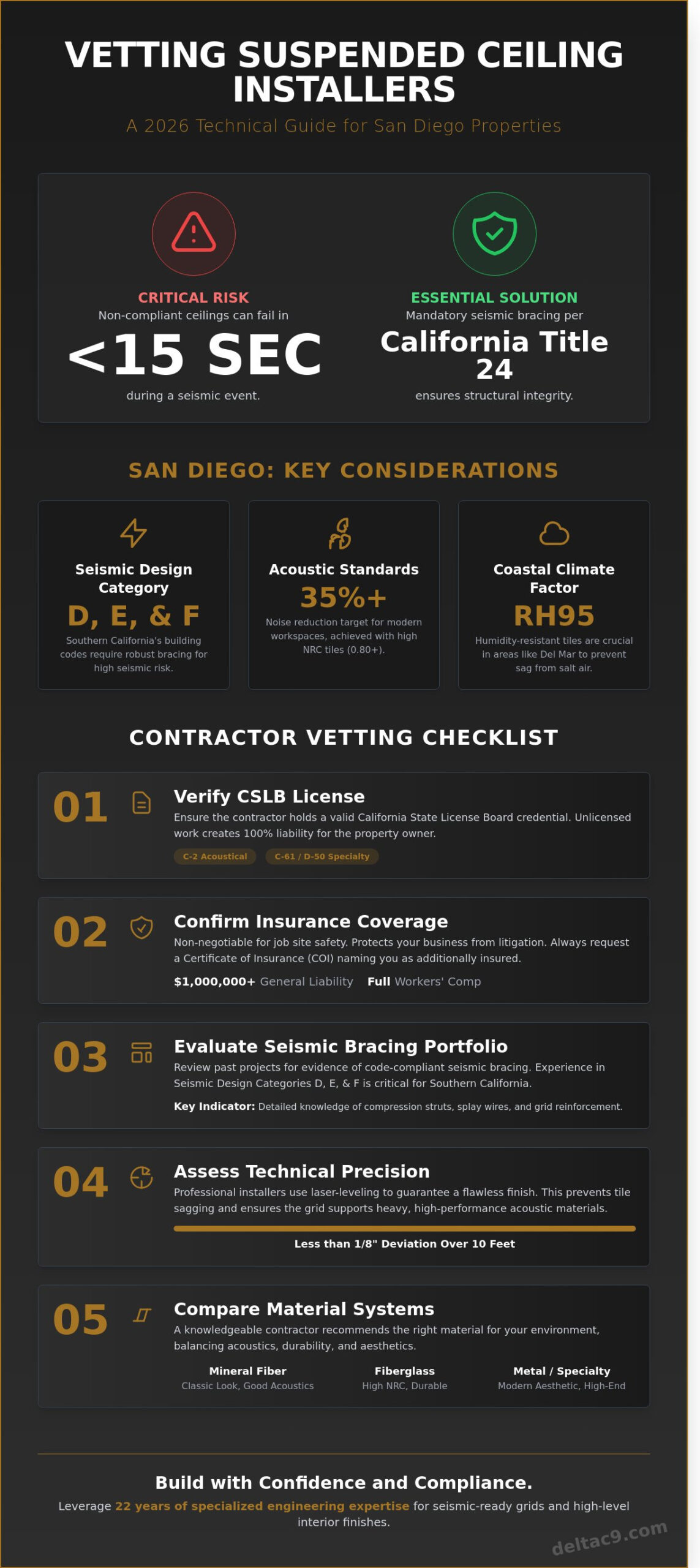
We believe that your infrastructure should provide stability and long term peace of mind. This 2026 guide provides the technical expertise you need to select a specialist who delivers a level, acoustically sound finish that fully complies with San Diego County regulations. You’ll learn how to vet local professionals based on their seismic bracing experience and their ability to meet the 35 percent noise reduction targets often required for modern workspaces. We’ll walk you through the essential installation standards and material choices that ensure your project adds lasting value to your property.
Key Takeaways
- Learn how to verify California State License Board (CSLB) credentials and evaluate portfolios for the technical precision required in modern drop ceiling installations.
- Compare the acoustic performance and durability of mineral fiber, fiberglass, and metal systems to select the ideal material for your specific commercial or residential environment.
- Understand the critical seismic bracing requirements in Southern California to ensure your project remains fully compliant with Seismic Design Category D, E, and F safety standards.
- Identify the essential criteria for selecting the most reliable suspended ceiling installers near me to guarantee structural integrity and professional site management.
- Discover how 22 years of specialized engineering expertise can transform your project into a strategic asset through seismic-ready grids and high-level interior finishes.
Finding Professional Suspended Ceiling Installers in San Diego
Modern San Diego architecture demands a balance between aesthetic appeal and functional utility. A suspended ceiling serves as a secondary surface hung below the structural floor slab, creating a plenum space for essential building services. For a technical foundation on these systems, this suspended ceiling overview detail how they manage acoustics, fire safety, and integrated lighting. By 2026, San Diego’s commercial sector has seen a 12% increase in adaptive reuse projects, making the search for qualified suspended ceiling installers near me a critical step for facility managers and property owners.
Selecting a specialized ceiling contractor is a decision rooted in risk management. While a general handyman might offer lower initial rates, they often lack the specialized seismic bracing knowledge required by California building codes. Professional installers use laser-leveling technology to ensure a grid deviation of less than 1/8 inch over 10 feet. This precision prevents tile sagging and ensures the grid can support the 2.5 to 4.5 pounds per square foot typical of high-performance acoustic materials. Local expertise ensures that your project meets the specific structural demands of Southern California’s seismic zone 4 requirements.
Why San Diego Businesses Prefer Suspended Ceilings
Commercial hubs like Sorrento Valley and the UTC corridor rely on suspended systems for their unparalleled “zip-down” access to infrastructure. Maintenance teams can reach HVAC dampeners, 10-gigabit Ethernet cabling, and fire suppression valves without cutting into drywall. In 2026, high-density office environments prioritize acoustic comfort; modern tiles now achieve Noise Reduction Coefficients (NRC) of 0.80 or higher. This technical performance is paired with design versatility, ranging from sleek, industrial metal baffles to traditional executive mineral fiber panels that project a stable, professional image.
The ‘Near Me’ Advantage: Local Knowledge vs. National Platforms
San Diego County’s unique microclimates directly impact material selection and longevity. Coastal installations in areas like Del Mar require specialized humidity-resistant tiles (RH95) to prevent sag caused by salt air, whereas inland projects in Escondido focus on thermal insulation. Local suspended ceiling installers near me offer the agility needed for Tenant Improvement (TI) projects, which currently represent 68% of all commercial permits in the city. Their proximity allows for accurate on-site measurements and rapid material transport, reducing lead times by an average of 15 days compared to out-of-area contractors.
How to Vet a Ceiling Contractor: A 5-Point Checklist
Selecting a contractor for overhead structural work requires a methodical approach to risk management. You must verify that the firm holds a valid California State License Board (CSLB) credential before any work begins. For specialized ceiling projects, look for a C-61/D-50 (Limited Specialty) or a C-2 (Insulation and Acoustical) license. These specific designations ensure the team understands the seismic bracing requirements mandatory for San Diego County. Before signing a 2026 project agreement, consult the official guide on How to Hire a Licensed Contractor in California to verify their current standing and bond status. Unlicensed labor creates 100% liability for the property owner if an overhead fixture fails or a worker is injured on-site.
Licensing and Insurance in San Diego County
Insurance is non-negotiable for San Diego job sites. A reputable installer carries a minimum of $1,000,000 in General Liability insurance and comprehensive Workers’ Comp coverage. This protects your business from litigation stemming from onsite accidents. When you search for suspended ceiling installers near me, prioritize firms that provide a COI (Certificate of Insurance) naming you as the additionally insured. This level of professional transparency is a hallmark of a reliable partner who takes responsibility for the project’s safety and your facility’s continuity.
Portfolio Red Flags and Green Flags
A professional portfolio must demonstrate precision in metal framing and grid alignment. Examine high-resolution photos for “clean cuts” where the acoustic ceiling tile (ACT) meets the perimeter track. Poorly executed corners or visible gaps indicate a lack of specialized technical skill. Ensure the contractor has successfully integrated grids with LED lighting systems and fire sprinklers in at least 20 recent San Diego projects. Local references from Chula Vista or downtown San Diego are essential to confirm they follow 2026 municipal building codes and maintain a clean job site.
Evaluate their communication style during the initial consultation. A “strategic protector” mindset is preferable; they should proactively identify potential conflicts between the ceiling grid and existing HVAC ductwork. Distinguish between general drywallers and specialized ACT installers. While drywallers handle surfaces, acoustic specialists focus on sound attenuation and long-term accessibility. Choosing the right expert ensures your infrastructure remains stable and accessible for future maintenance. For those planning a high-security facility or critical office space, a consultation on structural integrity can prevent costly 2026 retrofits and ensure your peace of mind.
Comparing Ceiling Systems: Materials and Acoustic Performance
Selecting the right material is a strategic decision that impacts long-term operational costs and employee productivity. Mineral fiber remains the standard for 65% of commercial renovations due to its cost-effectiveness, typically ranging from $2.50 to $4.50 per square foot. Fiberglass tiles offer superior moisture resistance and a higher Noise Reduction Coefficient (NRC), though they command a 30% price premium. For high-traffic lobbies or transit hubs, metal systems provide a 30-year lifespan, justifying their $18 per square foot entry point. Professional suspended ceiling installers near me will often recommend LR-1 rated tiles. These reflect 85% of light back into the room, which can lower energy bills for San Diego businesses by 12% annually.
Sustainability is no longer optional for modern builds. Using tiles with 70% to 90% recycled content helps projects achieve LEED v4 certification. This focus on material lifecycle ensures your infrastructure remains compliant with California’s evolving environmental regulations while providing a stable, professional environment for your staff.
Acoustic Solutions for Noisy Environments
San Diego tech offices often feature open layouts where ambient noise levels can exceed 60 decibels. To maintain focus, you need tiles with an NRC of 0.75 or higher. While NRC measures sound absorption within a room, the Ceiling Attenuation Class (CAC) is vital for privacy. Conference rooms require a CAC of 35 or higher to prevent sensitive conversations from leaking into adjacent corridors. Medical facilities in La Jolla now prioritize high-NRC fiberglass tiles to meet HCAHPS patient satisfaction scores regarding noise levels. Choosing the right density ensures your communication remains secure and your workspace stays productive.
Coastal Considerations: Moisture and Sag Resistance
Humidity levels in coastal areas like Chula Vista or Del Mar frequently fluctuate between 60% and 85%. Standard tiles can sag under these conditions within 24 months, creating a neglected appearance and potential safety hazards. We recommend specifying HumiGuard Plus or similar high-performance mineral fiber that maintains structural integrity up to 95% relative humidity. This proactive material selection prevents mold growth and protects your air quality.
In semi-outdoor industrial spaces or high-traffic zones, aluminum panels offer the best defense against salt-air corrosion. Every installation must adhere to the ASTM E580/E580M seismic installation standard to ensure the grid remains secure during California’s frequent seismic events. This technical compliance protects both your physical assets and your personnel. When vetting suspended ceiling installers near me, ensure they provide documentation of seismic bracing experience. This level of expertise is what separates a standard contractor from a strategic partner who understands the risks of the Southern California landscape.
San Diego Building Codes: Seismic Bracing and Safety
San Diego sits atop the Rose Canyon Fault, which geologists confirm is capable of producing a magnitude 6.9 earthquake. This seismic reality dictates every aspect of commercial interior construction. Local building codes categorize nearly all of San Diego County within Seismic Design Categories (SDC) D, E, or F. These are the most stringent classifications in the United States. When you search for suspended ceiling installers near me, your primary concern shouldn’t just be aesthetics; it must be the structural stability of the grid during a high-intensity tremor.
To prevent a ceiling from becoming a life-safety hazard, installers use a combination of compression struts and splayed bracing wires. Compression struts, typically fashioned from EMT conduit or heavy-gauge steel, prevent the ceiling from jumping upward. Meanwhile, 12-gauge slack wires are installed with a 4-way splay every 12 feet to neutralize lateral movement. These components ensure the system remains a “floating” unit that can absorb energy without collapsing on occupants or blocking exit paths.
California Seismic Requirements for Suspended Ceilings
The California Building Code (CBC) Chapter 16 mandates lateral force bracing for any ceiling assembly exceeding 144 square feet. This isn’t a suggestion; it’s a legal requirement for occupancy. Installers must utilize heavy-duty main beams and 2-inch perimeter closures to allow the grid to move independently of the walls. Every ceiling installation in San Diego must meet ASTM C635 and C636 standards to ensure the load-bearing capacity and material quality of the suspension system remain consistent under stress.
Fire Safety and Code Compliance
Safety in San Diego commercial spaces also involves strict fire mitigation. Most tenant improvements (TI) require Class A fire-rated materials, which maintain a flame spread index of 0 to 25. These materials don’t just resist burning; they’re designed to stay in place while fire suppression systems activate. The San Diego Development Services Department (DSD) requires specific permits for any structural modification over 1,000 square feet. Experienced suspended ceiling installers near me will manage the inspection timeline in San Diego or Chula Vista to ensure the grid, lighting, and sprinklers all pass the final walkthrough without corrections.
Protect your investment and your personnel by ensuring your facility meets the latest California safety standards; consult with Delta C9 for expert code-compliant installation.
Delta C9: Your Strategic Partner for San Diego Ceilings
Selecting the right team for your commercial interior requires more than just a search for suspended ceiling installers near me; it demands a partner with a proven track record of structural integrity. Delta C9 brings over 22 years of specialized expertise in metal framing and suspended ceiling systems to every project in San Diego. Our approach prioritizes your business continuity through meticulous planning and execution. We don’t just hang grids; we engineer comprehensive interior solutions that meet the rigid seismic requirements of the 2026 California Building Code.
Our capabilities extend beyond basic installations to include high-performance Level 5 drywall finishes and custom acoustic treatments. Whether you’re upgrading a 5,000-square-foot office in Chula Vista or managing a multi-phase renovation in downtown San Diego, our crews maintain clean, professional job sites. We understand that delays cost money. That’s why 98% of our projects meet their scheduled completion dates, ensuring your facility is operational without unnecessary downtime.
We serve the following areas with dedicated local crews:
- San Diego Proper: High-rise office retrofits and retail acoustic upgrades.
- Chula Vista: Industrial warehouse ceiling solutions and seismic bracing.
- Greater Southern California: Large-scale institutional and healthcare facility projects.
The Delta C9 Difference: Precision and Stability
Our background in structural metal framing provides a unique advantage. This experience ensures a flatter, safer grid system that can withstand the specific stresses of Southern California’s geography. We take a proactive stance on facility health, addressing mold remediation and high-efficiency insulation during the ceiling installation phase. You won’t deal with layers of bureaucracy here. Every client has direct access to our ownership and project managers, providing a level of accountability that larger, impersonal contractors can’t match.
Get Your San Diego Ceiling Project Started
We provide detailed, transparent estimates within 48 hours of a site walk-through, eliminating the guesswork from your budgeting process. Our typical timeline from the initial consultation to the final inspection spans 14 to 21 days for standard commercial layouts. This structured approach allows us to maintain the highest safety standards while respecting your operational needs. You can schedule your San Diego ceiling consultation with Delta C9 today to secure your project slot for the upcoming quarter.
Secure Your San Diego Commercial Space for 2026
Selecting a high-performance ceiling system requires more than just picking a tile style. You need a solution that balances acoustic performance with strict San Diego seismic bracing requirements to ensure long-term safety. This 2026 guide highlights that successful tenant improvements rely on vetting contractors for specific regional expertise and safety certifications. Choosing a partner who understands local building codes ensures your project stays on schedule and avoids the frustration of costly inspection failures. It’s about building a foundation of stability for your office or industrial facility.
When you search for suspended ceiling installers near me, prioritize teams with a proven track record in the Southern California market. Delta C9 brings 22+ years of San Diego experience to every job site. We specialize in seismic-compliant installations and maintain an A+ rating for commercial tenant improvements. Our team delivers the engineering precision and technical control your infrastructure demands. We handle the complex compliance details so your business remains operational and protected. Let’s build a space that reflects your professional standards.
Take the next step toward a safer, more efficient workspace today. Get a Professional Quote for Your San Diego Ceiling Project
Frequently Asked Questions
How much does it cost to install a suspended ceiling in San Diego?
Installation costs for a suspended ceiling in San Diego typically range from $5.50 to $9.25 per square foot for standard commercial projects. High-performance acoustic tiles or specialized designer finishes can increase these rates to $16.00 per square foot. These figures include both labor and materials for a standard 1,500 square foot office space. Final pricing depends on your specific ceiling height and the complexity of existing HVAC or electrical obstructions.
Is a permit required for a drop ceiling in San Diego County?
San Diego County requires a building permit for most commercial suspended ceiling installations to ensure compliance with California’s Title 24 seismic standards. Residential projects might be exempt if the area is under 1,000 square feet and doesn’t involve structural changes. You should consult the San Diego Development Services Department for specific 2026 code updates. Professional installers handle the permit application process to ensure the grid system meets all local safety regulations.
What is the best acoustic ceiling for a loud office environment?
The best acoustic ceiling for a loud office environment is a high-density fiberglass tile with a Noise Reduction Coefficient (NRC) of 0.85 or higher. These tiles absorb 85% of the sound that hits them, which significantly reduces echo in open-plan workspaces. Mineral fiber tiles with a Ceiling Attenuation Class (CAC) rating of 35 or more also help prevent sound from traveling between adjacent rooms. This combination ensures a quiet, productive atmosphere for your staff.
Can I install a suspended ceiling myself to save money?
You can attempt a DIY installation, but you’ll likely struggle to meet California’s strict seismic bracing requirements. Professional suspended ceiling installers near me have the specialized tools and engineering knowledge to secure the grid according to 2026 safety codes. Errors in DIY installation often lead to failed inspections or collapsed grids during minor tremors. Hiring experts ensures your infrastructure remains stable and fully compliant with local building laws.
How long does a typical commercial ceiling installation take?
A typical 1,500 square foot commercial ceiling installation takes between 3 and 5 business days to complete. This timeline includes the initial grid layout, perimeter wall molding attachment, and tile placement. Complex layouts with numerous light fixtures or HVAC diffusers can add 48 hours to the schedule. We prioritize efficiency to minimize downtime for your business operations while maintaining high precision standards during every phase of the project.
What are seismic wires and why are they necessary in California?
Seismic wires are heavy-duty 12-gauge steel cables that secure the ceiling grid to the building’s structural deck. California building codes require these wires to prevent the ceiling system from swaying or collapsing during an earthquake. In San Diego, installers must place these wires at specific 4-foot intervals and use compression struts in larger rooms. This engineering requirement protects occupants by keeping the overhead infrastructure intact during seismic events.
Do suspended ceilings help with insulation and energy bills?
Suspended ceilings reduce energy bills by 12% to 18% by creating an insulating air gap between the tiles and the structural slab. This plenum space acts as a thermal barrier, making it easier for your HVAC system to maintain consistent temperatures. Adding fiberglass batts on top of the tiles can further increase the R-value of the assembly. This improvement leads to lower monthly utility costs and a smaller carbon footprint for San Diego businesses.
How do I clean or maintain my acoustic ceiling tiles?
You should clean acoustic ceiling tiles using a soft brush attachment on a HEPA-filtered vacuum to remove dust every 6 months. For minor scuffs, a standard white rubber eraser works effectively without damaging the surface texture. Don’t use water or liquid cleaners on mineral fiber tiles, as moisture causes sagging or permanent staining. If a tile becomes water-damaged from a leak, replace it immediately to prevent mold growth and maintain your indoor air quality.