
In San Diego’s rigorous construction environment, a single error in mil-thickness can compromise a project’s seismic certification. As of April 22, 2026, new local amendments to the California Building Standards Code have added layers of complexity to how developers must manage commercial metal stud framing specifications. You likely recognize that balancing structural integrity with cost efficiency is more difficult than ever, especially as U.S. steel prices are anticipated to rise by up to 8% starting June 1, 2026.
It’s understandable to feel concerned about the technical distinctions between structural Cold-Formed Metal Framing (05 40 00) and non-structural partitions (09 22 16). This guide provides the clarity you need to master technical specifications and ensure code compliance for your next Southern California project. We will examine steel gauges, web sizes, and the specific AISI standards required to meet the 2025 California Building Code’s strict fire and seismic safety mandates. By the end of this article, you’ll have the confidence to select specifications that protect both your timeline and your structural investment.
Key Takeaways
- Distinguish between MasterFormat divisions 05 40 00 and 09 22 16 to ensure your commercial permit applications meet San Diego’s strict documentation standards.
- Master the transition from traditional gauges to precise mil-thickness measurements within your commercial metal stud framing specifications to prevent structural discrepancies.
- Identify the specific ASTM standards and seismic deflection track requirements necessary to maintain structural integrity in Southern California’s active seismic zones.
- Gain a systematic approach for reviewing submittals and verifying on-site material stamps to ensure every steel member aligns with the architect’s original design.
- Leverage professional insights to navigate the evolving 2025 California Building Code and avoid costly delays during the inspection process.
Decoding Commercial Metal Framing Codes: 05 40 00 vs. 09 22 16
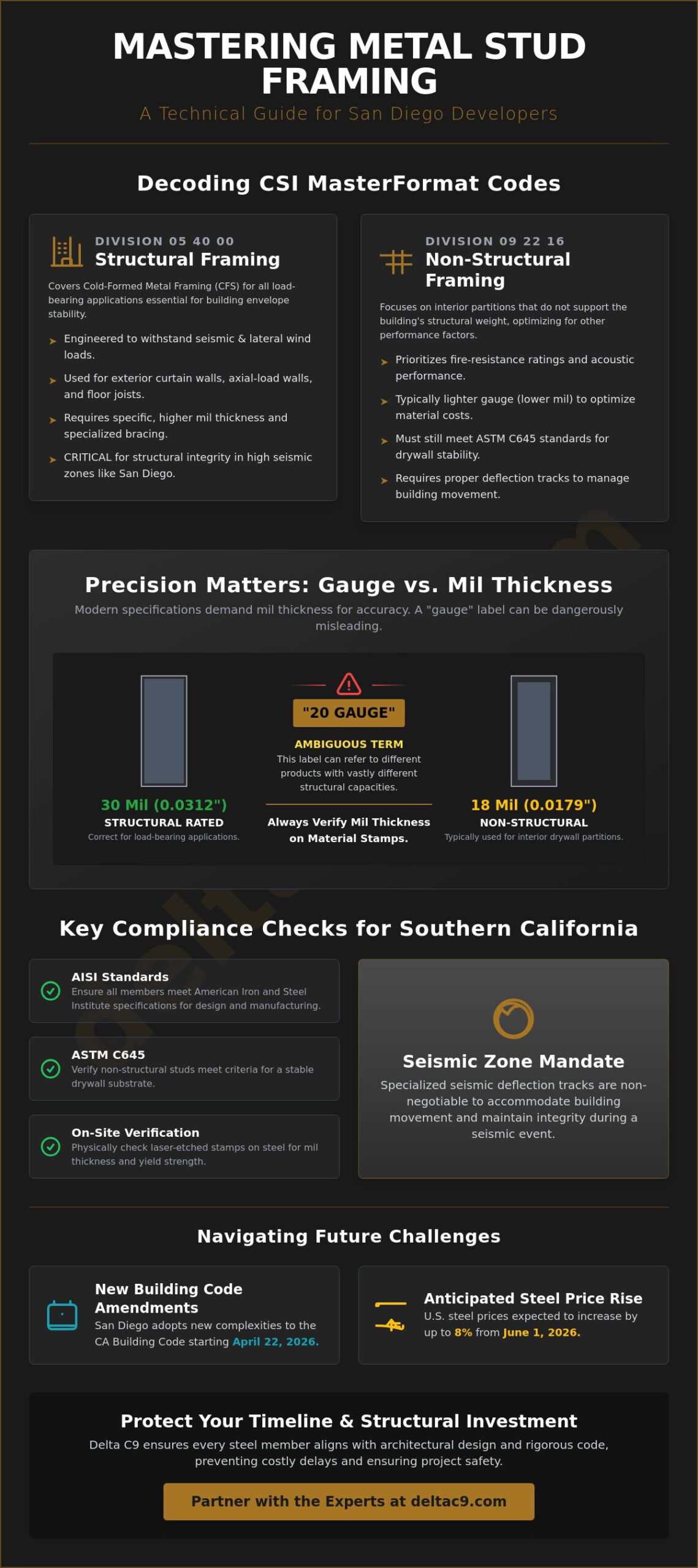
San Diego’s Development Services Department requires absolute clarity in technical documentation. For developers, the distinction between CSI Division 05 40 00 and Division 09 22 16 is the foundation of a compliant project. While both involve metal studs, their roles in a building’s structural integrity couldn’t be more different. Understanding the nuances of commercial metal stud framing specifications begins with this MasterFormat system. Misidentifying these codes in your submittals can lead to plan check rejections or, worse, structural failure during a seismic event.
Structural Cold-Formed Steel (CSI 05 40 00)
This division covers Cold-formed steel (CFS) used for load-bearing applications. In San Diego’s commercial landscape, this often includes exterior curtain walls, axial load-bearing interior partitions, and floor joists. These members must be engineered to withstand lateral wind loads and vertical weight. Because Southern California is a high seismic zone, structural framing requires specific mil thicknesses and specialized bracing. You can’t substitute these for lighter materials without risking the stability of the entire building envelope.
Non-Structural Metal Framing (CSI 09 22 16)
This division focuses on interior partitions that don’t support the building’s weight. The primary objectives here shift from load-bearing capacity to fire-resistance ratings and acoustic performance. These studs are typically lighter, which helps developers optimize material costs. However, they must still meet ASTM C645 standards to ensure they provide a stable substrate for drywall finishing. Even though they aren’t structural, they must be installed with proper deflection tracks to account for the building’s natural movement.
At Delta C9, our approach to complex industrial projects ensures that these codes aren’t just numbers on a page. Our team meticulously verifies that the materials on-site match your commercial metal stud framing specifications. This precision prevents the common mistake of using non-structural studs where structural strength is required. We prioritize the stability of your project, ensuring that every stud and track meets the exact requirements of the 2022 California Building Code. By maintaining this level of control, we provide our partners with the business continuity and safety they expect in a professional build.
Technical Specs: Gauges, Mil Thickness, and Web Sizes
Precision is the hallmark of a successful build. In San Diego, following commercial metal stud framing specifications isn’t just about meeting the minimum code; it’s about ensuring structural predictability and long-term safety. Modern engineering has moved away from the ambiguity of legacy “gauges” in favor of mil thickness, which provides a definitive measurement of the steel’s decimal thickness. This shift allows for more accurate calculations of load-bearing capacity and seismic resilience.
The Gauge to Mil Thickness Conversion
The transition from legacy gauge measurements to mil thickness represents a shift toward engineering transparency. While many in the field still refer to material by gauge, modern commercial metal stud framing specifications rely on thousandths of an inch (mils). This distinction is vital because a “20-gauge” label is often applied to both 30 mil (structural) and 18 mil (drywall) studs. Confusing the two can lead to significant deflection issues or inspection failures. A higher mil thickness directly correlates to increased structural load capacity and greater resistance to lateral forces. To verify compliance on-site, inspectors and project managers should check the laser-etched stamps on the steel members, which list the minimum thickness and yield strength.
Web and Flange Dimensions for San Diego Projects
Web sizes determine the depth of your wall or floor assembly. For standard office partitions in San Diego, 3-5/8 inch webs are the most common choice. Larger industrial projects or exterior curtain walls may require up to 14-inch webs to handle significant spans and wind loads. Flange width is equally important for the integrity of the finish. A wider flange provides a larger “target” for drywall installation, which reduces the risk of fasteners missing the stud and compromising the fire-rated assembly. Standard flange sizes typically range from 1-1/4 inches for non-structural work to 3 inches for heavy-duty structural applications.
Steel yield strength, measured in kilopounds per square inch (ksi), adds another layer of security. Most non-structural studs use 33 ksi steel. However, for load-bearing walls or high-wind exterior curtain walls, 50 ksi steel is often specified. This higher strength rating allows for thinner mil sections to carry the same load, potentially reducing material weight without sacrificing safety. If you’re unsure which mil thickness fits your load requirements, our team at Delta C9 can help verify your spec sheets against current California standards. Selecting the right punchout spacing is also a practical necessity. Properly aligned punchouts allow for the seamless integration of plumbing and electrical runs, maintaining the structural continuity of the stud while protecting the building’s vital systems.
Performance Specifications: Fire, Acoustic, and Seismic Standards
Performance is the ultimate metric for any commercial structure. In San Diego, following commercial metal stud framing specifications means adhering to the 2025 California Building Code, which became effective on January 1, 2026. ASTM C645 sets the manufacturing criteria for non-structural members, while ASTM C754 outlines the installation requirements. These standards ensure that the framing provides a reliable foundation for fire-rated drywall and acoustic systems. Neglecting these details often results in significant rework during the inspection phase.
Seismic Deflection and Lateral Bracing
San Diego’s proximity to active fault lines requires a proactive approach to seismic design. All framing must comply with ASCE 7-16 standards to manage the lateral forces generated during an earthquake. Slotted track systems are essential. They allow the building’s primary structure to move independently of the interior partitions. This vertical deflection prevents the studs from crushing the drywall or buckling under pressure. Beyond the tracks, lateral bracing must be specified for any wall exceeding standard height limits. This bracing creates a rigid framework that resists swaying. It ensures the wall remains upright even when the ground moves. Properly executed seismic bracing is a primary focus for San Diego building inspectors.
Fire-Resistive Framing Assemblies
Fire safety is equally dependent on the skeleton of the building. Most commercial projects require 1-hour or 2-hour fire-rated assemblies. These are typically coordinated with specific UL design numbers that dictate stud spacing, usually at 16 or 24 inches on center. The inclusion of mineral wool insulation within the wall cavity is often a requirement for these ratings. Verifying these UL designs during the framing phase is a critical step. It maintains the building’s safety envelope and prevents the need for costly adjustments after the drywall has been hung. Our team ensures that every component, from the track to the fasteners, aligns with the specified fire rating.
Acoustic control also depends on the precision of the framing. By utilizing resilient channels and specific stud gauges, developers can achieve high STC (Sound Transmission Class) ratings. This is vital for multi-tenant office spaces or medical facilities where privacy is paramount. Integrating high-performance soundproofing materials directly into the framing spec ensures that the finished space meets the tenant’s expectations. It creates a quiet, professional environment that supports business continuity. This holistic approach to commercial metal stud framing specifications protects your investment from both environmental risks and operational noise.
The Implementation Process: Reading and Verifying Spec Sheets
Having a set of commercial metal stud framing specifications is only the first step toward a successful build. The transition from architectural intent to on-site reality requires a rigorous verification process. In San Diego’s competitive development market, oversight during the submittal phase often leads to delays that ripple through the entire project timeline. Proactive management ensures that the materials delivered to your job site are exactly what the structural engineer of record intended.
The Submittal and Approval Workflow
The submittal process acts as a final gatekeeper for quality control. This workflow typically follows three critical steps to maintain project integrity. First, the contractor must compare the manufacturer’s product data sheets against the specific MasterFormat section in the project manual. This ensures that the web depth, flange width, and mil thickness align perfectly with the design. Second, you must verify the galvanized coating requirements. For standard interior work, a G40 coating is often sufficient, but coastal San Diego projects or high-moisture environments may require G60 or even G90 protection to prevent long-term corrosion. Finally, any material substitutions must receive formal approval from the engineer of record. Unauthorized changes, even minor ones, can invalidate seismic certifications and fire ratings.
Field Quality Control for Metal Framing
Once materials arrive, field verification becomes the priority. Steel members are color-coded on their ends to indicate their mil thickness, providing a quick visual reference for inspectors. For instance, a red end typically signifies 43 mil (18 gauge structural), while a yellow end indicates 33 mil (20 gauge structural). Beyond color, every member must have a physical stamp listing the manufacturer, the minimum thickness, and the yield strength. This level of detail is necessary to meet AISI standards during the framing inspection.
Quality control also extends to the physical installation. Walls must be plumb, level, and true, with standard commercial tolerances typically limited to a 1/8-inch deviation over a 10-foot span. Maintaining precise vertical alignment and spacing across the framing layout ensures the wall surface remains flat, which prevents the mechanical stress that leads to unsightly drywall screw pops. This precision is especially vital when your project requires high-end drywall finishing for Level 4 or Level 5 results. If the framing is uneven, even the most skilled finisher cannot hide the structural shadows. To ensure your project meets these exacting commercial metal stud framing specifications, contact the experts at Delta C9 for a professional consultation on your next commercial build.
Why Delta C9 is San Diego’s Choice for Precision Metal Framing
Delta C9 has spent over 22 years refining our approach to commercial metal stud framing specifications. We don’t just follow the plans; we verify them against the practical realities of Southern California construction. Our team brings deep expertise to complex industrial projects, where structural stability is non-negotiable. We understand that a developer’s peace of mind depends on a contractor who treats seismic and fire codes as a baseline, not a hurdle. By using only prime, certified steel, we ensure that every member meets the yield strength and mil thickness required for long-term project longevity.
Our commitment to excellence extends beyond the metal skeleton. We provide a seamless transition between framing, drywall, and acoustic ceiling solutions. This integrated service model eliminates the communication gaps that often exist between separate trades. When one team manages the entire interior envelope, the result is a more cohesive structure that meets every fire-rating and soundproofing requirement. We take full responsibility for the systems we install, ensuring they function as a single, high-performance unit.
A Local Partner for San Diego Developers
Our proximity to the San Diego market allows us to manage local permitting and inspection processes with finessed efficiency. We’ve delivered precision framing for diverse tenant improvements, including high-stakes projects in Chula Vista where strict adherence to timelines was paramount. Our “move-in ready” philosophy integrates the framing phase with the final finish. This approach significantly reduces the friction between trades. It allows California corporations to occupy their spaces faster without compromising on quality or safety. We act as a strategic protector of your project’s timeline and structural integrity.
Get a Technical Consultation for Your Next Build
Engaging a specialist during the pre-construction phase often uncovers opportunities for value engineering that aren’t apparent on paper. We review your current commercial metal stud framing specifications to identify potential material optimizations or assembly improvements. These adjustments maintain code compliance while protecting your budget from unnecessary expenditures. Early involvement prevents the costly re-orders and field adjustments that frequently plague commercial builds. It’s about building control and predictability into the process from day one.
If you’re ready to secure a partner who takes full responsibility for your project’s structural systems, request a detailed quote for metal framing and drywall today. Our technical consultations provide the stability and clarity your next San Diego project requires. We look forward to helping you build a space that is as safe as it is functional.
Building a Resilient Future for San Diego Commercial Projects
Mastering commercial metal stud framing specifications is more than a technical requirement; it’s a commitment to the safety and longevity of your investment. By distinguishing between structural and non-structural divisions and verifying mil-thickness on-site, you ensure that your project withstands both seismic forces and the scrutiny of San Diego inspectors. Precision at the framing stage prevents costly finishing errors and supports long-term business continuity for your future tenants. It’s the foundation of a predictable, high-quality build that protects your reputation and your capital.
Delta C9 brings over 22 years of San Diego construction expertise to every project. We specialize in seismic-compliant commercial framing and provide comprehensive interior services that carry your project from the metal skeleton to a flawless Level 5 finish. Our proactive approach identifies potential issues before they impact your timeline, providing the stability you need in a complex regulatory environment. We take responsibility for the systems we install, so you can focus on the growth of your development portfolio.
Request a Precision Metal Framing Quote from Delta C9 Today. We’re ready to help you build with confidence, control, and engineering precision.
Frequently Asked Questions
What is the difference between structural and non-structural metal studs?
Structural studs are engineered to carry axial or lateral loads, such as the weight of a floor or external wind pressure. Non-structural studs are designed for interior partitions that only support the weight of the wall finish. Distinguishing these in your commercial metal stud framing specifications is vital for maintaining the building’s structural integrity and safety.
How do I convert steel gauge to mil thickness for commercial specs?
Mil thickness represents the actual decimal measurement of the steel in thousandths of an inch. For example, a 20-gauge structural stud is typically 33 mils, while a 20-gauge drywall stud is only 18 mils. This conversion is necessary because mil thickness provides a precise, verifiable standard that legacy gauge labels lack in modern engineering.
Are metal studs better than wood for commercial buildings in San Diego?
Metal studs provide superior fire resistance and dimensional stability compared to wood framing. In San Diego’s seismically active environment, steel framing offers a predictable response to lateral forces and won’t warp, rot, or support mold growth. These characteristics help developers meet strict California Building Code requirements while ensuring long-term structural reliability.
What are the common web sizes for commercial metal framing?
Web sizes typically range from 1-5/8 inches to 14 inches. While 3-5/8 inches is the standard for most interior office partitions, larger sizes like 6 or 8 inches are frequently used for taller spans or exterior walls. The specific choice depends on the required wall depth and the height of the assembly.
Does San Diego have specific seismic requirements for metal framing?
San Diego enforces the 2022 California Building Code with local amendments that took effect on April 22, 2026. These regulations require specialized deflection tracks and lateral bracing to allow for building movement during a tremor. Every commercial project must adhere to ASCE 7-16 standards to ensure the framing doesn’t buckle under seismic stress.
How does metal stud spacing affect fire ratings?
Stud spacing is a critical component of UL-rated fire assemblies, usually set at 16 or 24 inches on center. Tighter spacing is often required to achieve specific hourly ratings or to support multiple layers of fire-rated drywall. Verifying the specific UL design number during the framing phase ensures the assembly meets its fire safety mandate.
What is ASTM C645 and why does it matter for my project?
ASTM C645 is the governing standard for non-structural steel framing members. It defines the minimum material thickness, galvanized coating requirements, and manufacturing tolerances for interior partitions. Adhering to this standard ensures that the materials used on your project provide a stable and safe substrate for high-quality drywall finishing.
Can metal stud framing be used for exterior curtain walls?
Structural cold-formed steel is the industry standard for exterior curtain walls in modern commercial construction. These members are specifically engineered to handle wind loads and transfer those forces back to the building’s primary structure. Using the correct commercial metal stud framing specifications for exterior applications protects the building envelope from environmental stressors and moisture.
One Response