
In San Diego’s 2026 construction environment, choosing the wrong material isn’t just a budget error; it’s a structural liability. You’re likely aware that meeting the updated 2025 California Building Standards Code (Title 24), which took effect on January 1, requires a shift toward more resilient materials. For commercial and industrial developers, heavy gauge metal framing San Diego has become the essential standard for managing seismic risks and resisting the corrosive effects of coastal moisture that often causes wood rot.
It’s understandable to feel the pressure of balancing strict regulatory compliance with the need for long-term structural integrity. This article provides a comprehensive roadmap to mastering the technical requirements and local advantages of heavy gauge steel. We’ll explore how these systems provide the fire-rated safety and structural precision necessary for high-end drywall finishes while ensuring your project remains compliant with the latest San Diego building amendments and seismic design standards like ASCE 7-22. By the end of this guide, you’ll have the technical clarity needed to ensure your next industrial or commercial build is both a safe and stable investment.
Key Takeaways
- Understand why San Diego’s Seismic Zone 4 classification makes heavy gauge steel a structural necessity for modern commercial and industrial developments.
- Identify the specific load-bearing requirements for your project by comparing the performance standards of 16, 18, and 20-gauge steel studs.
- Discover how to mitigate coastal wood rot and termite risks by implementing heavy gauge metal framing San Diego solutions with G90 galvanized coatings.
- Learn the technical steps for ensuring laser-perfect alignment and seismic bracing to provide a stable foundation for high-end drywall finishes.
- Explore the advantages of an integrated construction approach that combines structural framing with professional interior finishing for maximum project efficiency.
What is Heavy Gauge Metal Framing and Why Does San Diego Require It?
Identifying the right materials is the first step toward a successful build. Heavy gauge metal framing San Diego builders utilize is technically defined as structural cold-formed steel. This material is essential for projects that require load-bearing capacity. While light gauge studs are perfect for interior drywall partitions, they lack the thickness needed to support floor joists or exterior wind pressures. Structural steel provides a reliable solution for commercial warehouses, medical suites, and mid-rise residential complexes throughout the county.
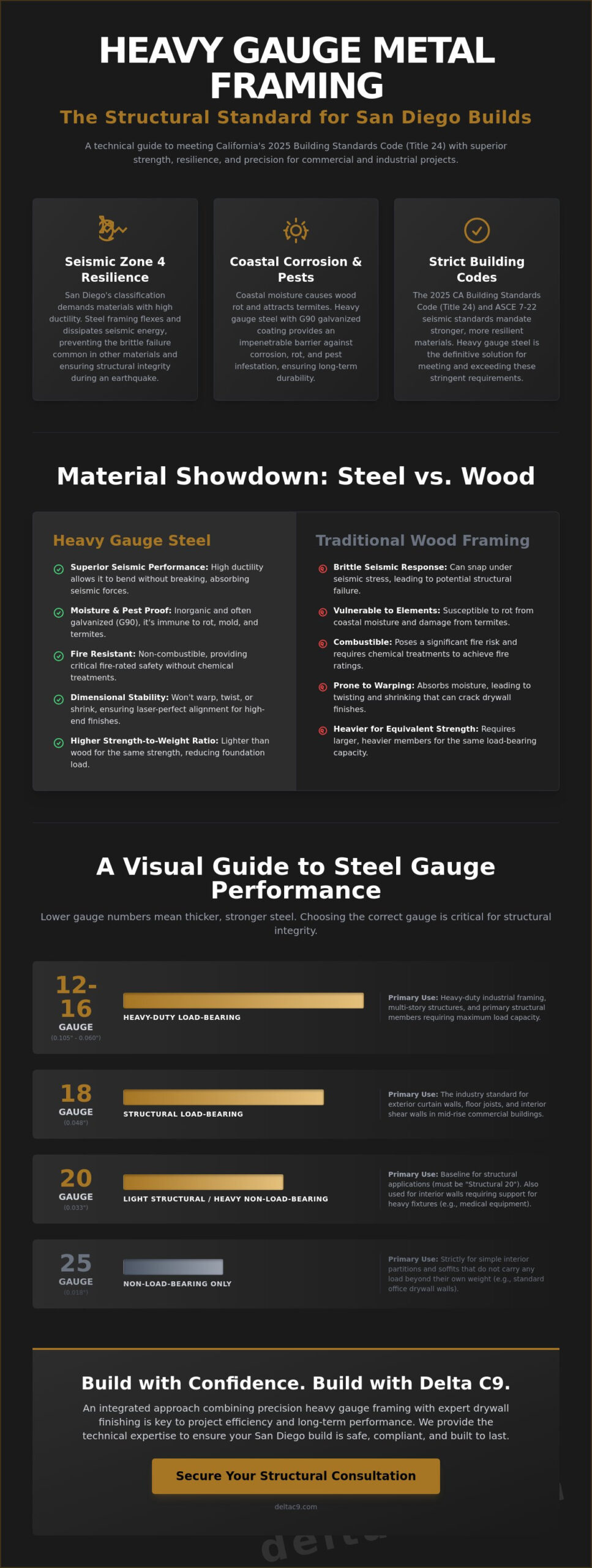
To grasp the technical nuances, one should look at What is Heavy Gauge Metal Framing in the context of manufacturing. These components are shaped at room temperature, which increases their yield strength through work hardening. In San Diego’s commercial sector, applications typically range from 20 gauge (0.033″) for light structural loads to 12 gauge (0.105″) for heavy-duty industrial framing. This range allows for precise engineering that matches the specific weight and tension requirements of a multi-story project.
The Structural Threshold: 20 Gauge and Beyond
It’s a common mistake to assume all 20-gauge studs are equal. San Diego building inspectors look for “Structural 20” gauge, which has a specific mil thickness and galvanized coating. Drywall 20 is strictly for non-load-bearing use. For mid-rise developments, 16 or 18 gauge studs are the industry standard for exterior curtain walls. Under the California Building Code, structural gauge is defined as any cold-formed steel member intended to carry a load beyond its own weight. This distinction is vital for ensuring the longevity of high-end drywall finishes and the overall stability of the building envelope.
Seismic Resilience in Southern California
Southern California’s seismic activity demands a building material that doesn’t just resist force but manages it. Steel’s ductility allows it to bend and dissipate energy during a seismic event. This prevents the brittle snapping associated with other materials. In open-plan office designs common in downtown San Diego, heavy gauge framing facilitates lateral load distribution. It ensures that the building remains stable even when traditional interior support walls are absent. Compliance with local engineering standards isn’t just a hurdle; it’s the foundation of occupant safety and business continuity.
Technical Specifications: Comparing Metal Gauges for Load-Bearing Performance
Precision in gauge selection is the difference between a project that merely meets code and one that offers long-term structural security. In the context of heavy gauge metal framing San Diego projects require a nuanced understanding of how thickness impacts performance. Gauges are measured in reverse order; a lower number indicates a thicker, stronger steel. While a 25-gauge stud is suitable for simple interior partitions, it lacks the structural integrity required for load-bearing applications. For most commercial tenant improvements (TIs) and medical suites, 20-gauge structural studs serve as the baseline. In contrast, heavy-duty warehouses and mid-rise developments often demand 16 or 18-gauge steel to manage higher axial and lateral loads.
Stud spacing further refines the load-bearing capacity of a frame. Standard 16-inch on-center spacing is common, but high-stress areas or tall spans may require 12-inch spacing to prevent deflection. Conversely, 24-inch spacing is typically reserved for non-structural walls. Selecting the correct combination of gauge and spacing is the primary way to ensure the stability of metal framing and drywall in San Diego. This technical alignment prevents wall bowing and ensures that the finished surfaces remain crack-free over time.
Load-Bearing vs. Non-Load-Bearing Applications
Choosing heavy gauge steel for interior shear walls is a strategic decision that enhances a building’s overall rigidity. This is particularly vital in medical environments where walls must support heavy wall-mounted equipment like imaging monitors or specialized cabinetry. A 16-gauge structural stud offers significantly higher axial load capacity than a 20-gauge stud, allowing it to support greater vertical weight in multi-story industrial structures. By prioritizing these heavy-duty specs, developers protect their equipment investments and ensure occupant safety. For those planning complex installations, partnering with a specialized framing team can help clarify these requirements during the pre-construction phase.
The Anatomy of a Structural Steel Frame
A robust frame relies on the synergy between tracks, studs, and joists. Structural C-Studs are the workhorses of San Diego multi-family housing, providing the necessary strength for load-bearing exterior walls. These components must be paired with heavy-duty tracks that are securely anchored to the concrete slab. For floor and roof systems, heavy gauge joists offer a non-combustible alternative to wood, providing a level of precision that simplifies the installation of suspended ceilings. Adhering to the NIST Seismic Design Guide ensures that these assemblies are braced correctly to handle the unique lateral forces present in Southern California.
The Coastal Advantage: Steel Framing in San Diego’s Marine Environment
San Diego’s coastline defines the city’s identity, but for commercial developers, it presents a relentless environmental challenge. Salt-laden air acts as a catalyst for oxidation and biological decay. In areas like La Jolla, Coronado, and Mission Beach, traditional wood framing often succumbs to moisture-driven rot or fungal growth within a few years. Utilizing heavy gauge metal framing San Diego projects can bypass these vulnerabilities entirely. Steel provides a predictable, inorganic skeleton that remains unaffected by the humidity levels typical of the Southern California bight.
The technical defense against a marine atmosphere lies in the galvanization process. While standard interior projects might utilize G60 coatings, coastal or industrial environments require G90 galvanized steel. This specification refers to the weight of the zinc coating; G90 provides 0.90 ounces of zinc per square foot. This thicker layer offers superior sacrificial protection against the chloride-rich atmosphere. It’s a strategic choice that ensures the structural skeleton remains intact for decades, even in high-corrosion zones. Beyond durability, steel’s dimensional stability is a major asset. It doesn’t warp, twist, or crown as it ages. This lack of movement is the prerequisite for Level 5 drywall finishes. When the framing is perfectly straight, the finishing team can achieve the mirror-smooth surfaces required for high-end commercial interiors without the risk of future nail pops or corner bead cracking.
Termite and Mold Resistance in SoCal
San Diego’s semi-arid climate is surprisingly conducive to subterranean termites and certain mold species that thrive in wall cavities. Inorganic materials like steel offer no food source for these pests, effectively eliminating a major source of structural risk. Integrating steel framing with professional mold remediation services during a renovation ensures a sterile, durable environment from the start. This proactive approach significantly reduces long-term maintenance costs for commercial property managers who must maintain high occupancy rates and avoid the downtime of invasive structural repairs.
Fire Safety and Building Code Compliance
Safety is a non-negotiable priority in high-density San Diego development zones. Steel is naturally non-combustible. It doesn’t contribute fuel to a fire, which is a critical distinction from even fire-treated wood. Meeting San Diego Fire-Rescue Department (SDFD) requirements becomes a more streamlined process when the primary structure is steel. This compliance often translates into tangible financial benefits. Many insurance providers offer reduced premiums for steel-framed commercial assets because the risk of total loss from fire, pests, or rot is significantly lower. Choosing heavy gauge metal framing San Diego standards is an investment in both safety and the project’s bottom line.
The Installation Process: Precision and Seismic Bracing
Successful installation begins long before the first stud is fastened. For projects utilizing heavy gauge metal framing San Diego contractors must first verify architectural shop drawings against actual site conditions. This pre-construction phase ensures that the specified gauges and mil thicknesses align with the structural engineer’s requirements. It’s a meticulous process where every track and stud is accounted for to prevent costly field modifications that could compromise the building’s integrity or the 2026 code compliance.
Once the materials are verified, the focus shifts to layout and track installation. Large floor plates, common in Sorrento Valley industrial parks or downtown commercial towers, require laser-perfect alignment. Any deviation at the base track will be magnified as the structure rises, leading to issues with door frames and cabinetry. Installers use high-precision transit levels to establish coordinates that match the digital models. This level of accuracy is the only way to ensure that heavy gauge metal framing San Diego projects meet the stringent tolerances required for modern, high-density construction.
Structural bracing is the final, critical step in the framing sequence. This involves installing kickers and lateral bridging to provide seismic stability. San Diego building inspectors follow a rigorous checklist during structural milestones. They look for specific gauge stamps on the metal members and verify that screw patterns match the engineered submittals exactly. For developers seeking a partner who understands the complexities of these 2026 requirements, our team provides expert heavy gauge metal framing services tailored to the region’s specific demands.
Seismic Connectors and Hardware
Specialized clips and connectors are the linchpins of a seismically resilient frame. In high-wind and seismic zones, standard fasteners aren’t enough; engineered connectors must be used to manage the transfer of forces between the frame and the primary structure. Proper screw patterns are equally vital, as they determine the shear strength of the entire assembly. Deflection tracks allow the building’s primary structure to move vertically during a seismic event without transferring that load to the non-load-bearing wall partitions. This prevents wall buckling and protects the interior finishes from catastrophic failure.
Integrating MEP and Acoustic Systems
A structural frame must accommodate more than just its own weight. Coordinating with electrical and plumbing teams for stud knockouts is essential to maintain the structural capacity of the heavy gauge members. Beyond strength, heavy gauge studs play a significant role in improving Sound Transmission Class (STC) ratings. Their increased mass helps dampen vibrations, which is a key requirement for medical suites and professional office builds. This precision framing also provides the stable foundation necessary for the installation of suspended and acoustic ceilings, ensuring a seamless transition between vertical and horizontal surfaces.
Why Delta C9 is San Diego’s Choice for Heavy Gauge Framing
Delta C9 has spent over 22 years navigating the specific structural demands of the Southern California market. Our tenure in San Diego’s commercial and industrial sectors has provided us with a deep understanding of the local landscape. We don’t just view a project as a set of blueprints; we see it as a commitment to business continuity and structural permanence. When you specify heavy gauge metal framing San Diego, you aren’t just buying steel; you’re investing in a system that must withstand seismic shifts and coastal corrosion for decades to come.
Our approach is rooted in engineering precision. We recognize that a structural frame is the foundation for every subsequent trade. If the framing is off by a fraction of an inch, the drywall finishing, insulation, and soundproofing will inevitably suffer. By managing the process from the first structural track to the final Level 5 drywall finish, we eliminate the communication gaps that typically plague large-scale projects. This integrated model ensures that the finished interior meets the high aesthetic and functional standards expected in modern San Diego developments.
Timeline and budget accuracy are the pillars of our operational philosophy. In a market where building permit fees and regulatory requirements are constantly evolving, we provide the stability needed to keep complex TIs on track. We’ve built our reputation on being a reliable partner for industrial projects where structural integrity is non-negotiable. Our team anticipates potential hurdles during the pre-construction phase, allowing for a smoother transition from framing to the move-in date. We act as a strategic protector for your investment, ensuring that every component of the heavy gauge metal framing San Diego project is executed with technical rigor.
A Comprehensive Interior Partner
Many contractors separate framing from remediation or soundproofing, but we believe these elements are fundamentally linked. Our expertise in structural steel framing directly informs how we approach insulation and acoustical performance, ensuring that every wall assembly performs exactly as engineered. Whether your project is located in Kearny Mesa, Chula Vista, or elsewhere in Greater San Diego County, we bring the same level of professional discipline to every site. This holistic view is why developers repeatedly choose Delta C9 for their commercial construction projects.
Ready to Build Your San Diego Project?
The most critical decisions are often made before the first stud is installed. Engaging with a professional consultant during the pre-construction phase can help clarify gauge requirements and seismic bracing strategies. Our “Move-In Ready” philosophy means we focus on the end result from day one, ensuring your interior build-out is efficient, compliant, and durable. Contact Delta C9 today for a comprehensive structural framing assessment. Let’s ensure your 2026 project is built on a foundation of excellence.
Secure Your Structural Future for 2026 and Beyond
Navigating the evolving landscape of San Diego construction requires a partner who prioritizes precision and safety. As we move into 2026, the shift toward higher seismic standards and more durable building envelopes is clear. Successfully implementing heavy gauge metal framing San Diego projects depends on a deep understanding of load-bearing capacities, coastal corrosion resistance, and the integration of complex MEP systems. By choosing materials that resist fire, rot, and seismic forces, you ensure your commercial or industrial asset remains a stable, long-term investment.
Delta C9 brings over 22 years of local expertise to every build. As a licensed, bonded, and insured CA contractor, we specialize in high-STC and seismic-compliant framing solutions. Our integrated approach ensures that your structural skeleton provides the perfect foundation for high-end interior finishes. If you’re ready to start your next development with a team that values engineering integrity, Get a Professional Structural Framing Quote from Delta C9. We’re here to help you build a structure that stands the test of time and California’s unique environmental challenges.
Frequently Asked Questions
What is the difference between heavy gauge and light gauge metal framing?
Heavy gauge metal framing is structural and designed to carry vertical or lateral loads, whereas light gauge is strictly for non-load-bearing partitions. Structural studs are thicker, usually starting at 20-gauge (structural grade) and going down to 12-gauge. Light gauge steel is thinner and lacks the axial strength needed to support floors or exterior wind pressures.
Is heavy gauge metal framing required for all commercial buildings in San Diego?
Heavy gauge is not mandatory for every interior wall, but it’s required for any element that supports the building’s weight or resists wind pressure. Local San Diego codes often mandate structural steel for exterior curtain walls and shear walls in high-density zones. Non-structural interior partitions can still utilize light gauge studs to save on material costs where load-bearing isn’t a factor.
How much does heavy gauge metal framing cost per square foot in San Diego?
Pricing for heavy gauge metal framing San Diego projects depends on fluctuating steel market rates and the specific complexity of the structural design. Factors such as the required mil thickness and current labor rates in Southern California will influence the total investment. It’s best to consult with a contractor for a project-specific estimate rather than relying on general averages, as material costs can shift based on global supply chains.
Does metal framing interfere with Wi-Fi or cellular signals in offices?
Steel studs don’t create a “Faraday cage” effect that would block cellular or Wi-Fi signals in a standard office environment. The gaps between the studs allow radio waves to pass through the wall cavities without noticeable degradation. Most signal issues in commercial buildings are caused by specialized glass coatings or thick concrete, not the metal framing skeleton itself.
Can heavy gauge metal framing be used for residential ADUs in California?
Yes, heavy gauge steel is a highly effective choice for Accessory Dwelling Units (ADUs) in California. It offers superior precision for small footprints and satisfies the state’s strict seismic and fire safety requirements. Because steel doesn’t warp or shrink, it’s particularly useful for maintaining the tight tolerances required in modern, prefabricated ADU designs.
How does steel framing perform in San Diego’s coastal humidity?
Galvanized steel is engineered to withstand high humidity and salt air without the risk of rot or termite damage. Using a G90 coating ensures the structural skeleton remains protected against the corrosive marine environment found along the San Diego coast. This makes it a much more stable long-term investment than wood, which can degrade quickly in coastal moisture.
What are the fire rating benefits of using structural steel studs?
Structural steel is naturally non-combustible, which simplifies the process of creating fire-rated wall and floor assemblies. This material doesn’t add fuel to a fire, helping buildings meet the 1-hour or 2-hour safety codes required by the San Diego Fire-Rescue Department. Using heavy gauge metal framing San Diego standards can also lead to lower insurance premiums for commercial property owners.
How do I know which gauge of steel is right for my load-bearing wall?
Selecting the correct gauge requires a structural engineer’s analysis of the axial and lateral loads. Factors like the height of the wall and the weight of the materials it supports will dictate whether an 18-gauge, 16-gauge, or heavier stud is necessary. You should always verify these specifications against your architectural shop drawings before the installation process begins.