
Mounting foam panels to a bedroom wall isn’t soundproofing; it’s acoustic decoration. To truly block the noise from the I-5 or the constant activity of a busy San Diego neighborhood, you need a solution rooted in structural engineering. Achieving successful soundproof wall construction San Diego depends on precision assembly and high-density materials rather than quick fixes. You’ve likely felt the frustration of hearing every conversation from the next room despite your best efforts to muffle the sound. We recognize that your privacy and peace of mind aren’t just luxuries; they’re essential requirements for your home or office.
This guide provides the technical breakdown you need to achieve genuine acoustic isolation. You’ll learn how to navigate complex STC ratings and why the City of San Diego enforces a minimum STC 50 for multi-family builds to ensure resident comfort. We’ll examine the structural secrets of decoupling and mass-loading, while providing a clear look at 2026 costs, such as the $1,617 to $1,854 average for professionally soundproofing a room. By understanding these professional construction techniques, you can move toward a quiet, controlled environment with total confidence.
Key Takeaways
- Understand why standard residential walls are insufficient for San Diego’s unique noise environment, including airport flight paths and heavy interstate traffic.
- Master the four pillars of soundproof wall construction San Diego—mass, decoupling, damping, and absorption—to achieve true acoustic isolation.
- Learn why metal framing provides a superior acoustic foundation over wood by naturally reducing vibration transmission throughout the structure.
- Discover the critical role of high-density materials, such as acoustic mineral wool and sound-dampening drywall, in blocking modern noise frequencies.
- Identify how a strategic construction partner can proactively address structural weaknesses to ensure long-term privacy and operational focus.
Why Standard Walls Fail: Addressing San Diego’s Unique Noise Challenges
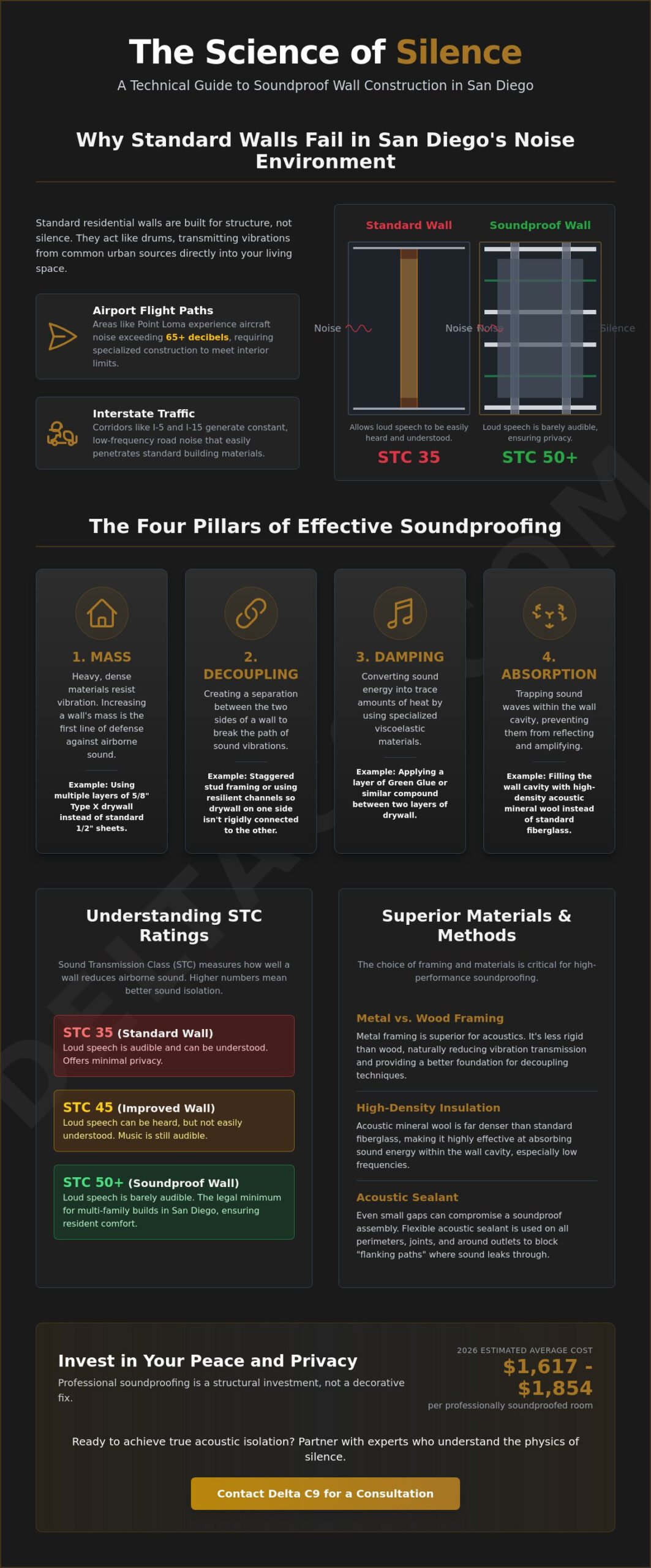
Standard residential walls aren’t designed to stop noise; they’re designed to hold up the roof. This structural focus creates a significant problem for anyone living near the I-5 or under a busy flight path. Most builders use 2×4 wood studs and standard half-inch drywall, which creates a rigid assembly that allows sound vibrations to pass through effortlessly. If you want a quiet home, you must address the physics of sound transmission rather than just sticking foam panels to the surface. Achieving high performance in soundproof wall construction San Diego requires moving beyond basic building practices.
Foam panels only handle reverberation; they don’t block sound from entering or leaving a room. True soundproofing focuses on transmission loss, which is the actual reduction of sound as it passes through a barrier. Understanding the Core Principles of Soundproof Wall Construction is the first step toward reclaiming your privacy. You need to distinguish between blocking sound and merely improving how it sounds inside a single space. Without a structural approach, you’re only treating the symptoms of noise pollution rather than the cause.
The Problem with Traditional Drywall and Framing
Standard walls act like a drum. When sound hits one side, the rigid wood studs vibrate and carry that energy directly to the other side. Standard R-13 fiberglass insulation provides minimal benefit for low-frequency sound blocking because it lacks the density required to dampen vibrations effectively. Flanking paths are the hidden gaps where sound leaks through seemingly solid structures, such as electrical outlets, HVAC vents, or the small spaces beneath baseboards. Without addressing these bridges, even the thickest drywall won’t provide the isolation you expect.
Local Noise Pollution in San Diego County
San Diego presents specific acoustic challenges that vary significantly by neighborhood. Residents in Point Loma or Little Italy deal with aircraft noise within the 65+ decibel contour map defined by the San Diego International Airport. Meanwhile, inland properties near the I-15 or I-8 corridors face constant low-frequency tire whine and engine roar. The City of San Diego mandates an interior noise limit of 45 dBA CNEL for multi-unit residential buildings. Meeting this standard requires an STC rating of 50 for common walls, a benchmark that standard soundproof wall construction San Diego rarely achieves without specialized intervention. Even the local climate plays a role; coastal humidity requires careful selection of moisture-resistant materials during the soundproofing process to prevent mold growth within the wall cavity.
The Core Principles of Soundproof Wall Construction
Effective soundproof wall construction San Diego requires a methodical application of physics rather than a collection of random materials. You can’t simply add one component and expect silence. Instead, we look at four pillars: mass, decoupling, damping, and absorption. Each pillar addresses a different way sound moves through a building. When these elements work together, they create a barrier that effectively isolates noise and ensures the privacy you require for your home or office.
Mass is the foundation of sound blocking. Heavy materials like 5/8″ Type X drywall are essential because they possess the inertia required to resist the energy of sound waves. When you increase the density of a wall, you make it significantly harder for airborne noise to vibrate the structure. For most residential projects, doubling the layers of drywall is the most cost-effective way to add the necessary mass to a partition.
Damping and absorption provide the finishing touches to a high-performance wall. Damping involves the use of specialized viscoelastic compounds layered between sheets of drywall. These compounds act as a shock absorber, converting sound energy into trace amounts of heat. Absorption, often achieved through mineral wool insulation, fills the internal wall cavity to soak up sound that manages to penetrate the first layer. This prevents the “drum effect” where sound bounces around inside an empty wall cavity.
Understanding STC (Sound Transmission Class) Ratings
The Sound Transmission Class (STC) is an integer rating that measures how well a partition attenuates airborne sound. In real-world terms, an STC 35 wall allows loud speech to be heard and understood. An STC 50 rating, which is the California Building Code minimum for multi-family dwellings, keeps loud speech muffled but audible. To reach professional levels of privacy, such as STC 60, every gap must be sealed with acoustical grade caulk. Even a tiny opening for an electrical box can drop a wall’s performance by several points, making precision installation vital.
Decoupling: The Secret to High-Performance Walls
Decoupling is the most effective way to stop low-frequency noise, like the bass from a home theater or the rumble of a heavy truck. This technique involves breaking the physical connection between the two sides of a wall. We achieve this through staggered stud layouts, double-stud construction, or the use of resilient sound isolation clips. When deciding on the structural core, understanding Metal Framing vs. Wood: The Acoustic Advantage is vital, as metal studs offer natural flexibility that aids in the decoupling process.
Precision is non-negotiable during the installation of these systems. A single screw can “short-circuit” a decoupled wall by creating a rigid bridge that allows sound to bypass the isolation clips entirely. If you’re ready to ensure your project meets these high standards, our team provides expert drywall installation services designed for maximum acoustic performance and long-term stability.
Metal Framing vs. Wood: The Acoustic Advantage
While wood framing remains the default for most San Diego homes, it’s often the weakest link in a soundproofing strategy. Wood is inherently rigid and dense, which makes it an excellent conductor of vibration. In contrast, metal studs are engineered with a profile that allows for slight flex. This flexibility is a critical component of soundproof wall construction San Diego because it disrupts the direct path of sound energy. When you combine metal framing and drywall, you create a foundation that is physically less capable of transmitting noise from one room to the next.
Metal’s structural precision also plays a vital role in long-term acoustic performance. Wood can warp, twist, or shrink as it loses moisture over time, which eventually creates microscopic gaps in your acoustic seals. Metal remains perfectly straight and dimensionally stable regardless of humidity levels. This ensures that the airtight seals required for high STC ratings stay intact for decades. For commercial office environments where confidentiality is a legal or operational requirement, metal framing is the industry standard for a reason. It provides the predictable performance needed to ensure that sensitive conversations stay behind closed doors.
Why Metal Studs Outperform Wood in Acoustic Tests
The primary advantage of metal lies in its limited contact area. A standard wood stud provides a wide, flat surface for sound to travel through. Light-gauge metal studs, specifically 25-gauge or 20-gauge, have a smaller footprint that reduces the physical bridge for vibrations. In laboratory tests, walls built with metal studs consistently achieve higher STC ratings than identical walls built with wood. This performance boost comes without the need for additional floor space, making it an efficient choice for high-density urban living in San Diego’s coastal and downtown corridors.
Advanced Framing Techniques for Maximum Silence
Achieving total isolation requires looking beyond the vertical walls. We often utilize cold-rolled channels for suspended acoustic ceilings to prevent impact noise from traveling between floors. By integrating these specialized ceiling and drywall solutions, we can create a “room within a room” that is completely decoupled from the main building structure. This approach is particularly effective when framing around HVAC ducts and electrical penetrations. We use precision framing to ensure that these necessary openings don’t become acoustic leaks, maintaining the integrity of your soundproof wall construction San Diego project from floor to ceiling.
Professional Installation: Materials and Finishing
The transition from structural framing to the final surface is where many soundproofing projects fail. Even the most robust metal frame cannot compensate for poor material selection or careless finishing. High-performance soundproof wall construction San Diego relies on the strategic layering of specialized materials designed to trap and dissipate energy. You must choose between specialized sound-dampening drywall, such as QuietRock, or multiple layers of standard drywall treated with viscoelastic compounds. While QuietRock offers high performance in a thinner profile, layered standard drywall remains a cost-effective alternative for many residential remodels.
Acoustic sealants are non-negotiable components of a professional build. We use Green Glue or similar acoustical caulking to seal the gaps between the floor and ceiling tracks. Sound behaves like water; it will find the smallest path of least resistance. If these tracks aren’t perfectly airtight, the entire investment in specialized drywall is compromised. This level of precision ensures that your office or bedroom remains a sanctuary from the external noise of the city.
Acoustic Insulation and Drywall Layering
Density is the primary differentiator when comparing insulation types. Standard pink fiberglass insulation is designed for thermal retention, but it’s largely transparent to low-frequency sound. We prioritize acoustic mineral wool because its high-density fibers are specifically engineered to soak up sound energy within the wall cavity. For the outer layers, we utilize “constrained layer damping” by applying specialized adhesives between two sheets of drywall. Using 5/8-inch Type X drywall provides the significant mass required to stop the heavy vibrations of San Diego’s urban environment from penetrating your private space.
The Importance of Sealing and Finishing
Electrical outlets and light switches are often overlooked “flanking paths” that allow noise to bypass your sound barrier. We protect these vulnerabilities with acoustic putty pads, which wrap the back of the electrical box and prevent air leaks. The final quality of the wall surface is equally important for acoustic integrity. Achieving a Level 5 drywall finish ensures a perfectly smooth, airtight surface that eliminates microscopic gaps where sound could leak through.
A flawless finish isn’t just about aesthetics; it’s the final seal on your acoustic defense. By integrating high-quality metal frame, insulation, and drywall, we provide a streamlined path to a move-in ready, silent environment. If you’re ready to secure your privacy with professional soundproof wall construction San Diego, our team is prepared to execute your build with the engineering precision your project deserves.
Delta C9: San Diego’s Strategic Partner for Soundproofing
Choosing the right contractor is the final piece of the acoustic puzzle. With over 22 years of experience in high-precision interior construction, Delta C9 approaches every project as a strategic protector of your environment. We don’t just install materials; we identify structural weaknesses before construction begins. Our comprehensive management covers everything from metal framing to the final Level 5 finish, ensuring that your soundproof wall construction San Diego project meets the highest standards of performance and reliability. We take full responsibility for the systems we build, ensuring that your business continuity or home life remains undisturbed by external noise.
Our commitment to local building codes means we guarantee superior STC performance that meets or exceeds the minimum requirements of the California Building Code. We understand the technical nuances of the San Diego Municipal Code and how it impacts your specific build. By maintaining strict control over every phase of the project, we eliminate the communication gaps that often lead to acoustic failure in multi-trade environments. You can trust our team to deliver a space where stability, control, and privacy are built into the very foundation of the walls. This methodical approach is what sets us apart as a leader in the San Diego construction market.
Our Precision Construction Process
We begin every project with a detailed structural assessment to identify potential flanking paths and noise sources that standard contractors might overlook. We then customize material selection based on the specific noise profile of your neighborhood. Whether you’re facing the low-frequency rumble of the I-8 corridor or the high-frequency whine of the Point Loma flight paths, our solutions are engineered for your specific coordinates. Our specialized framing and drywall crews execute the plan with engineering precision. We ensure that every seal is airtight and every component is correctly decoupled to prevent the transmission of unwanted sound energy.
Beyond Soundproofing: A Healthier Interior
A professional build offers benefits that extend beyond simple noise reduction. We integrate mold remediation services and high-quality mineral wool insulation to create a safer, more resilient indoor environment. In San Diego’s high-density market, professional soundproof wall construction San Diego is a significant asset that increases long-term property value. It provides a level of privacy and focus that standard residential or commercial builds simply cannot match. If you’re ready to transform your office or home into a quiet sanctuary, Contact Delta C9 today for a professional acoustic consultation and take the first step toward total environmental control.
Secure Your Privacy with Structural Precision
True acoustic isolation is the result of methodical engineering rather than a single material purchase. You’ve seen how standard walls often fall short of San Diego’s rigorous noise challenges and why structural decoupling and mass-loading are the only ways to achieve genuine silence. By prioritizing high-performance soundproof wall construction San Diego, you ensure that your home or office remains a controlled, private environment regardless of external traffic or airport activity. Success depends on the perfect alignment of metal framing, dense insulation, and an airtight Level 5 finish.
Delta C9 brings over 22 years of local construction expertise to every project. We specialize in high-STC metal framing and drywall assemblies designed to meet the most demanding privacy requirements. Our team identifies potential sound leaks before they become permanent problems, providing you with the stability and peace of mind you deserve. To start your journey toward a quieter space, Request a Professional Acoustic Assessment from Delta C9 today. We’re ready to help you build an interior that protects your focus and your privacy.
Frequently Asked Questions
What is the best material for soundproof wall construction?
The most effective materials for soundproof wall construction San Diego include 5/8-inch Type X drywall, acoustic mineral wool insulation, and viscoelastic damping compounds. Mineral wool provides the necessary density to soak up sound energy within the cavity; specialized drywall adds the mass required to block transmission. Combining these with decoupling hardware like resilient clips ensures the highest level of isolation for both residential and commercial spaces.
How much does it cost to soundproof a wall in San Diego?
Professional soundproofing costs in San Diego vary based on the specific method and materials used. According to 2026 market data, the average cost to professionally soundproof a room ranges from $1,617 to $1,854. If you require specialized solutions like Mass-Loaded Vinyl (MLV) for a shared wall, installation typically falls between $1,499 and $3,999. These figures reflect the investment in high-quality materials and the precision labor required for acoustic integrity.
Can I soundproof an existing wall without tearing it down?
You can improve an existing wall’s performance without a full demolition by adding a second layer of 5/8-inch drywall using a damping compound. This “constrained layer” technique is effective for reducing airborne noise like voices or television. Another option involves installing resilient channels directly over the existing surface before adding new drywall. While these methods provide significant improvement, they won’t match the total isolation achieved by a full structural rebuild with decoupled framing.
What is the difference between soundproofing and acoustic treatment?
Soundproofing is designed to block noise from entering or leaving a room, while acoustic treatment improves sound quality within the room. Soundproofing requires structural mass and decoupling to stop transmission through walls. Acoustic treatment uses soft panels or diffusers to reduce echo and reverberation for better recording or listening. If your goal is privacy or silence from neighbors, you need structural soundproofing rather than surface-mounted foam panels.
Do metal studs provide better soundproofing than wood studs?
Metal studs offer a significant acoustic advantage over wood because they are more flexible and have smaller contact points. Wood studs are rigid and act as a direct bridge for sound vibrations to travel through the structure. Light-gauge metal studs disrupt this path, naturally reducing the amount of energy that passes from one side of the wall to the other. This flexibility makes metal framing the preferred choice for high-performance acoustic assemblies.
How thick will a soundproof wall be?
A high-performance soundproof wall typically measures between 5 and 7 inches in total thickness. A standard residential wall is approximately 4.5 inches thick. When you incorporate staggered studs, double layers of 5/8-inch drywall, or resilient sound isolation clips, the footprint increases slightly. This small trade-off in floor space is a technical necessity to accommodate the air gaps and mass required for effective acoustic isolation.
Does soundproofing also help with thermal insulation?
The materials used for soundproof wall construction San Diego provide excellent thermal benefits alongside noise reduction. High-density mineral wool has a superior R-value compared to standard fiberglass, which helps maintain consistent indoor temperatures. The airtight seals and extra layers of mass also prevent drafts and heat loss. This dual benefit improves your property’s energy efficiency while simultaneously securing your acoustic privacy in San Diego’s coastal or inland climates.
How long does a typical soundproofing project take to complete?
A typical soundproofing project for a single room usually takes about 3 to 5 business days to complete. This timeline includes the structural framing, insulation placement, and specialized drywall installation. The final stages involve taping, mudding, and achieving a Level 5 finish for maximum airtightness. Precise drying times for damping compounds and joint compounds are essential to ensure the long-term integrity and performance of the acoustic barrier.