
Did you know that the 2022 California Building Standards Code mandates seismic lateral force requirements that can increase traditional framing costs by over 12% in coastal zones? You likely recognize that building in San Diego’s dense urban environment requires a precise balance between strict fire safety regulations and the volatile pricing of traditional lumber. It’s a complex landscape where structural integrity isn’t just a goal; it’s a legal and financial necessity for any serious developer or homeowner.
This guide ensures you master the technical nuances of structural metal framing to build with absolute confidence. We’ll provide the expert insights needed to navigate San Diego’s specific seismic requirements while ensuring your project remains fully compliant with California Title 24. By choosing the right materials, you’ll secure a structure that’s immune to termites, resilient against coastal humidity, and eligible for lower insurance premiums thanks to its non-combustible nature.
We’ll examine the specific engineering benefits of cold-formed steel, detail the latest 2026 local building code updates, and outline a strategic path toward faster construction timelines that don’t compromise on safety or quality.
Key Takeaways
- Identify the critical technical specifications of heavy-duty cold-formed steel to ensure your project meets essential load-bearing requirements.
- Discover why structural metal framing provides superior seismic resilience and energy absorption in high-risk zones like San Diego.
- Compare the total cost of ownership between steel and lumber, focusing on long-term stability, fire resistance, and reduced maintenance.
- Master the precision installation steps required to move a project seamlessly from architectural blueprints to a drywall-ready state.
- Learn the advantages of utilizing a single-source local expert to maintain structural integrity and operational continuity throughout the construction process.
What is Structural Metal Framing and Why is it Essential in San Diego?
Structural metal framing refers to cold-formed steel (CFS) members engineered to support the primary weight and environmental stresses of a building. Unlike the light-gauge studs used for non-load-bearing interior partitions, structural members are fabricated from heavy-duty steel ranging from 12 to 18 gauge. This thickness allows the material to carry axial loads, resist wind pressure, and withstand seismic forces common in Southern California. For a foundational overview of these systems, understanding What is a Steel Frame provides the necessary context for how CFS differs from heavy-rolled structural steel.
The construction landscape in San Diego has shifted significantly toward metal as developers prioritize density and safety. Between 2015 and 2025, the region saw a measurable increase in multi-family and mixed-use projects utilizing steel over traditional wood. This transition is driven by the need for non-combustible materials that allow for taller, more resilient structures. Structural metal framing provides a stable, predictable foundation that does not warp, rot, or succumb to termite damage, ensuring the long-term integrity of the building envelope.
The Core Components: Studs, Tracks, and Joists
The system relies on a “C-shape” design for studs and joists, featuring a web, flange, and return lip. The flange width is a critical specification; wider flanges provide the necessary surface area for axial load-bearing walls to distribute weight effectively. Structural tracks function as the top and bottom runners, securing the vertical studs and anchoring the entire assembly to the concrete foundation or floor slab. Load-bearing in the context of 2026 structural metal framing defines any assembly engineered to carry vertical or lateral loads while maintaining the building’s structural equilibrium under California’s strict seismic requirements.
Material Grades and Coatings for Coastal San Diego
Proximity to the Pacific Ocean requires specific metallurgical standards to prevent salt-air corrosion. California building codes for 2026 mandate G60 or G90 galvanized coatings for structural members within five miles of the coast. These coatings provide a protective zinc layer that extends the lifecycle of the steel. Engineering specifications typically dictate 33ksi steel for lighter structural applications, while 50ksi steel is required for high-stress areas in multi-story builds. All assemblies must utilize UL-certified systems for fire-rated wall construction, ensuring the project meets the rigorous safety standards of San Diego County. This technical precision reduces risk and guarantees that the infrastructure remains operational and safe for decades.
Seismic Resilience and Structural Integrity in Southern California
San Diego sits in one of the most active seismic regions in the United States. Local engineers classify much of the county as Seismic Design Category D, often referred to as Zone 4. In these high-risk environments, structural metal framing provides a level of safety that traditional masonry cannot match. Steel possesses a unique property called ductility. This allows the frame to absorb and dissipate energy during a tremor. Instead of snapping or crumbling under pressure, the steel members deform slightly, keeping the structure’s core intact. This flexibility is one of the primary reasons to frame with steel when building in Southern California.
Weight is a critical factor during a seismic event. The force exerted on a building is directly proportional to its mass. Because steel has a high strength-to-weight ratio, a metal-framed building can weigh up to 50% less than a comparable concrete structure. This lower mass reduces the seismic load on the foundation, which often leads to lower costs for site preparation. To manage lateral forces, engineers utilize specialized shear walls and braced frames. These components act as a rigid spine for the building, preventing the dangerous swaying that can lead to structural failure.
Meeting San Diego County Building Codes
The San Diego Development Services Department (DSD) enforces strict standards for all new construction. Under the 2025 California Building Code updates, every project requires professional engineering stamps on framing shop drawings to verify load-bearing capacities. Using structural metal framing simplifies compliance with California Title 24 energy and safety standards. Steel’s precision allows for tighter building envelopes, which reduces air leakage by as much as 15% compared to wood. You can ensure your project meets these technical requirements by consulting with a specialized infrastructure partner early in the design phase.
Wind Loads and Coastal Engineering
San Diego’s geography creates diverse weather challenges. Santa Ana winds can produce gusts exceeding 85 miles per hour in inland valleys. Along the coast, salt-heavy air and high-pressure gusts put constant stress on building exteriors. Steel framing handles these conditions through high-performance curtain wall applications. These systems are the standard for Downtown San Diego high-rises. They maintain structural tolerances within 1/16th of an inch over decades. This level of precision prevents windows from leaking and joints from shifting, even under intense wind pressure. The durability of the material ensures that the building remains stable and secure for its entire lifecycle.
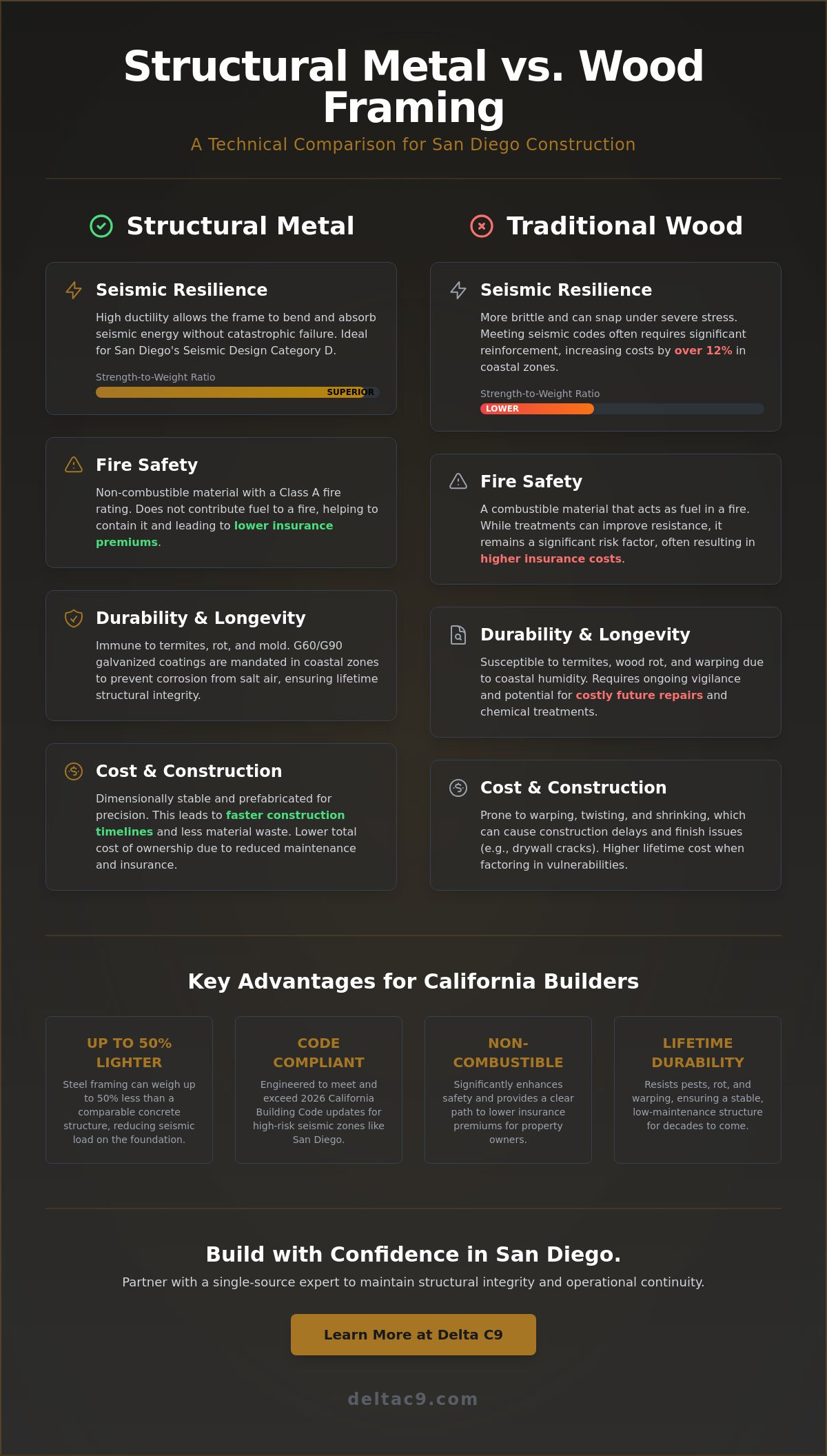
Structural Metal vs. Wood: Comparing Costs and Benefits
While wood has been the traditional choice for residential projects, structural metal framing offers a level of precision that organic materials cannot match. Wood studs often warp, shrink, or twist as they lose moisture content. This physical change leads to nail pops, cracked drywall, and uneven wall surfaces over time. Cold-formed steel remains straight and true for the life of the building. This structural integrity simplifies the installation of cabinetry and high-end finishes, ensuring that corners remain square and surfaces stay flat.
Total cost of ownership favors steel in the modern San Diego market. Construction speed increases because steel components arrive pre-cut and pre-punched for electrical and plumbing lines. This reduces on-site labor hours. According to industry data from the Steel Framing Alliance, steel’s high strength-to-weight ratio allows for longer spans. This flexibility reduces the number of load-bearing walls required in a floor plan. Beyond labor, the environmental impact is a significant factor for 2026 developments. Steel is 100% recyclable. Most structural steel produced today contains at least 25% recycled content, with some batches reaching 90%.
Fire Safety and Insurance Advantages
San Diego building codes classify many commercial and multi-family structures as Type I or Type II construction. These classifications require non-combustible materials. Structural metal framing provides a critical safety barrier that wood simply cannot provide. Insurance providers recognize this reduced risk profile. Commercial property owners often see insurance premium reductions ranging from 5% to 15% when choosing steel over wood. These fire-rated assemblies work in tandem with professional drywall finishing to create a secure environment for occupants.
Termite and Mold Resistance in SoCal
Southern California faces constant pressure from drywood and subterranean termites. Wood framing requires expensive, ongoing chemical treatments to prevent structural failure. Steel is inorganic. It offers zero food source for pests, eliminating the need for toxic pesticides. In coastal areas like La Jolla or Del Mar, high humidity often leads to moisture trapped in wall cavities. Wood absorbs this moisture, creating a breeding ground for fungi. Metal remains unaffected by humidity. Understanding the critical difference between wood and metal framing for coastal San Diego homes is essential for long-term durability. If moisture does infiltrate a system through a leak, Delta C9 provides expert mold remediation services to restore the interior to a healthy state.
The Installation Process: From Blueprint to Drywall Ready
Executing structural metal framing requires a level of engineering discipline that far exceeds standard residential methods. At Delta C9, we view the framing stage as the skeleton that dictates the health and longevity of the entire facility. The process follows a rigorous five step sequence to ensure every vertical and horizontal member meets 2026 seismic and load-bearing standards.
- Step 1: Precision Layout. Teams utilize laser levels and digital blueprints to establish floor-to-ceiling alignment. This ensures that every partition is perfectly square, preventing cumulative errors that often plague lower-quality builds.
- Step 2: Secure Track Installation. We anchor the top and bottom tracks using powder-actuated fasteners or heavy-duty expansion anchors. This creates a rigid perimeter capable of resisting the lateral forces common in Southern California.
- Step 3: Stud Placement and Bracing. Each stud is snapped into the track, plumbed for verticality, and braced. We maintain strict spacing, typically 16 or 24 inches on center, to guarantee structural integrity.
- Step 4: MEP Integration. Mechanical, electrical, and plumbing systems pass through pre-punched knockouts. This eliminates the need for field-cutting, which can weaken the structural metal framing if performed incorrectly.
- Step 5: Inspection and Final Prep. Before any surfaces are closed, a thorough quality control check ensures the assembly is ready for high-quality drywall installation.
Specialized Labor and Project Management
Structural framing isn’t a task for general laborers. It demands a specialized crew that understands gauge thickness, load transfer, and metallurgical properties. Unlike residential wood stick-framing, metal requires precise cutting tools and specific welding or fastening techniques. Coordination is the priority; the framing crew must work in tight synchronization with electricians and plumbers to avoid rework. For a typical 5,000 sq ft commercial framing project in San Diego, the installation phase generally spans 10 to 14 business days, depending on the complexity of the architectural design.
Acoustics and Insulation Integration
San Diego office environments demand high-performance sound dampening. We use structural studs to create sound-rated assemblies that often achieve STC ratings of 50 or higher. By installing mineral wool or high-density fiberglass insulation within the metal cavity, we significantly reduce decibel transfer between rooms. To achieve a comprehensive interior environment, these wall systems often pair with our suspended and acoustic ceiling services, providing a total solution for noise control and thermal efficiency.
Build your next project on a foundation of precision and expertise. Contact Delta C9 today to discuss your structural framing requirements.
Why Delta C9 is San Diego’s Choice for Structural Metal Framing
Delta C9 has built a reputation over 22 years as the premier choice for San Diego County’s most demanding construction projects. We operate as a strategic protector. This means we prioritize the long-term stability and safety of your structure above all else. Our experience spans more than two decades of local evolution in building codes and seismic requirements. From the coastal humidity of Oceanside to the urban density of Chula Vista, we understand how San Diego’s unique environment affects structural metal framing.
Working with a single-source contractor provides a distinct advantage in project efficiency. We manage the framing, drywall, and remediation processes under one unified management structure. This integration prevents the common delays caused by hand-off errors between different trades. It ensures that the structural integrity established during the framing phase is perfectly preserved through the final finishing stages. You get a streamlined workflow that protects both your timeline and your budget.
Comprehensive Interior Solutions
The success of an interior build depends on the synergy between the metal skeleton and the final surface. We specialize in the full spectrum of professional drywall finishing, covering every grade from Level 0 through Level 5. Our team handles complex tenant improvements that require surgical precision in existing occupied spaces. For industrial retrofits, we implement heavy-gauge solutions that support modern machinery and high-traffic demands. We exclusively use premium materials from trusted partners like ClarkDietrich and Studco. These components are selected for their superior fire ratings, acoustic properties, and load-bearing capacities. This level of detail ensures your facility isn’t just built; it’s engineered for 2026 standards of resilience.
Get Started with a San Diego Framing Expert
Peace of mind is the most valuable asset in any construction project. When you partner with Delta C9, you gain access to a licensed and insured team that treats your project’s safety as its own. We provide clear, data-driven consultations that remove the guesswork from your planning. Our local expertise allows us to anticipate challenges before they become costly delays. Don’t leave your project’s stability to chance. Contact us today to secure a partner who understands the high stakes of San Diego construction. We’re ready to help you build a foundation that lasts for decades.
Secure Your Investment with Resilient San Diego Construction
Choosing structural metal framing represents a strategic decision for any commercial project in Southern California. The 2026 building standards emphasize seismic resilience and fire resistance, areas where steel consistently outperforms traditional timber. By prioritizing these materials, you ensure your facility maintains its structural integrity against the regional risks identified by the California Geological Survey. Delta C9 brings over 22 years of San Diego construction experience to every job site. We’re fully licensed and insured for large-scale commercial and industrial projects, providing a seamless transition from initial framing to final drywall and remediation. Our team treats your business continuity as our primary objective, delivering precise results that protect your long-term assets. You’ll find that a proactive approach to engineering today prevents costly structural failures tomorrow. We’ve built our reputation on stability and technical mastery, ensuring every stud and track meets the highest safety benchmarks. Your project deserves the protection of a partner who understands the complex demands of the San Diego landscape.
Contact Delta C9 today for expert structural metal framing in San Diego County.
We look forward to fortifying your next project with engineering excellence.
Frequently Asked Questions
Is structural metal framing more expensive than wood in San Diego?
Structural metal framing often carries a higher initial material cost, typically 10% to 15% more than traditional lumber according to 2024 industry benchmarks. You’ll find these costs are offset by reduced waste and lower insurance premiums. Steel doesn’t warp or rot, which ensures your building’s long-term stability and reduces maintenance expenses over a 30-year lifecycle. It’s a strategic investment in your property’s durability and overall value.
How does metal framing affect the Wi-Fi and cellular signal in a building?
Metal studs cause minor signal attenuation but won’t completely block your connectivity. Research indicates that standard 3.5-inch steel members reduce signal strength by approximately 2 to 5 decibels. You can easily manage this by placing wireless access points in central locations or using signal repeaters. We ensure your digital infrastructure remains robust by planning the layout to maintain high availability for all your critical communication devices.
What is the minimum gauge required for load-bearing metal walls?
The minimum thickness for load-bearing members is 18 gauge, which equals 0.043 inches. The 2022 California Building Code and AISI S100 standards mandate this thickness to ensure structural safety under vertical and lateral loads. Using a lighter gauge for structural purposes isn’t just risky; it’s a code violation. We prioritize your safety by strictly adhering to these engineering requirements for every load-bearing assembly we design.
Can structural metal framing be used for residential homes in Chula Vista?
Yes, structural metal framing is a permitted and effective choice for residential construction in Chula Vista. The City of Chula Vista Building Division operates under the 2022 California Residential Code, which fully supports cold-formed steel for Type V construction. It’s an excellent option for homeowners who want a fire-resistant and termite-proof structure. This choice provides a high level of protection for your family and your long-term real estate investment.
How does metal framing perform in San Diego coastal environments regarding rust?
Modern steel framing utilizes G60 or G90 galvanized coatings to prevent corrosion in salty coastal air. ASTM A653 standards confirm these zinc coatings provide 20 to 50 years of protection in environments like La Jolla or Del Mar. You don’t have to worry about the structural integrity failing due to moisture. This proactive protection ensures your building remains standing and secure against the elements for many decades to come.
Does structural metal framing require special permits in San Diego County?
It requires the same standard building permits as any other material, but your plans must include calculations stamped by a California-licensed structural engineer. San Diego County’s Department of Planning and Development Services requires two sets of detailed plans for approval. We handle the technical documentation to ensure your project meets all local safety regulations. This methodical approach prevents delays and keeps your construction schedule on a predictable track.
What is the difference between cold-formed steel and hot-rolled structural steel?
Cold-formed steel is shaped at room temperature into thin, lightweight C-sections, while hot-rolled steel is molded at 1,700 degrees into heavy I-beams. Cold-formed steel typically offers a yield strength of 33 to 50 ksi and is ideal for wall partitions and light framing. Hot-rolled steel is reserved for the primary skeletons of skyscrapers or large industrial spans. Understanding these differences allows us to select the most efficient material for your specific load requirements.
How long does it take to install structural metal framing for a commercial tenant improvement?
A typical 5,000-square-foot commercial space takes 7 to 10 business days for full framing installation. Using prefabricated components can accelerate this timeline, reducing onsite labor by 25% compared to wood. This efficiency minimizes the disruption to your business operations and allows you to occupy the space sooner. We focus on rapid, precise execution so you can return to your core business activities without any unnecessary or costly downtime.